
A first dive into inquiry
In our EDUC 496 class on Teaching Secondary Science and Mathematics, we are exploring the inquiry process as a way of facilitating learning in the high school classroom. Inquiry and project-based learning fascinates me (in fact, I think I’ve found my “thing” in teaching!), and based on my learning in these classes, I was inspired to dive right in to inquiry on my first week back at Yale. This quickly became a theme that permeated several aspects of the week.
The artifact.
I taught my very first lesson on Monday in Anatomy & Physiology 12. Nathan was planning to take his class through one final class on DNA and end it with an exploration into ethical considerations of genetic manipulation. I recalled that there was an activity I’d tried out last semester in my short practicum, so I asked if I could jump in and do this part of the lesson. It was totally impromptu, I only had about 20 minutes to prep, but it worked. I ended up taking the students through a brief controlled inquiry lesson, in which students were given a worksheet and asked to explore the world of CRISPR in cancer research in groups, ending their exploration with some ethical considerations about potential benefits and risks of genetic manipulation procedures. We finished off the class with a “PROS” and “CONS” list on the board, and each group shared their ethical considerations.

After this class, I started planning for a fetal pig dissection next week. My goal with next week’s activity was to make it more valuable than the standard label-the-body-part dissections that are so prevalent in high schools today. I wanted to make the learning more inquiry-based and meaningful to students. For some ideas, I posted my own “inquiry” of sorts on Twitter, where I asked my professional learning network for thoughts. This Tweet encouraged me to keep posting my inquiries on Twitter – after all, it doesn’t hurt to get ideas from other seasoned educators and education authors!
For my dissection activity next week, I ended up planning a more inquiry-based dissection activity (see below) where students pretend they are coroners investigating the death of a pig. Their task is to collaboratively conduct a dissection, come up with a cause of death, take pictures of various body parts and organs, and present it all in a report.
Mysterious Death Probed by Grade 12 A&P StudentsTo incorporate some controlled inquiry into this activity, I am asking students to prepare for the dissection by reading up on procedures and creating a plan-of-action flowchart to map out their dissection process. My hope is that, by getting students to prepare for the procedure ahead of time, they are practicing an important part of the inquiry process by evaluating how to best conduct a dissection lab on their own PRIOR to making the first incision.

After the dissection, I will ask students to reflect on the process and come up with their own future inquiry questions. The hope is that this will become an “extension” point for groups that finish early to keep exploring and for me to be aware where the curiosities of students lie.
I’ve never conducted a fetal pig dissection myself, but I wanted to be prepared to assist my students as needed next week. So, to extend my own inquiry, I conducted my own fetal pig dissection (warning: image contains graphic content) in the lab on Friday. I used videos online and the lab manual to guide my steps. Through my own inquiry-based dissection, I learned some valuable dissection techniques, the best tools to use in certain conditions, and successfully discovered the sex of my specimen. I also experienced the sense of awe and privilege that comes from being able to independently explore a whole animal. I hope to encourage my students to consider the sense of awe and respect as well as they prepare for their dissection on Wednesday.
Why it matters.
The inquiry-based process is hugely important for a plethora of reasons:

- It involves students actively learning based on constructing meaning from their own observations.
- It cultivates skills for all areas of learning.
- It deepens understanding.
- It promotes student autonomy and engagement.
- It creates a love of learning that students will hopefully keep forever.
After all, the inquiry student captures, reflects on, and shares their learning. They are involved in a journey of discovery that will be replicated in all aspects of their professional life in future years — as professionals, if they don’t know something, they will need to figure it out! Inquiry allows students to develop question-asking, problem-solving, and critical-thinking skills to prepare them for the real world.

I strive to be an inquiry teacher. For my students, the fact that I am actively engaged in the inquiry process with them (how do I best teach this material? how do we conduct this investigation? what methods are most effective?) helps me empathize with them, and will hopefully show them my enthusiasm and openness for learning in the process — after all, if the teacher is involved in inquiry, they must not have all the answers after all. Although I have a degree in Biology, I do not have all the answers — but I do have a helpful set of skills that I’d like to instil in my students as well. The “answers” (or better yet, the discoveries) are found when we all inquire together.

The inquiry-based process has been heavily pioneered by Trevor McKenzie, who has published several helpful resources for teachers who wish to implement these values and procedures into their classroom.
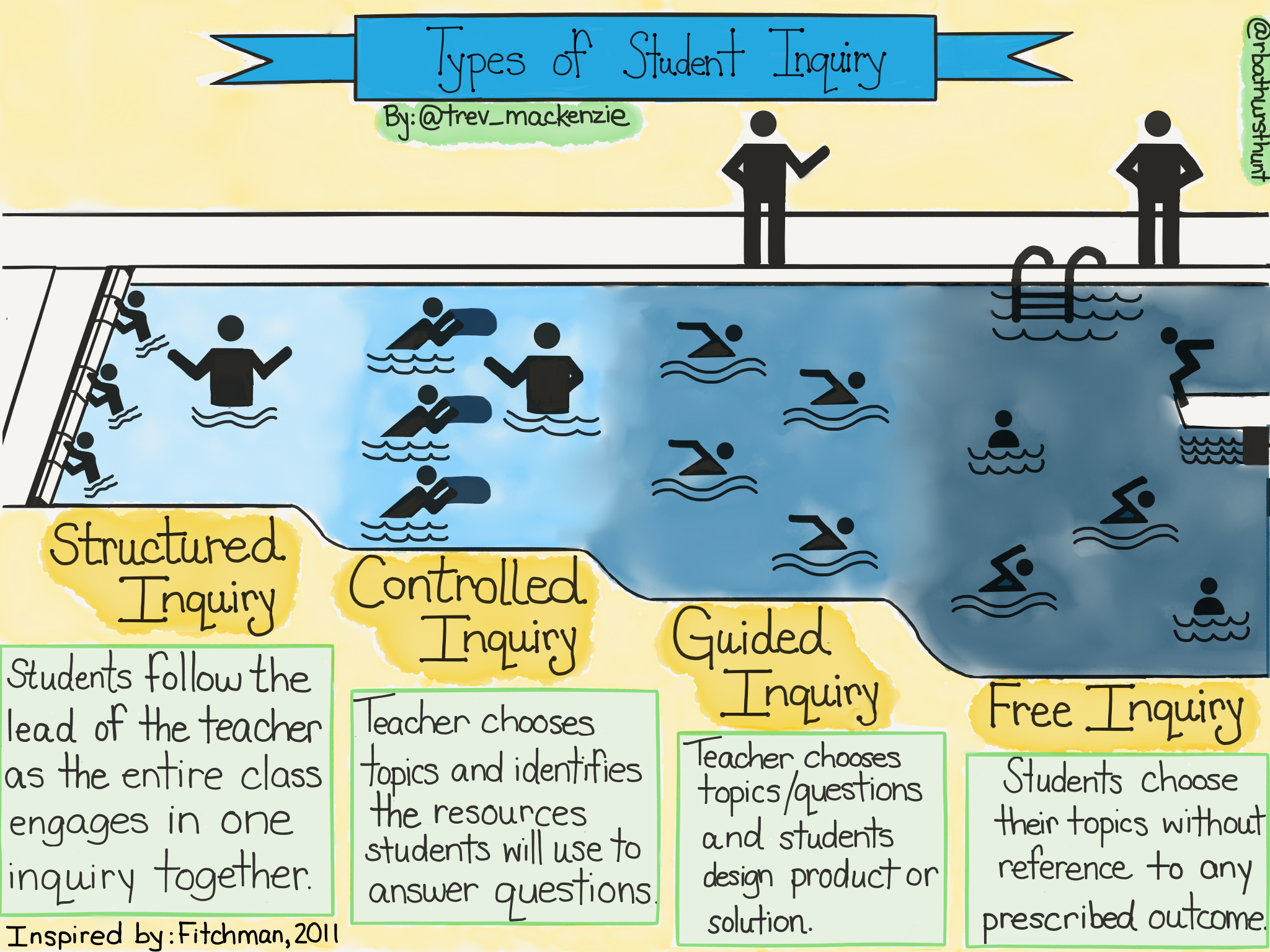
Inquiry doesn’t mean a “free-for-all” — students aren’t just free to randomly explore questions as they see fit. The reality is that the inquiry classroom involves a carefully-chosen setup, facilitated by the teacher, where students are free to ask questions and conduct their own investigations. Inquiry can be classified in a series of tiers, yet each layer involves the students in the question-asking process and encourages them to make their discoveries and learning their own.
Next steps.
On the inquiry series of tiers, I am certainly not at “guided” or “free” inquiry yet. My versions of inquiry are still very structured or controlled, because I believe my students require that level of structure while being introduced to the idea of generating their own questions. Yet with time, I hope to develop my classroom into one that gives students more and more autonomy to conduct inquiries themselves.
My next steps as a teacher who wishes to work on inquiry and project-based learning involves contacting my PLN for ideas, resources, and feedback when questions arise.
This week in Thursday night class, Dani DeJong and her husband shared about their project-based learning style at Abbotsford Christian School. Their presentation excited me immensely, and I asked them for access to a bank of PBL resources.
I also hope to continue to utilize my Twitter PLN to ask open-ended inquiry questions of my own. For example, I’ve already asked a question about using breakout rooms in Google Meet. I plant to keep using this for various questions that come up in my PYP and beyond.
Finally, my next plan for inquiry- and project-based learning activities (after the dissection) will be in my English 9 class next Friday! I will get students to conduct research on a human-driven environmental issue (of their choice!), present their findings, and conduct writing and discussion strategies in response to their findings. My hope is to develop students’ reading, responding, and creating skills, while also encouraging them to learn something new and nurture their sense of responsibility for preserving the beauty and health of our planet. Inquiry really can be used in so many areas, and I hope to keep implementing it into my Biology and English classrooms!
Professional Standard 3: Educators understand and apply knowledge of student growth and development.
Professional Standard 5: Educators implement effective planning, instruction, assessment and reporting practices to create respectful, inclusive environments for student learning and development.
October 4, 2020 @ 11:53 am
OK. Now I really feel bad that I’m not able to see your fetal pig dissection class this week. I love your idea and would have enjoyed the observation so much. Inquiry can be so effective in engaging students and I’m so pleased to hear that you are committed to implementing inquiry in your teaching.
Keep tweeting! There are a wealth of ideas and conversations out there that are so easily accessed.
Thanks Sarah.