Visual Cultural Research
Material semiotic research is supplemented with research into contemporary art and visual culture. Students contextualize their practice within contemporary visual culture and discourse by studying artists and attending artist talks and exhibitions. Students also conduct research through developing a reading list of texts that are relevant to their body of work. These texts deepen their understanding and bring complexity and nuance to their artistic research.
Artist Influences
Blog Categories: sr-studio, influences
Add to your artist chart. You should already have a collection 10-15 artists whose work has informed your practice. By mid-term of the spring semester you should have at least 25 artists in your collection. Take into account feedback from last semester when researching artists.
See Unit 4: Conducting Visual Cultural Research for resources and further guidance.
Make sure that you are selecting artists who are:
- primarily contemporary (unless there is a clear reason for looking at historical work)
- receiving critical attention in the contemporary art/design world (major museum exhibitions, credible publications etc.)
- connected to the learner’s practice and line of inquiry
Assessment:
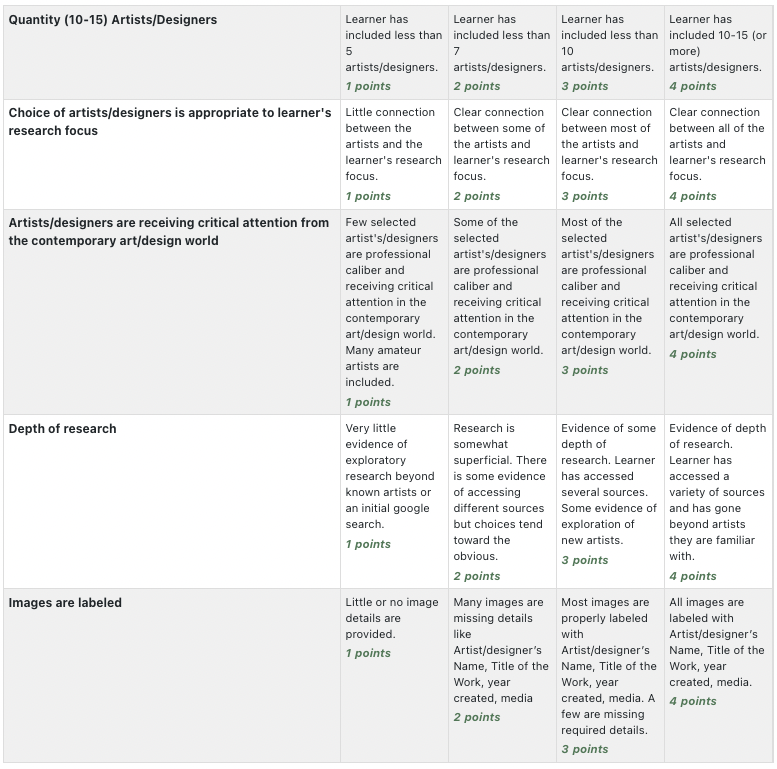
- Learner has included 10-15 artists/designers
- Choice of artists/designers is appropriate to the learner’s research focus
- Artists/designers are receiving critical attention from the contemporary art/design world. Artists/designers are primarily contemporary.
- Evidence of depth of research— learner has gone beyond artists and designers they are familiar with, they have accessed a variety of sources
- Images are properly labeled
Exhibition Responses
Blog Categories: sr-studio, review
Attend at least two off campus art/design exhibitions at museums, artist-run-centres or commercial galleries. Choose exhibitions that are relevant to your project, practice and areas of research. In your blog post respond to the following prompts:
- Post 3-5 of your own photographs of the exhibition.
- What exhibition did you attend? Was the exhibition held at a public, commercial or artist-run gallery?
- How does the exhibition relate to your work and research formally, conceptually or methodologically?
- What elements of the work might inform your practice, process, thinking, research for your project?
- What did you observe about the way the artist/curator has presented the work? How does the work exist in relation to other works in the exhibition? How does the context, the space and the arrangement of the artwork influence the way you engage with it?
Assessment:
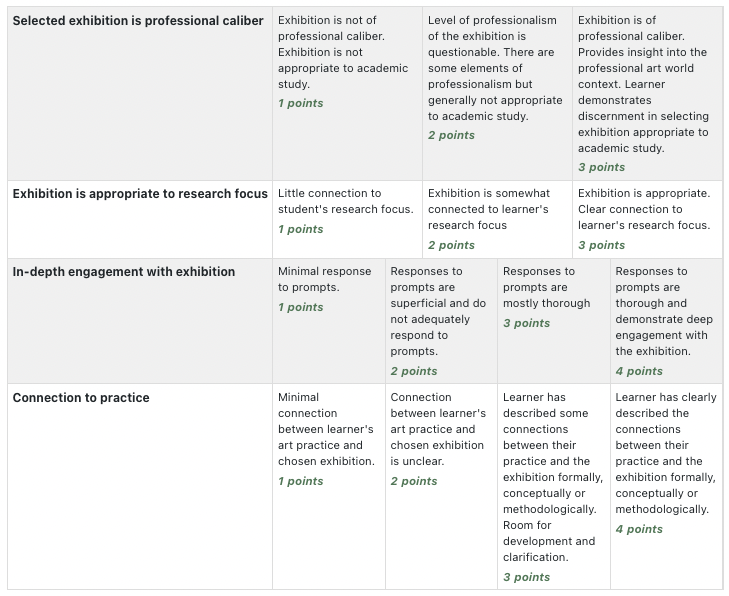
- Choice of exhibition is appropriate to the learner’s research focus
- Learner has selected a professional calibre exhibition to write about
- Evidence of depth of research— learner has gone beyond galleries and institutions they are familiar with, have sought out new art/design spaces
- Thoughtful and thorough response to the prompts.
Annotated Bibliography
Blog Categories: sr-studio, bibliography
For spring semester you are required to list four more sources on your annotated bibliography. Please refer to instructor feedback for guidance on moving forward with your bibliography.
Create a new blog post for each bibliography item. Your annotated bibliography should have at least eight sources. Four sources for the fall semester and four for spring semester.
Your bibliography may include books, journal articles, films, podcasts etc. Pay particular attention to the quality of the sources and how the sources relate to your project. Consult with the instructor regarding your sources. For further resources and strategies see Unit 4: Conducting Visual Cultural Research.
Ask yourself, does this source:
- deepen my understanding of the topic I am considering?
- help me contextualize my work in contemporary art/design discourse?
- help me develop language to articulate what I’m doing in my project?
- help me theorize my project?
Assessment:
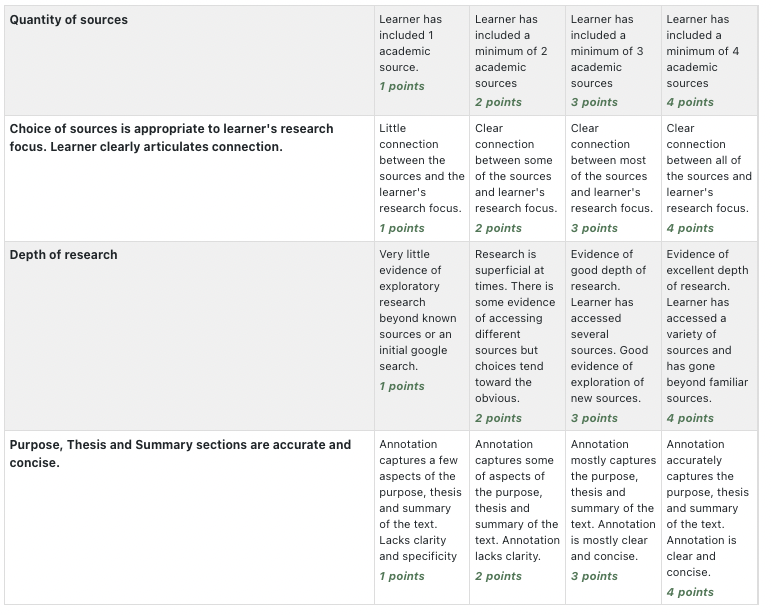
- Quality of sources: Learner has included a minimum of 4 academic sources.
- Choice of sources support learner’s research focus. Learner clearly articulates connection.
- Depth of research: learner has gone beyond familiar texts and has accessed a variety of sources
- Reference is correct and uses consistent citation style
- Purpose, thesis and summary is accurate and concise
 This work is licensed under a Creative Commons Attribution 4.0 International License.