Favour/Opposition
Chapter 5 of Lepsinger’s Closing the Execution Gap (pp. 133-166) entitled Bridge Builder 5: Facilitate Change Readiness outlines several principles for how top performing companies handle change initiatives (pp. 133-141), what addicts can teach us about change (pp. 141-145), change level appropriate strategies (pp. 145-154) and understanding the Impact of leader behaviour (pp. 154-166).
Favour Original Post
“One person at a time” – Health Angel’s Favour Op
This post was originally published by Samson at https://create.twu.ca/chiefanalyzerofthings/2018/11/07/onepersonatatime/.
Health Angels – HC2’s team blog post in favour of how top-performing companies manage change, by making staff engagement a priority.
 Change is inevitable. In today’s fast-paced world change takes place on an ongoing basis. In order to handle challenges and competitions with opposing companies, one must understand the importance of change. It is easy for leaders or managers to implement change, come up with new ideas but the success depends on how well the change is carried through within the company. Change is well managed when there is open communication, guidance, and support provided by the management team. “When you look at what the best companies do to prepare for and manage change, you can clearly see that success hinges more on common sense and leader behaviour than on a change management structure or processes”(Lepsinger, 2010). How the management team facilitate and coach employees throughout the change process is crucial. If employees are not supported throughout the change process, they may start to resent the employer. “Make sure you are keeping your employees involved. This will strengthen the relationship, build buy-in, encourage reactions and identify barriers” (Newell, 2018).
 Before the change process begins, it is important to understand the emotions and fears of employees. Some employees may be resistant to change. Companies must keep up with the growing technologies but sometimes there are employees who may not accept technological changes because they may not have the background knowledge. When Fraser Health initiated Paris (paperless documentation and assessments) many employees opposed to it because they did not want to use the computers and rather had continued to use paper. It may be worth a while for the management team to share the video “Who moved my cheese”. This will help employees understand the importance of change. As Lepsinger 2010 addresses employees may be inflexible because they want to maintain the status quo. Top companies maintain an open and honest communication with employees to ease the process of change.
As mentioned in Lepsinger (2010), “you change an organization one person at a time”. A well-managed change initiative not only involves structure and plan to be in place, but also to make staff engagement a priority. Lepsinger (2010) provides three additional insights into how top-performing companies manage change which the Health Angels HC2 team is in favour of. These three points are outlined in the following.
Before the change process begins, it is important to understand the emotions and fears of employees. Some employees may be resistant to change. Companies must keep up with the growing technologies but sometimes there are employees who may not accept technological changes because they may not have the background knowledge. When Fraser Health initiated Paris (paperless documentation and assessments) many employees opposed to it because they did not want to use the computers and rather had continued to use paper. It may be worth a while for the management team to share the video “Who moved my cheese”. This will help employees understand the importance of change. As Lepsinger 2010 addresses employees may be inflexible because they want to maintain the status quo. Top companies maintain an open and honest communication with employees to ease the process of change.
As mentioned in Lepsinger (2010), “you change an organization one person at a time”. A well-managed change initiative not only involves structure and plan to be in place, but also to make staff engagement a priority. Lepsinger (2010) provides three additional insights into how top-performing companies manage change which the Health Angels HC2 team is in favour of. These three points are outlined in the following.
“Stay focused during the first 3 months…success depends on it”
 First three months after implementing any change are equally crucial for the employees as are for the employer. Change can be implemented successfully only when a company can survive the change for the first three months (Lepsinger, 2010). At the initial stages, many people in the organization are still resistant to change. They lack trust which inhibits change (p.116). As a leader, one must stay empathetic and consistent to pull everyone together. In this process, the involvement of middle-level managers is crucial as success depends on their contribution (p. 102). Moreover, adopting a democratic style of leadership (Remple, 2010) will allow every employee to participate and make them feel involved, they must realize that they are a part of something significant and that is where their performances and contribution will improve (Maslow, Stephens, Heil, & Bennis, 1998). However, constant motivation and encouragement will keep the employees on track. This can be done through daily reminders in the form of mail or a short text message.
“Don’t just focus on senior leaders….involved middle managers and keep them engaged”
 When an organization is planning to implement a new initiative or project, the senior leadership would go through countless hours of planning and strategize in order to make the necessary preparations for the change. Yet, during the stages of such planning and executing the plan, the senior leadership often neglect to engage other staff members for their input. As suggested by Hughes et al. (2014), strategic thinking ss a collective process and organizations need to engage diverse perspectives and viewpoints (pg. 54). In addition, we also know certain individuals have greater opportunities and responsibility to affect their organization than others (Hughes et al., 2014, pg. 3). Some of these individuals include middle managers and leaders within the organization. As mentioned by Lepsinger (2010), “it’s usually the middle managers who do the heavy lifting and drive day-to-day execution”. Without the engagement of the middle managers and leaders, the change initiative is doomed to fail.
As an example, Vancouver Coastal Health (VCH) is currently in the process of a change initiative in the effort to increase staff engagement. The CEO of VCH, as well as many of the senior executives, have been front and centre in terms of supporting and driving this new initiative and many communications sent out to staff with regards to this change. While the goal of this change initiative is much needed as voiced by many people, there seems to be a disconnect and confusion in messaging. Many department managers and leaders have not mentioned or engaged frontline staff regarding the initiative even though the messaging from senior leadership is continually being sent out. It appears the senior leadership is neglecting to engage middle managers and leaders and the result of this is confusion in communications and staff being uncertain as to how what to believe. Direct managers and supervisors have an effect on staff that is different compared to senior leadership. Employees tend to be more engaged in their work when their supervisors are supportive and concerned about their welfare and interests (Chughtai, A. A., & Buckley, F., 2008). The result of a direct supervisor or manager engagement could promote staff learning, growth and development. The consequence of such an encouraging and productive work environment can play a pivotal role in breeding work engagement (Chughtai & Buckley, 2008). When middle managers, or in this scenario department managers, are on board and part of the process, they can help drive change and increase the likelihood of success. Alternatively, when these leaders are not engaged, they can be change-delaying bottlenecks (Lepsinger, 2010).
When an organization is planning to implement a new initiative or project, the senior leadership would go through countless hours of planning and strategize in order to make the necessary preparations for the change. Yet, during the stages of such planning and executing the plan, the senior leadership often neglect to engage other staff members for their input. As suggested by Hughes et al. (2014), strategic thinking ss a collective process and organizations need to engage diverse perspectives and viewpoints (pg. 54). In addition, we also know certain individuals have greater opportunities and responsibility to affect their organization than others (Hughes et al., 2014, pg. 3). Some of these individuals include middle managers and leaders within the organization. As mentioned by Lepsinger (2010), “it’s usually the middle managers who do the heavy lifting and drive day-to-day execution”. Without the engagement of the middle managers and leaders, the change initiative is doomed to fail.
As an example, Vancouver Coastal Health (VCH) is currently in the process of a change initiative in the effort to increase staff engagement. The CEO of VCH, as well as many of the senior executives, have been front and centre in terms of supporting and driving this new initiative and many communications sent out to staff with regards to this change. While the goal of this change initiative is much needed as voiced by many people, there seems to be a disconnect and confusion in messaging. Many department managers and leaders have not mentioned or engaged frontline staff regarding the initiative even though the messaging from senior leadership is continually being sent out. It appears the senior leadership is neglecting to engage middle managers and leaders and the result of this is confusion in communications and staff being uncertain as to how what to believe. Direct managers and supervisors have an effect on staff that is different compared to senior leadership. Employees tend to be more engaged in their work when their supervisors are supportive and concerned about their welfare and interests (Chughtai, A. A., & Buckley, F., 2008). The result of a direct supervisor or manager engagement could promote staff learning, growth and development. The consequence of such an encouraging and productive work environment can play a pivotal role in breeding work engagement (Chughtai & Buckley, 2008). When middle managers, or in this scenario department managers, are on board and part of the process, they can help drive change and increase the likelihood of success. Alternatively, when these leaders are not engaged, they can be change-delaying bottlenecks (Lepsinger, 2010).
“Take aggressive action to avoid the commitment dip”
 Even if the team leader manages to get everybody on board with the idea of change, it is difficult to keep the momentum going. A leader must be dynamical and constantly make efforts to maintain the spirits of the employees which is usually high in the beginning. Therefore, an aggressive action needs to be taken to avoid the commitment dip (Lepsinger, 2010, p.103). It reminds me of a funny quote by American author Zig Zigler- “People often say motivation doesn’t last. Well, neither does bathing- that’s why we recommend it daily.” As these situations are rapidly changing, in no time the team members can lose their interest in the freshly developed ideas and would want to go back to routine, it is, therefore, important for the leader to take instant actions to prevent this plunge. The leader should be swift and strategic in responding to the rapidly changing situations (Hughes, 2014, p. 237). There are no shortcuts to transformation; it requires consistent efforts to bring the change. The Cultural Change Principal states that it is important to be proficient in managing the process of change (Fullan, 2002, p.3). The process of change does require holding the members accountable and help them sustain their enthusiasm. Constantly reminding the members of the change that the organization wants and their role in achieving the same helps them stay connected to the transformation and prevent the commitment dip.
References:
Even if the team leader manages to get everybody on board with the idea of change, it is difficult to keep the momentum going. A leader must be dynamical and constantly make efforts to maintain the spirits of the employees which is usually high in the beginning. Therefore, an aggressive action needs to be taken to avoid the commitment dip (Lepsinger, 2010, p.103). It reminds me of a funny quote by American author Zig Zigler- “People often say motivation doesn’t last. Well, neither does bathing- that’s why we recommend it daily.” As these situations are rapidly changing, in no time the team members can lose their interest in the freshly developed ideas and would want to go back to routine, it is, therefore, important for the leader to take instant actions to prevent this plunge. The leader should be swift and strategic in responding to the rapidly changing situations (Hughes, 2014, p. 237). There are no shortcuts to transformation; it requires consistent efforts to bring the change. The Cultural Change Principal states that it is important to be proficient in managing the process of change (Fullan, 2002, p.3). The process of change does require holding the members accountable and help them sustain their enthusiasm. Constantly reminding the members of the change that the organization wants and their role in achieving the same helps them stay connected to the transformation and prevent the commitment dip.
References:Charece Newell, MSILR, sHRBP, CCLC, CRC. (2018, July 20). Change As An Opportunity: A Strategic Approach To Change Management. Retrieved November 6, 2018 from https://www.forbes.com/sites/forbeshumanresourcescouncil/2018/07/20/change-as-an-opportunity-a-strategic-approach-to-change-management/#e1ff0e122412 Chughtai, A. A., & Buckley, F. (2008). Work Engagement and its Relationship with State and Trait Trust: A Conceptual Analysis. Journal of Behavioral & Applied Management, 10(1), 47–71. Retrieved November 6, 2018 from https://ezproxy.student.twu.ca/login?url=http://search.ebscohost.com/login.aspx?direct=true&db=a9h&AN=35749073&site=eds-live Fullan, M., (2002). The Change. Retrieved November 6, 2018 from
http://www.ghaea.org/files/IowaCoreCurriculum/Module1/Mod1-FullanChangeLeaderArticle.pdf Gerardo, L. (2013, November 05). Who moved my cheese Full Movie. Retrieved November 6, 2018, from https://www.youtube.com/watch?v=2QmeWe2KoDs Hughes, R., Beatty, K. & Dinwoodie, D. (2014). Becoming a strategic leader: your role in your organization’s enduring success. San Francisco: Jossey-Bass. Lepsinger, R. (2010). Closing the execution gap: How great leaders and their companies get results. San Francisco: Jossey-Bass. Maslow, A. H., Stephens, D. C., Heil, G., & Bennis, W. (1998). Maslow on management. New York: John Wiley. Retrieved from http://altfeldinc.com/pdfs/maslow.pdf Remple, S. (2010). Transformational Servant Leaders: TWU’S Master of Arts in Leadership Program. Leadership Monograph 2017. Retrieved from https://learn.twu.ca/pluginfile.php/75991/mod_resource/content/1/MA_Leadership_Monogra ph_approved.pdf
Opposition Original Post
Opposition Rebuttal
Rebuttal HC2 team favour OP

The thought of Change is inevitable is so correct and appropriate, but the ways to adapt those changes are indispensable for successful implementation of reform. Every point and aspect put forward by the HC2 team to the best of our knowledge by the points mentioned in their post we redefined it as following:
Who moved my cheese
The premise of who moved my cheese “if you do not change you become extinct.” It was written
in the wall of the maze in the story. Change initiatives always bring out resistance in individual team members. People have complex emotions and feelings attached to their job. Most job seekers look for job stability, and benefits. Coincidently those that constantly seek security are the ones who are riddled with worry about losing it. Hem and Haw learn that learning to face your fears is quite freeing (2010, Johnson).
In facing resistance, it is the Managers and Team Leaders responsibility to stop the resistance in their tracks. Wouldn’t it be the leader’s job to create mass buy-in? When dealing with resistance to change have you considered a lack of knowledge? I work for Fraser Health as well, and we have run across this many times and found the strength to be an education gap. If you look at Bridges Change Model, it explains that people experience a change in three phases, Losing, the neutral zone and the new beginning. Not all people will experience each period at the same time. Resistance can be expressed in both the losing phase and the neutral zone. Once an employee has genuinely let go of the old ways, accepted the new style only then can they move onto the new beginning phase (2017, Bridges).
Change is a part of life, and we must adapt to it regularly as it arises. Hem and Haws’ story is a good one but if don’t change you don’t become extinct, stagnant and behind the times, yes, but not gone.
“Don’t Just Focus on Senior Leaders…Involved middle managers and keep them engaged.”
The Health Angels discussed the strategy of involving middle managers and keeping them engaged, saying without the engagement of the middle manager, the change initiative is doomed to fail. Their argument has merit – middle managers are the striking face of organizational leadership to frontline staff. However, the Health Angels fail to mention the effect of other factors which may hamper leader’s efforts to effect change.
One such factor is the influence of a union. Union-management relationships can often be adversarial (Hoffman & Brown, 2016). Management’s goals are to deliver results, while the union believes management sees the collective as a hindrance (Furlong, 2011). Management also perceives union leadership members as “working for somebody else,” when they are still employees of the organization (Furlong, 2017). As such, management and unions may feel “like an arranged or forced marriage without the option of divorce” (McCorriston, 2013). Vancouver Coastal Health has employees who belong to different unions, such as the Hospital Employees Union and the British Columbia Nurses Union. Based on personal experience, the shop stewards often held much influence, sometimes even more than managers and leaders.
Union-management collaboration can increase productivity, product quality, and employee satisfaction, as well as decrease employee turnover (Ostrowsky, 2005). Workers feel they have a voice while management sees a heightened sense of involvement and ownership (Mahan et al., 2018). There is a need to cultivate these relationships, which require extensive training, open communication, and joint decisions (Furlong, 2017).
Another factor is the nature of the middle manager’s position. Middle managers, by their very name, have the unique position of being both a “victim” and a “carrier” of change (Giangreco & Peccei, 2005). Change targets the function of the middle manager, making her a victim, while the middle manager must echo these changes to frontline staff, making her a carrier. Anicich & Hirsh (2017) conclude “middle managers often find themselves stuck in between various stakeholder groups, which can produce relentless and conflicting demands.” Middle managers may be at higher risk for burnout and turnover, bringing into question their effectiveness as they may not remain in their positions for long – Anicich & Hirsh (2017) say middle managers are at higher risk for hypertension, heart disease, stress, anxiety, and disrupted cognitive performance.
To conclude, middle manager engagement is important but does not adequately explain failed initiatives initiated from senior leadership. Other factors such as the union and the nature of middle management may contribute to the failure to change.
“Take aggressive action to avoid the commitment dip.”
We believe HC2 organization needs to have a consultation on their progression. Articulating the elements and assisting with the various tools required to clarify the objective of the HC2 organization.
Committed employees bring added value to the organization, including their determination and proactive support, high productivity and an awareness of quality. Non- the committed employee can work against the organization and hold back the organization success.
The best way for organizations to thrive in the face of this new reality is to become continual learning engines. In practical terms, that means, the organizational strategy, the vision, the directions, and the tactics adopted to move toward success—ought to be held in an ongoing state of formulation, implementation, reassessment, and revision (Hughes, Beatty, & Dinwoodie, 2014, p.4). “Implementation entails collective (or conjoint) action among interdependent individuals and work units. Coordinating action across many individuals and groups and promoting organizational learning are good examples of collective (or conjoint) capabilities” (Weiner, 2009). It’s the kind that makes decisions and takes action not just to boost the organization’s current performance but also to strengthen the organization’s future effectiveness and competitiveness. Therefore, the organization learns and enhances its capabilities in the VUCA world. It is the iteration over time (Hughes et al., 2014, P. 21). And it is a learning process involved everyone in the organization. It requires to model behaviors that support the change, and adopt the servant leadership approach to leverage organizational members to collaborate and bring the best of their employees as a whole towards the change.
As Bandura and others noted, “efficacy judgments refer to action capabilities; efficacy judgments are neither outcome expectancies nor assessments of knowledge, skills, or resources. Change efficacy is higher when people share a sense of confidence that collectively they can implement a complex organizational change” (as cited in Weiner, 2009).
“Servant leadership is considered as a controllable independent variable that affects the dependent variable of organizational performance.” (Aij & Rapsaniotis, (2017).
Are the mindsets of people in the organization ready for something new and different?
The theory described in Weiner’s article (2009) treats organizational readiness as a shared psychological state in which corporate members feel committed to implementing an organizational change and confidence in their collective abilities to do so. Therefore, thinking about organizational readiness is best suited for examining regulatory changes where collective behavior change is necessary to implement the change effectively and, in some instances, for the shift to producing anticipated benefits.
So, change is a shared team property-that is, a shared psychological state in which organizational members feel committed to implementing an organizational change and confidence in their collective abilities to do so. This way of thinking about organizational readiness is best suited for regulatory changes where joint, coordinated behavior change is necessary to implement the change effectively and, in some instances, for the shift to producing anticipated benefits. In Weiner’s theory (2009), resources and other structural attributes of organizations do not enter directly into the definition of readiness. Instead, they represent an important class of performance determinants that organizational members consider in formulating change efficacy judgments. This view is consistent with Bandura’s (as cited in Weiner, 2009) contention that efficacy judgments focus on generative capabilities–that is, the ability to mobilize resources and orchestrate courses of action to produce a skillful performance.
Stay Focused During 3 Months
The Health Angels support the idea that “Stay focused during the first three months…success depends on it.” To adopt a change, a person needs to make a new habit because a change of behavior is not just enough. As stated by Clear (n.d.), “On average, it takes more than two months before a new behavior becomes automatic — 66 days to be exact. And how long it takes a new habit to form can vary widely depending on the behavior, the person, and the circumstances. In Lally’s study, it took anywhere from 18 days to 254 days for people to form a new habit.”
There is a perfect example of how an only change in behavior can affect the success as there are thousands of students coming to Canada for their studies, but not every one of them can be able to make it to the end. Some, of them, end up by going back to their home Country as they failed to make it a habit to adapt to this significant change of their life. But it is true that adapting to that change is becoming necessary these days as stated by Goldsmith (2016) “Life can be difficult to navigate in our fast-moving society. Things are changing so quickly these days that by the time you’ve opened the box of your new cell phone, it’s probably out of date.” So, it is no harm to adapt to change, but changing behavior only is not just enough.
There is another argument put forward by Health angels that “…daily reminders in the form of mail or a short text message.” It is true that encouragement is necessary to adopt any change but at the same time, poking them and reminding them on a daily basis could be frustrating. It might appear to be more like implementing change on them rather than helping them to adopt it.
References:
Aij Kh, Rapsaniotis S. (2017). Leadership requirements for Lean versus servant leadership in health care: a systematic review of the literature. Journal of Healthcare Leadership. 9,.1-14. doi.org/10.2147/JHL.S120166
Anicich, E., & Hirsch, J. (2017). Why being a middle manager is so exhausting. Retrieved from https://hbr.org/2017/03/why-being-a-middle-manager-is-so-exhausting
Bridges, W. (2017). Managing transitions: Making the most of change. Place of publication not identified: Da Capo.
Clear, J. (n.d), How Long Does it take to form a New Habit? Behavioral Psychology, Habits. Retrieved from: https://jamesclear.com/new-habit
Furlong, G. (2011). Cultivating effective management-union relationships in the unionized workplace. Retrieved from https://irc.queensu.ca/articles/cultivating-effective-management-union-relationships-unionized-workplace
Furlong, G. (2017). Best practices for the union-management relationship in the workplace. Retrieved November 9th, 2018, from https://irc.queensu.ca/articles/best-practices-union-management-relationship-workplace
Giangreco, A., & Peccei, R. (2005). The nature and antecedents of middle manager resistance to change: evidence from an Italian context. International Journal of Human Resource Management, 16(10), 1812–1829. https://doi.org/10.1080/09585190500298404
Giangreco, A., & Peccei, R. (2005). The nature and antecedents of middle manager resistance to change: evidence from an Italian context. International Journal of Human Resource Management, 16(10), 1812–1829. Retrieved from https://doi.org/10.1080/09585190500298404
Goldsmith, B. (2016). Adapting to Change, Positive Changes can be as difficult to accept as negative ones. Psychology Today. Retrieved from: https://www.psychologytoday.com/us/blog/emotional-fitness/201603/adapting-change
Hoffman, R. C., & Brown, M. O. (2016). Employee ownership and union labor: the case of United Steel Workers of America. Labor History, 58(3), 350–371. Retrieved November 9th, 2018, Retrieved from https://doi.org/10.1080/0023656x.2017.1255540
Hughes, R. L., Beatty, Collarelli-Beatty, K., & Dinwoodie, D. L. (2014). Becoming a strategic leader: Your role in your organization’s enduring success. San Francisco, CA: Jossey-Bass.
Johnson, S., Bracken, B., Johnson, L. D., Lowenheim, A., Hamby, D. A., Red Tree Leadership & Development (Firm), Double Take Productions., … Owen-Stewart Performance Resources. (2010). Who moved my cheese?. Orem, UT: Spencer Johnson/Red Tree
Lepsinger, R. (2010). Closing the execution gap: How great leaders and their companies get results. San Francisco, CA: Jossey-Bass
Mahan, B., Maclin, R., Ruttenberg, R., Mundy, K., Frazee, T., Schwartzkopf, R., & Morawetz, J. (2018). Labor-management cooperation in Illinois: How a joint union company team is improving facility safety. New Solutions: A Journal of Environmental & Occupational Health Policy, 28(2), 227–239. Retrieved November 9th, 2018 from https://ezproxy.student.twu.ca:2420/10.1177/1048291118759303
McCorriston, R. (2013). From confrontation to collaboration: Making union-management relationships Work. Retrieved November 9th, 2018 from https://irc.queensu.ca/articles/confrontation-collaboration-making-union management-relationships-work
Ostrowsky, J. (2005). Union-management cooperation: Can a company move from an adversarial relationship to a cooperative relationship and is interest-based bargaining a necessary condition to do So? Retrieved November 9th, 2018, from http://citeseerx.ist.psu.edu/viewdoc/download?doi=10.1.1.558.4213&rep=rep1&type=pdf
Weiner, J., B. (2009). A theory of organizational readiness for change. Implementation Sciences, 4,67. Retrieved from: https://doi.org/10.1186/1748-5908-4-67
Favour Rebuttal
Response to Rebuttal by HC1 team
“Who moved my Cheese?”
Thank you HC1 for your response to our post. When dealing with resistance to change there can be a number of factors. Some of these factors are; lack of open communication, lack of knowledge, lack of support, and some simply not willing to do so due to rigidity. I also work for Fraser health and often times I have witnessed lack open communication builds resistance. For the changes I have seen in Fraser health, there has always been education around the change provided to employees. For example; when new tools are implemented, staff are provided in-services on how to utilize these tools, whether online or paper. Often times there are a point person appointed to help the rest of the team, if all members are not able to attend due to shift work, or cost purpose. So I don’t think knowledge is just the only factor here. I believe ongoing support from leadership is necessary. “Management can take concrete steps to deal constructively with these staff attitudes. The steps include emphasizing new standards of performance for staff specialists and encouraging them to think in different ways, as well as making use of the fact that signs of resistance can serve as a practical warning signal in directing and timing technological changes”(Lawrence, 2014). A big way to help those resistive to change is to support and guide them through. Despite, education and knowledge, some still may not agree with the change. In these cases, having the resources available and management availability to facilitate change goes a long way. Perhaps change talk as mentioned by Lepsinger can be an essential piece. “Change talk techniques include identifying the behaviour the person or team needs to change, “(Lepsinger, 2010, p.157).
“Don’t Just Focus on Senior Leaders…Involved middle managers and keep them engaged.”
The HC1 team provided some very good insights into the complex relationship of middle managers/leaders and their staff, including the tension of union environments and the nature of middle managers being stuck between senior management and frontline staff. Indeed, many people who work in a union environment often sense the tension between the employers, who is represented by managers, versus the union, who are represented by staff members. One of the ways of resolving this tension is by managers using authentic leadership when dealing with middle managers and staff members. Authentic leadership means that leaders treat employees authentically, are consistent between their values and actions and work together with the employees for the benefit of the organization (Hsieh, C.C., & Wang, D.S., 2015). This will positively affect employee attitudes, behaviour as well as engagement (Hsieh & Wang, 2015).
Because of the very nature of middle managers being stuck between stakeholders and frontline staff members, it is more the reason to engage with middle managers during a change initiative. Middle managers in their unique situation often have many valuable insights into the atmosphere of current frontline staff as well as the senior manager’s directive and challenges. Middle managers act as a bridge between the two groups and often able to find common ground. The engagement of middle managers proves to be invaluable during change initiatives because of the middle manager’s position in the organization.
Take aggressive actions to avoid commitment dip
We agree that it is crucial to make progression a learning process but what good will comes out of learning if a leader is not quick enough to apply that information for the advancement of the organization.
Seventeen percent of executives attending a Strategic Leader Program said that they face the challenge of gaining commitment to their ideas and their success requires the engagement efforts of their team members (Hughes, 2014, p. 123). Whether directly or not, the leader always sets an example of what the organization expects from its employees so it becomes their duty to ensure commitment. The idea of change is not enough, finding collective meaning and commitment and redefining resistance by taking necessary actions to instil motivation and transforming the culture changing values and the way people work together to achieve it is the way to attain everlasting changes (Fullan, 2002, p. 17)
Stay focused for the first three months
Thank you for your thoughts on this HC1. It is very true about developing a habit which takes at least 2 months; however, this happens only when you take small steps each day. In fact, to stay focused for the first 3 months does not necessarily mean developing a habit; it simply means to stay adamant on your decision and not forget it. Moreover, the development of any project or process (change) depends on the response in initial months.
Also, team HC1 presented an example of international students coming to Canada and going back if they cannot adopt the change. I believe, this phenomenon is personal; besides, this might not be comparable to organizational or workplace policy change. Immigrating to a different country brings change into an individual’s life and does not affect people around; whereas, policy change in the organization is more of a collective effort (Weiner, 2009). For this collective effort to be successful, there needs to be a behaviour change (para 3).
Reminders can be frustrating only when it is framed or written in a particular way. Friendly reminders are meant for motivation. For example; instead of saying, “don’t forget to complete the presentation”, one may say “looking forward to another dynamic presentation of yours”. Many of us have inspirational quotes or pictures in their room; it motivates us and reminds us of our goal.
Conclusive Statement
Change is not an easy process. There are various factors involved, whether its resistance, communication via the middle manager, commitment or motivation to change. Change requires ongoing support towards each other within the team. In order to facilitate change, senior management and frontline staff must have an open and honest line of communication. Resistance may be unavoidable; however, with resources and support from one another this can be minimized. Building a trusting relationship between each other and taking the opportunity to understand feeling and emotions during change is crucial. “Empathy is a way of showing you understand what others think and how they feel about change”(Lepsinger, 2010, p. 158). Overall change becomes easier when compassion is shown by each other during this stressful process.
References:
Fullan, M., (2002). The Change. Retrieved November 6, 2018 from
http://www.ghaea.org/files/IowaCoreCurriculum/Module1/Mod1-FullanChangeLeaderArticle.pdf
Gerardo, L. (2013, November 05). Who moved my cheese Full Movie. Retrieved November 6, 2018, from https://www.youtube.com/watch?v=2QmeWe2KoDs
Hughes, R., Beatty, K. & Dinwoodie, D. (2014). Becoming a strategic leader: your role in your organization’s enduring success. San Francisco: Jossey-Bass.
Hsieh, C.-C., & Wang, D.-S. (2015). Does supervisor-perceived authentic leadership influence employee work engagement through employee-perceived authentic leadership and employee trust? International Journal of Human Resource Management, 26(18), 2329–2348. Retrieved from https://ezproxy.student.twu.ca:2420/10.1080/09585192.2015.1025234
Lawrence, P. R. (2014, August 01). How to Deal With Resistance to Change. Retrieved from https://hbr.org/1969/01/how-to-deal-with-resistance-to-change
Lepsinger, R. (2010). Closing the execution gap: How great leaders and their companies get results. San Francisco: Jossey-Bass.
Weiner, B. J. (2009). A theory of organizational readiness for change. Implementation science, 4(1), 67. Retrieved from https://www.ncbi.nlm.nih.gov/pmc/articles/PMC2770024/
Favour Conclusion
Opposition Conclusion
Counter- Argument to HC 2 Team Rebuttal
COUNTER-ARGUMENT
Vance, Groves, Yongsun, and Kindle (2007) defined “linear thinking style as a preference for attending to external data and facts and processing this information through conscious logic and rational thinking to form knowledge, understanding, or a decision for guiding subsequent action. They also further defined nonlinear thinking style as a preference for attending to internal feelings, impressions, intuition, and sensations; and for processing this information (both consciously and subconsciously) to form insight, understanding, or a decision for guiding subsequent action (P.170). Linear thinking consistent with 2-part definitions from the literature of general thinking style and modes of thought that involve (1) attending to an information source, and (2) processing that information for subsequent decision making (Vance et al., 2007, p.168). Practical thinking, planning, and problem-solving in our complex, turbulent, unpredictable, and uncertain global business environment requires managers and professionals to reach beyond merely a linear thinking platform of rules, rationality, analysis, logic, reason, and cause-effect predictability (Siggelkow & Rivkin, 2005; as cited in Vance et al., 2007, p.167).
This reach must also include other thought patterns of intuitive and emotional assessments, creativity and lateral thinking, holistic and total systems appraisal, integrative and synergistic thinking, perceptual flexibility, imagination and visualization, and insight (Vance et al., 2007, p.168).
At present, the conceptualization of these other patterns of thought to linear thinking is fragmented at best. Their collective identification and efficient measurement, along with models of rational and logical thinking, could provide potentially helpful diagnostic and developmental feedback for managers and professionals interested in enhancing personal thinking style flexibility and versatility in more effectively meeting the demands of our challenging business environment (Vance et al., 2007, p.168). The fact is that organizations don’t just change because of new systems, processes or structures; they change because the people within the organization adapt and change too (Galbraith, 2014, p.131).
Miller and Ireland (2005) recently noted intuitive decisions involve “novel approaches, changes in directions, and actions that run counter to prevailing thinking or data” (p. 21), and are often described as “gut feelings.” Vance et al., (2007) argue effective decision making in a highly complex and turbulent business environment requires both linear thinking and reliance on formal data sources as well as intuition and other forms of nonlinear thinking (169).
The Health Angels argue the need to monitor, learn, and repeat the process, concluding the process is non-linear (Sonvane, 2018). We disagree with this assessment. The diagram below outlines how leaders can include these steps and still result in a linear process.

Figure 1
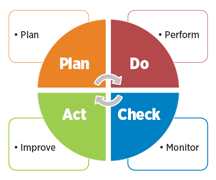
The depiction of the PDCA cycle (or Deming cycle). Continuous quality improvement is achieved by iterating through the period and consolidating achieved progress through standardization.
The PDCA cycle, also known as the PDSA cycle or Deming cycle, is a four-step model for carrying out change. It is continuous, just as a circle has no end (American Society for Quality, n.d.). Figure 2 outlines the steps of the PDCA cycle:

Figure 2
Plan-do-check-act cycle
The PDCA cycle covers the three steps recommended by the Health Angels, namely check (monitor), learn (act and plan), and repeat (do). Figure 1 shows the linear process of improvement; as new standards are established, the cycle continues. Even though the PDCA steps progress through a cycle and may appear to go backward, the overall direction of improvement is linear.
Nonlinear systems are highly unpredictable, where seeming chaos eventually emerges into new patterns of order (Vance et al., 2007). As a fitting thinking style for nonlinear systems, creativity is characterized by spontaneity and flexibility, with a balanced integration of rational analytic and unconventional imaginative processes, and where individuals in a highly focused state of consciousness take new perspectives and reassemble interrelated parts of a system in a novel and unusual ways leading to viable solutions. The use of metaphors also can be helpful in increasing flexibility by bringing a comparison of a problem with a seemingly unrelated object or system, providing new perspectives for gaining a better understanding of complex systems, and generating multiple creative solutions (p.169).
Change is not predictable
This statement redefined as “Change is not predictable always.”
We do make plans, future goals and set an aim to achieve for which we have to adopt a pathway involving strategic steps in progression. Which means changes that planned to be happening in future, unless circumstances would be the same as thought.

For a predictable change to aspire, one needs to do hard work and beats all the bumps, twist and turns of life. A linear change doesn’t mean that a progression and outcome of evolution is following a straight pathway, it does involve few curves on the graph of growth. So, this doesn’t mean that change is not predictable. Instead, it is predictable, and it depends on the way how you accept it and implement it.

Change Readiness
The HC-2 team stated that in the change readiness phase “not everyone including leaders may be ready for the change.” Leaders have a responsibility to ensure that everyone is ready for an organizational change. If employees require education and training to understand the differences better to come, then it is the Leader’s job to facilitate it. Strong leaders will perform a change readiness assessment of their team. In Lepsinger’s five levels of change readiness, he explains change readiness is a process. The five levels are; intent to change, contemplating change, planning, and preparation, visible action. One could argue that the five levels of change readiness point to a linear model of change (2010, Lepsinger, p.143). Part of being an effective leader is building trust within your team. When there is trust within the team members do not question the intentions of their leader.
A change readiness assessment looks at a depth of the change, the impact on employees involved, the kind of change that is happening, the anticipation of growth the change potentially will bring. Change readiness requires quantitative and qualitative data. Qualitative data would be getting feedback from all stakeholders involved. An example of quantitative would be to survey with a large audience. The survey would focus on what areas need improvement, other resources that could be used. Furthermore, this proves both change readiness and change are a linear process.
Conclusion:
Practical thinking, planning, and problem-solving in our complex, turbulent, unpredictable, and uncertain global business environment requires to have the other patterns of thoughts to linear thinking. Therefore, can provide a potentially helpful diagnostic tool and developmental feedback to leaders and professionals in meeting the demands of the challenging business environment. Effective decision-making requires both linear and reliance on formal data sources as well as intuition and other sources of nonlinear thinking. For reconfigurable organizations, a fondness for working in teams is the ability to solve problems and handle conflicts. The ability to assess the risk and manage the reaction of the employees is part of the management change.
References:
American Society for Quality (2018). Plan-do-check-act (PDCA) cycle. Retrieved November 11, 2018, from http://asq.org/learn-about-quality/project-planning-tools/overview/pdca-cycle.html
American Society for Quality (2018). Pit-pdsa-cycle [Digital image]. Retrieved November 11, 2018, from http://asq.org/-/media/Images/learn-about-quality/pdca-cycle/ppit-pdsa-cycle.png?la=en
Galbraith, J. R. (2014). Designing Organization: strategy, structure, and process at the business unit and enterprise level. San Francisco: Jossey-Bass. ISBN:978-1-118-40995-4
Hughes, R. L., Beatty, Collarelli-Beatty, K., & Dinwoodie, D. L. (2014). Becoming a strategic leader: Your role in your organization’s enduring success. San Francisco, CA: Jossey-Bass.
Lepsinger, R. (2010). Closing the Execution Gap: How Great Leaders and Their Companies Get Results. Hoboken: John Wiley & Sons.
Miller, C., & Ireland, D. 2005. Intuition in strategic decision making: Friend or foe in the fast-paced 21st century. Academy of Management Executive, 19(1): 19 –30.
Riddell, Roisland, V., R., Tofte, M. (2017). Change Readiness Factors influencing employees’ readiness for change within an organization: A systematic review. Ubiversitetet I Agedr / Aura. Retrieved from: https://brage.bibsys.no/xmlui/handle/11250/2452955
Sonvane, P. (2018). Health Angel’s rebuttal to HC1 team’s opposition OP. Retrieved November 11, 2018, from https://create.twu.ca/psonvane/2018/11/09/health-angels-rebuttal-to-hc1-teams-opposition-op/
Siggelkow, N., & Rivkin, J. W. 2005. Speed and search: Designing organizations for turbulence and complexity. Organization Science, 16(2): 101–123.
Vance, C. M., Groves, K. S., Yongsun Paik, & Kindler, H. (2007). Understanding and Measuring Linear–NonLinear Thinking Style for Enhanced Management Education and Professional Practice. Academy of Management Learning & Education, 6(2), 167. Retrieved from https://ezproxy.student.twu.ca/login?url=http://search.ebscohost.com/login.aspx?direct=true&db=edb&AN=25223457&site=eds-live
Viertze, J. (2013, June 17). PDCA process [Digital image]. Retrieved November 11, 2018, from https://commons.wikimedia.org/wiki/File:PDCA_Process.png
