
Counter- Argument to HC 2 Team Rebuttal
COUNTER-ARGUMENT
Vance, Groves, Yongsun, and Kindle (2007) defined “linear thinking style as a preference for attending to external data and facts and processing this information through conscious logic and rational thinking to form knowledge, understanding, or a decision for guiding subsequent action. They also further defined nonlinear thinking style as a preference for attending to internal feelings, impressions, intuition, and sensations; and for processing this information (both consciously and subconsciously) to form insight, understanding, or a decision for guiding subsequent action (P.170). Linear thinking consistent with 2-part definitions from the literature of general thinking style and modes of thought that involve (1) attending to an information source, and (2) processing that information for subsequent decision making (Vance et al., 2007, p.168). Practical thinking, planning, and problem-solving in our complex, turbulent, unpredictable, and uncertain global business environment requires managers and professionals to reach beyond merely a linear thinking platform of rules, rationality, analysis, logic, reason, and cause-effect predictability (Siggelkow & Rivkin, 2005; as cited in Vance et al., 2007, p.167).
This reach must also include other thought patterns of intuitive and emotional assessments, creativity and lateral thinking, holistic and total systems appraisal, integrative and synergistic thinking, perceptual flexibility, imagination and visualization, and insight (Vance et al., 2007, p.168).
At present, the conceptualization of these other patterns of thought to linear thinking is fragmented at best. Their collective identification and efficient measurement, along with models of rational and logical thinking, could provide potentially helpful diagnostic and developmental feedback for managers and professionals interested in enhancing personal thinking style flexibility and versatility in more effectively meeting the demands of our challenging business environment (Vance et al., 2007, p.168). The fact is that organizations don’t just change because of new systems, processes or structures; they change because the people within the organization adapt and change too (Galbraith, 2014, p.131).
Miller and Ireland (2005) recently noted intuitive decisions involve “novel approaches, changes in directions, and actions that run counter to prevailing thinking or data” (p. 21), and are often described as “gut feelings.” Vance et al., (2007) argue effective decision making in a highly complex and turbulent business environment requires both linear thinking and reliance on formal data sources as well as intuition and other forms of nonlinear thinking (169).
The Health Angels argue the need to monitor, learn, and repeat the process, concluding the process is non-linear (Sonvane, 2018). We disagree with this assessment. The diagram below outlines how leaders can include these steps and still result in a linear process.

Figure 1
The depiction of the PDCA cycle (or Deming cycle). Continuous quality improvement is achieved by iterating through the period and consolidating achieved progress through standardization.
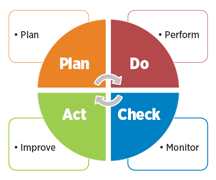
The PDCA cycle, also known as the PDSA cycle or Deming cycle, is a four-step model for carrying out change. It is continuous, just as a circle has no end (American Society for Quality, n.d.). Figure 2 outlines the steps of the PDCA cycle:

Figure 2
Plan-do-check-act cycle
The PDCA cycle covers the three steps recommended by the Health Angels, namely check (monitor), learn (act and plan), and repeat (do). Figure 1 shows the linear process of improvement; as new standards are established, the cycle continues. Even though the PDCA steps progress through a cycle and may appear to go backward, the overall direction of improvement is linear.
Nonlinear systems are highly unpredictable, where seeming chaos eventually emerges into new patterns of order (Vance et al., 2007). As a fitting thinking style for nonlinear systems, creativity is characterized by spontaneity and flexibility, with a balanced integration of rational analytic and unconventional imaginative processes, and where individuals in a highly focused state of consciousness take new perspectives and reassemble interrelated parts of a system in a novel and unusual ways leading to viable solutions. The use of metaphors also can be helpful in increasing flexibility by bringing a comparison of a problem with a seemingly unrelated object or system, providing new perspectives for gaining a better understanding of complex systems, and generating multiple creative solutions (p.169).
Change is not predictable
This statement redefined as “Change is not predictable always.”
We do make plans, future goals and set an aim to achieve for which we have to adopt a pathway involving strategic steps in progression. Which means changes that planned to be happening in future, unless circumstances would be the same as thought.

For a predictable change to aspire, one needs to do hard work and beats all the bumps, twist and turns of life. A linear change doesn’t mean that a progression and outcome of evolution is following a straight pathway, it does involve few curves on the graph of growth. So, this doesn’t mean that change is not predictable. Instead, it is predictable, and it depends on the way how you accept it and implement it.

Change Readiness
The HC-2 team stated that in the change readiness phase “not everyone including leaders may be ready for the change.” Leaders have a responsibility to ensure that everyone is ready for an organizational change. If employees require education and training to understand the differences better to come, then it is the Leader’s job to facilitate it. Strong leaders will perform a change readiness assessment of their team. In Lepsinger’s five levels of change readiness, he explains change readiness is a process. The five levels are; intent to change, contemplating change, planning, and preparation, visible action. One could argue that the five levels of change readiness point to a linear model of change (2010, Lepsinger, p.143). Part of being an effective leader is building trust within your team. When there is trust within the team members do not question the intentions of their leader.
A change readiness assessment looks at a depth of the change, the impact on employees involved, the kind of change that is happening, the anticipation of growth the change potentially will bring. Change readiness requires quantitative and qualitative data. Qualitative data would be getting feedback from all stakeholders involved. An example of quantitative would be to survey with a large audience. The survey would focus on what areas need improvement, other resources that could be used. Furthermore, this proves both change readiness and change are a linear process.
Conclusion:
Practical thinking, planning, and problem-solving in our complex, turbulent, unpredictable, and uncertain global business environment requires to have the other patterns of thoughts to linear thinking. Therefore, can provide a potentially helpful diagnostic tool and developmental feedback to leaders and professionals in meeting the demands of the challenging business environment. Effective decision-making requires both linear and reliance on formal data sources as well as intuition and other sources of nonlinear thinking. For reconfigurable organizations, a fondness for working in teams is the ability to solve problems and handle conflicts. The ability to assess the risk and manage the reaction of the employees is part of the management change.
References:
American Society for Quality (2018). Plan-do-check-act (PDCA) cycle. Retrieved November 11, 2018, from http://asq.org/learn-about-quality/project-planning-tools/overview/pdca-cycle.html
American Society for Quality (2018). Pit-pdsa-cycle [Digital image]. Retrieved November 11, 2018, from http://asq.org/-/media/Images/learn-about-quality/pdca-cycle/ppit-pdsa-cycle.png?la=en
Galbraith, J. R. (2014). Designing Organization: strategy, structure, and process at the business unit and enterprise level. San Francisco: Jossey-Bass. ISBN:978-1-118-40995-4
Hughes, R. L., Beatty, Collarelli-Beatty, K., & Dinwoodie, D. L. (2014). Becoming a strategic leader: Your role in your organization’s enduring success. San Francisco, CA: Jossey-Bass.
Lepsinger, R. (2010). Closing the Execution Gap: How Great Leaders and Their Companies Get Results. Hoboken: John Wiley & Sons.
Miller, C., & Ireland, D. 2005. Intuition in strategic decision making: Friend or foe in the fast-paced 21st century. Academy of Management Executive, 19(1): 19 –30.
Riddell, Roisland, V., R., Tofte, M. (2017). Change Readiness Factors influencing employees’ readiness for change within an organization: A systematic review. Ubiversitetet I Agedr / Aura. Retrieved from: https://brage.bibsys.no/xmlui/handle/11250/2452955
Sonvane, P. (2018). Health Angel’s rebuttal to HC1 team’s opposition OP. Retrieved November 11, 2018, from https://create.twu.ca/psonvane/2018/11/09/health-angels-rebuttal-to-hc1-teams-opposition-op/
Siggelkow, N., & Rivkin, J. W. 2005. Speed and search: Designing organizations for turbulence and complexity. Organization Science, 16(2): 101–123.
Vance, C. M., Groves, K. S., Yongsun Paik, & Kindler, H. (2007). Understanding and Measuring Linear–NonLinear Thinking Style for Enhanced Management Education and Professional Practice. Academy of Management Learning & Education, 6(2), 167. Retrieved from https://ezproxy.student.twu.ca/login?url=http://search.ebscohost.com/login.aspx?direct=true&db=edb&AN=25223457&site=eds-live
Viertze, J. (2013, June 17). PDCA process [Digital image]. Retrieved November 11, 2018, from https://commons.wikimedia.org/wiki/File:PDCA_Process.png
