
Welcome to the Quick Start Guide on synthesizing information!
Synthesis is an important skill to develop in academic writing, no matter your discipline. It was the power to elevate your writing to a higher standard. This guide will explain:
- What is synthesis
- How to synthesize
- Identifying good synthesis
Course Information
Course Level: Beginner
Time to Complete: 10 mins
Perfect for: Students in WRTG100/101, ENGL103, or anyone who needs a refresher.
Guide Creator: Nina Volzhanina
Additional Resources
If you would like to talk any of this through then we look forward to talking to you. Book an appointment!
Synthesizing 101
This video will introduce you to the concept of synthesis.
In this mini-course we explore the following concepts in more detail:
- What is synthesis in writing
- Steps for synthesizing ideas
- Identifying good synthesis
What is Synthesis in Writing?
Watch the following video.
Your Turn: Test Your Understanding!
Use the information from the video to answer the following questions.
Identifying Good Synthesis
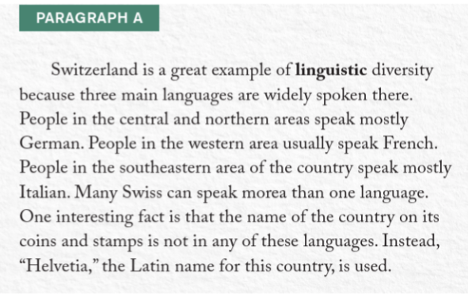
Read the following two paragraphs on Switzerland from Folse and Pugh (2020):
Paragraph A
Paragraph B
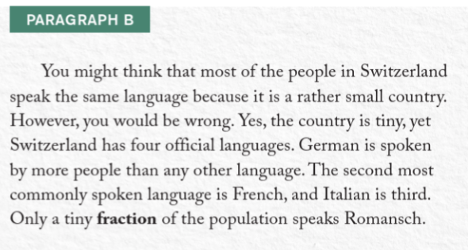
The following two paragraphs have been synthesized using the information from Paragraph A and B. Which of these do you feel is a better synthesized paragraph and why?
Paragraph 1
Switzerland is not big, but there are four national languages, the languages in order of usage are: German, French, Italian, and Romansch. Portuguese and Greek are not spoken. People in the western area speak French. People in the southeastern area of the country speak Italian. People in the central and northern areas speak German. One interesting fact is that the name of the country on its coins and stamps is not in any of these languages. Instead, “Helvetia,” the Latin name, is used.
Paragraph 2
Although Switzerland is a small country, several languages are spoken there. In fact, it has four national languages. The most commonly spoken language is German, which is used in the central and northern regions. The second most widely spoken language is French, which is used in the western area of the country. The third is Italian, which is spoken in the southeast. A fourth language, Romansch, is spoken by a small percentage of the population. Ironically, the name for Switzerland on Swiss currency is not in any of these languages. Instead, “Helvetia,” the Latin term for this country, is used.
Paragraph 1
Paragraph 1
- Ideas from both sources present
- Ideas from paragraphs A and B presented separately
- The third sentence is an unrelated idea (Portuguese and Greek)
- Sequence of information is geographic
Paragraph 2
Paragraph 2
- Ideas from both sources present
- Information is woven together; sentences include relevant information from both sources
- The sequence of the information is logical (focused on language)
Your Turn: Test Your Understanding!
Use the information from the above comparison to answer the following questions.
How to Synthesize Your Information
As previously mentioned, synthesizing requires grouping similar information in your own writing to form your own opinions. Synthesis in writing is usually made up of five distinct steps:
- The first step is to always research and read the required materials; this will help you better understand what kind of information currently exists. As you read, it is essential to engage in critical reading. Critical reading refers to a more active form of reading in which the reader approaches the material skeptically and asks the questions of what, how, and why. This type of reading is done with a purpose in mind.
- After reading the materials critically, you should consider which information is relevant to your topic from each of your resources. At this point in time, it is helpful to take notes about key ideas that are related to your topic
- Once you have critically read your articles and taken some notes, consider how these ideas can be grouped together. Do the authors agree or disagree? Do some authors elaborate on ideas presented elsewhere? Have any patterns or trends emerged from your reading? Can you find any common themes?
- Using your skills of paraphrasing, combine these ideas into well-structured sentences. Your synthesized information should include the original ideas of the authors in your own word and should be properly cited. Use transitional words and phrases to demonstrate the connection between ideas.
- Finally, organize your new synthesized sentences in your writing while incorporating your analysis; this is when you can include new ideas that resulted from your research as well as your opinion on the importance of the information.
Your Turn: Test Your Understanding!
Use the above information to answer the following questions.
Additonal Resources
See the below list of links for additional support:
- How to Synthesize Information from Multiple Sources
- Guide to Synthesis Essays: How to Write a Synthesis Essay
- Synthesizing Sources
If you would like to talk any of this through then we look forward to talking to you. Book an appointment!
References
Folse, K.S., & Pugh, T. (2020). Great writing 5: From great essays to research papers. National Geographic.