Welcome!
Welcome to the Learning Commons Quick Start Guide on how to master the use of apostrophes!
While a small piece of punctuation, apostrophes have the power to shorten sentences and change the meaning of the ideas. This Guide will explain:
- What are apostrophes
- When to use apostrophes
- When not use apostrophes
Apostrophes 101
Course Information
Course Level: Beginner
Time to Complete: <10 mins
Perfect for: Students in WRTG100/101, ENGL103, or anyone who needs a refresher.
Guide Creator: Emily Keery
This video introduces the main uses of apostrophes:
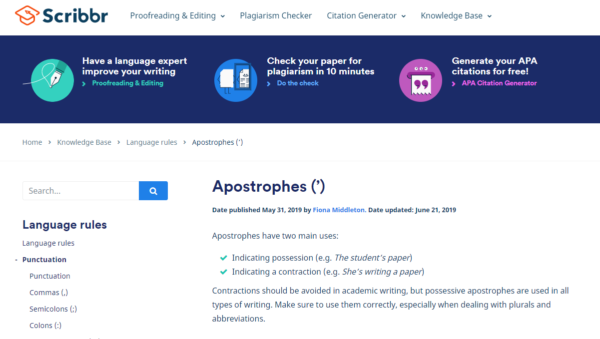
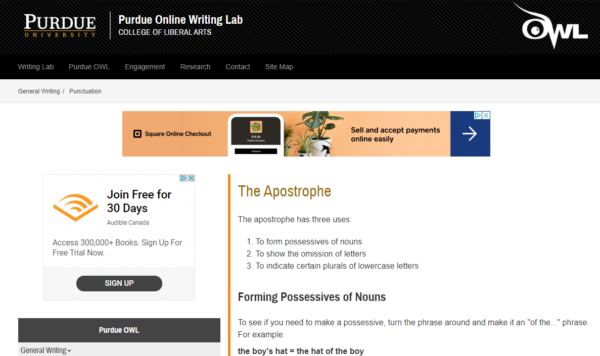
- Possessives (ownership or belonging)
- Contraction (omission of letters).
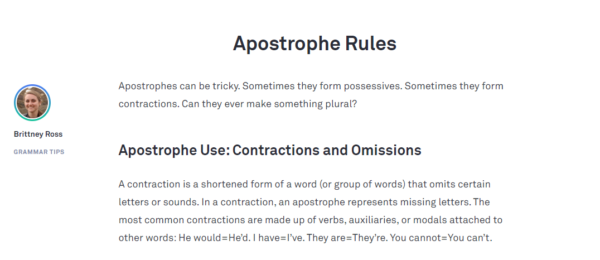
- Plurals
In this mini-course we explore this in more detail:
- Possessives
- Dates and Plurals of Lowercase Letters
- Omission of Letters
Topic 1: Possessives
There are two different types of possessives that we’re going to look at today: Possessive Nouns and Possessive Pronouns.
Add an apostrophe to express possession. This shows the relationship between the first and second noun is one of belonging or ownership.
Singular Noun (‘s)
- Jacob‘s ladder
- Thomas‘s doubt (Thomas‘ is also technically correct, but MLA/APA prefers ‘s.)
Plural Noun (‘s)
- The men’s dinner
- Girls’ lunch
Joint
- Sam and Sally’s children (They have the same children.)
- Sam’s children and Beth’s children (They have different children.)
These do NOT use apostrophes.
- Yours, His, Hers, Theirs
- Examples: His friends said the money was theirs. Are the shoes yours?
Tip: Be sure to understand the difference between “It is” as a contraction and “its” the possessive pronoun for “it.”
- Its engine is overheated. (Possessive)
- It’s a great day for a drive. (Contraction)
Your Turn: Test Your Understanding
Think you’ve got a good grasp on how to use possessive pronouns? Test yourself!
Topic 2: Dates and Plurals
Apostrophes are also used to shorten dates to refer to a specific year or set of years (ex. the ‘20s). If you are referring to specific letters in the alphabet, an apostrophe is required (ex. Mind your p’s and q’s).
Dates
The 1960s were eventful.
The culture of the ‘60s incited change.
How will the 1920s compare to the 2020s?
My favourite decade was the ’20s.
Lowercase Letters
I find it hard to write q‘s.
My program requires me to have A‘s and B‘s.
Your Turn: Test Your Understanding
Think you’ve got a good grasp on how to use possessive pronouns? Test yourself!
Topic 3: Omission of Letters: Use an Apostrophe to Create Contractions
Contractions are the most common type of apostrophe that you will use in daily life (ex. I’m frustrated by autocorrect.). The apostrophe stands in for missing letters to allow you to shorten and combine common word sets. However, in academic writing, you avoid the use of contractions and spell everything out (ex. I am frustrated by autocorrect.). For this reason, you will need to be able to find contractions in your writing and write out the words in full.
I don't want to confuse you.
I do not want to confuse you.
I'd like to come to campus tomorrow.
I would like to come to campus tomorrow.
Your Turn: Test Your Understanding
Think you’ve got a good grasp on how to use possessive pronouns? Test yourself!
Wrap-up and self-check
Congratulations!
Now, return to the Learning Commons Resource Moodle and do the exit quiz to confirm your new knowledge!
Additional Resources
See the below list of handouts and links for additional support.