Reading Response: A Christian Perspective on Art
Art as Mimesis
this part tells the story of art as a mirror of the real world, and the task of the artist is to create works that are as close to an exact replica of reality as possible. This is the embodiment of “Art as Mimesis”. Dr. Erica Green asserts that this view derives from Greek philosophy, particularly the works of Plato and Aristotle. This idea was important during the Renaissance, when painters prioritized accurate depictions of their surroundings. She also believes that while using art as a model has its limits, it can be effective in some cases. For example, it may discourage artists from attempting more abstract or symbolic art forms and instead force them to create only realistic images. Moreover, because it implies that the physical world is the only reality, it ignores the spiritual world, which can be a hindrance to Christians. as a Christian I believe that Art as Mimesis can indeed glorify God.
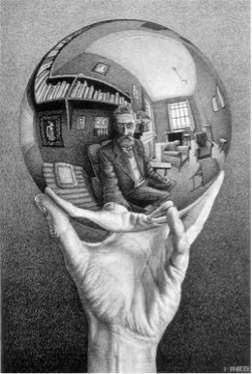 Hand with Reflecting Sphere
“Hand with Reflecting Sphere, also known as Self-Portrait in Spherical Mirror, is a lithograph by Dutch artist M. C. Escher, first printed in January 1935. The piece depicts a hand holding a reflective sphere. In the reflection, most of the room around Escher can be seen, and the hand holding the sphere is revealed to be Escher’s”(Wikipedia, 2022).
Art as Form
Dr. Erica Grimm examines the elements in “Art as Form” , such as line, colour, and composition, in the section titled “Art as Form.” She thinks that these formal components contribute to the content of the artwork itself and are not merely ornamental. From a Christian viewpoint, these formal components can aid us in comprehending and appreciating the order and beauty of God’s creation. She also emphasises how we may interact with the spiritual components of the universe through the formal aspects of art. She had the opinion that art had the ability to illuminate the hidden truths of the universe, such as the sublime beauty of God. Christians may strengthen their spiritual life and establish a connection with God by connecting with the tangible aspects of art. Dr. Erica Grimm also thinks that art’s formal qualities, in addition to its spiritual component, may aid us in addressing significant ethical and societal problems. For instance, art may assist us in exploring complicated subjects in a way that is both understandable and interesting by employing form to transmit meaning. According to her, Christians ought to embrace this perspective on art as a potent tool for social and political participation.
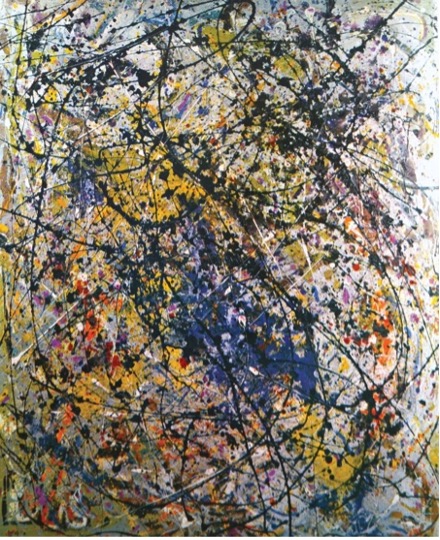
Reflection of the Big Dipper, paint on canvas by Jackson Pollock, 1947; in the Stedelijk Museum, Amsterdam.
https://www.britannica.com/topic/philosophy-of-art/Art-as-form
Art as Sign
In “Art as Sign,” Dr. Erica Grimm examines how art acts as a sign or symbol. Even if a piece of art is symbolic or indirect, in her opinion, it may nevertheless communicate vital facts and concepts. From a Christian perspective, religious concepts and ideas may be communicated via art. She makes the point that all art has the capacity to guide us towards the divine, even if certain forms may be more obviously religious than others. The ability of art to communicate on a profound emotional level is what gives it its power as a symbol or representation. Art has the ability to touch our hearts and appeal to our emotions and intuitions. Christians can broaden their knowledge of the outside world and their spiritual connection to God by utilising art as a sign.
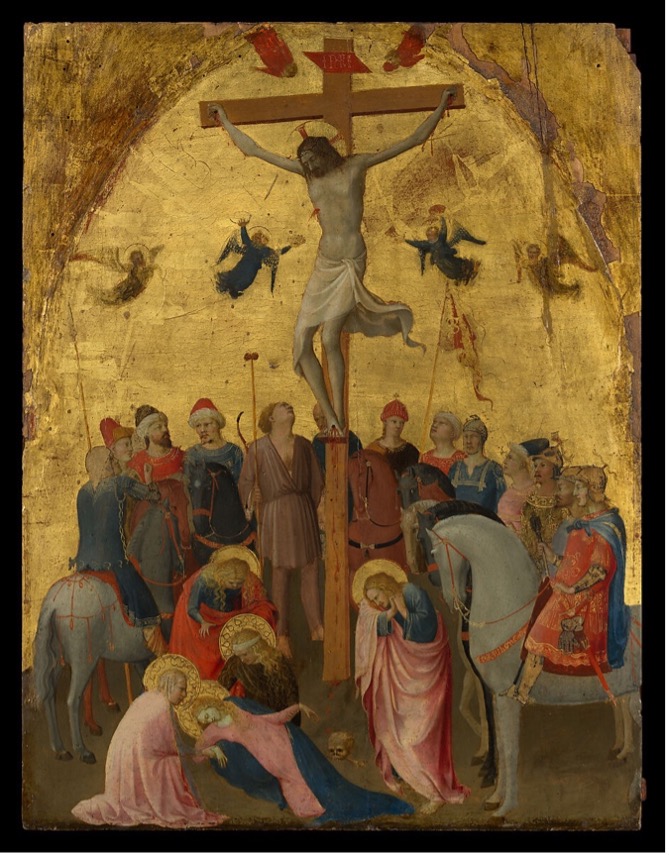 The Crucifixion
Fra Angelico (Guido di Pietro) (Italian, Vicchio di Mugello ca. 1395–1455 Rome)
Date: ca. 1420–23
Credit Line: Maitland F. Griggs Collection, Bequest of Maitland F. Griggs, 1943
Art as Philosophical Inquiry
According to Dr. Erica Grimm, philosophical inquiry may be used to investigate and articulate concepts about the universe and the human experience via art. People can ponder life’s purpose, interpersonal connections, and social challenges by making and interpreting art. Also, art may question our preconceptions and provide fresh ideas. We may comprehend art’s significance and interact with it more deeply if we acknowledge its worth as a method of inquiry. Moreover, using art may help spread awareness of Christian principles and ideals as well as explore and express one’s religion. The church is critical of some artistic genres that go against conventional ideas or ideals, hence the link between art and Christianity is not always clear-cut. Grimm said that although artists may profit from using Religion as a source of inspiration for delving into problems of meaning and purpose, Christians could gain from art by engaging in works that address themes of faith and spirituality.
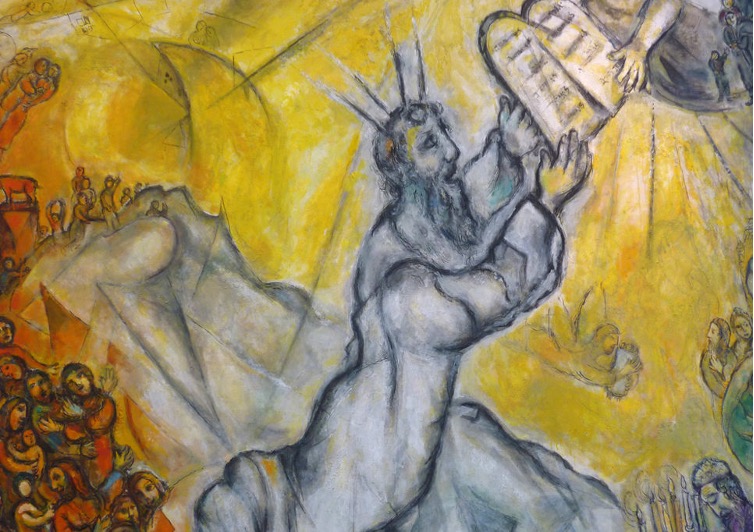 The legal form Moses received was an oil on canvas by the painter Marc Chagall between 1960 and 1966.
It is kept at the Pompidou Centre in Paris.
https://it.wikipedia.org/wiki/Mos%C3%A8_riceve_le_tavole_della_legge
I prefer Art as a Sign, which I think resonates more with me. As a Christian, I hope that art will help Christianity spread more effectively. Also, using art as a sign might give it a more original and enigmatic expression, which could make viewers feel closer to the artist. Another reason is that, in my opinion, the significance of art as a sign depends not only on the particular spectator but also on their own experiences and viewpoints. The audience is freer to explore and interpret the artworks, thus interacting and communicating with them on a deeper level. When the audience is invited to develop their own interpretations and meanings for the work, this enables a higher level of engagement in and contact with the artwork. According to Art as a Sign, art frequently serves as both a representation of reality and a symbol for it. The concept acknowledges the ability of art to transcend the constraints of textual communication and communicate complex thoughts and feelings. So the audience can experience the meaning inside through the signs expressed in these arts. I think it’s interesting that this is more visceral than superficial art.
References
Wikimedia Foundation. (2022, November 19). Hand with reflecting sphere. Wikipedia. Retrieved February 28, 2023, from https://en.wikipedia.org/wiki/Hand_with_Reflecting_Sphere