Body of Work
Developing a mature, professional, self-directed body of work forms the heart of the course. During the second half of the semester students extend their material semiotic research, informed by their visual cultural research, into in-depth projects geared towards their senior studio exhibition.
Art/Design Extended Project(s)
This semester you will begin work on a body of work for presentation at the Senior Studio exhibition in April 2024. As this project is self-directed and research-led it may take various forms: a series of smaller works, a large installation, an animation, a design project etc. Expect to invest 60-100 hours on this project this semester.
Project Plan
Prior to commencing work on the Extended Project learners will present a Project Plan to the instructor during the Mid-Term review meetings. The project plan gives a bird’s eye overview of the project, segments work into phases and sets realistic, achievable goals for completing the project within the semester.
More on the Extended Project
Through this year-long course you will create a series that responds to a research question or develops a line of inquiry. Think of the body of work as a series of works that explore a single idea or question.
You should finish this course with a body of art/design work with which you could apply for a solo exhibition, build your design portfolio or apply to graduate school programs. The work you create for this class should exceed what will fit in your senior show in the spring.
This course is not media-specific. Project may take the form of any contemporary art/design practice, including but not limited to: speculative or critical design, animation, video, performance, socially engaged art, installation, site-specific work etc. It is possible that the work you create for this course is not suited to a gallery exhibition context. You may create a mural, a public artwork, a site-specific work or a performance for which the gallery is not the appropriate venue. In this case discuss with the instructor.
Document your progress each week and upload it to your blog. If there are things you have been doing that are “invisible” like research, shopping, failed attempts etc. record these on your blog as well. This helps me assess your investment and progress on your project.
Assessment:
- FORMAL ELEMENTS: elements of art, principles of design, material sensitivity, craft
- CONTENT/CONCEPT: originality, complexity, evidence of research, engagement with contemporary art/design discourse
- FORM/CONTENT RELATIONSHIP: form strengthens concept/concept strengthens form
- INVESTMENT: commitment to project, investment of time and effort, quantity and scale of work
- RISK: work demonstrates risk-taking in media, concept or process, moves beyond comfort zone
Artist Statement
Blog Categories: sr-studio, statement
Write a statement that folds in research, theory, process and other significant content. Think of your statement as an additional entry point to your work. Artist statements can take many forms– discursive, narrative, poetic. Each statement is a custom job. The nature of your work as well as your given audience will determine the kind of language that is appropriate for a particular statement.
See the RESOURCE page Writing About Your Work for a statement writing exercise.
A good artist statement will:
- Help the viewer understand why you made the work and why the work matters
- Give the viewer key information or context to help her engage the work
- Help the viewer connect the formal and material choices with the meaning of the work
- Make direct connections to the images the viewer is seeing (your statement is unsuccessful if it doesn’t seem to have anything to do with the work)
- Make reference to specific elements of the work (images, formal elements, materials etc.)
- Discuss the visual or conceptual strategies you are using
- Give the viewer insight into the creation process (if it is significant to the meaning of the work)
Assessment:
- Statement is clearly written
- Grammar, punctuation and spelling are correct
- Language used in the statement is appropriate to the content of the work (form/content)
- Statement includes appropriate information about process, research, theory
- Awareness of audience: statement acts as an additional entry point to the work
Photo Documentation
Photo-documentation of your whole series of extended Art/Design Projects.
Documentation should be taken on a good quality camera with adequate lighting. When in doubt, aime for more light than less. If your work is very textural you may want to use a directional light (from the side) to bring out the texture. Otherwise, it’s good practice to keep light even.
Documentation will be assessed based on professionalism, how faithfully it “documents” your work and technical elements like exposure, lighting, white balance, focus and resolution.
Documentation should include:
- Documentation of individual works Document each work on its own. These photos should be taken straight on on a neutral background with even lighting. The goal for these images is a faithful representation of the work (detail, colour, materials etc.)
- Installation shots should capture the scale of the work, how the work exists in space, how the viewer interacts with it and how it relates to the other works. In most cases you will photograph the work installed in your final review. Include:
- Multiple angles of the work to help capture a sense of the whole
- Photos that include a viewer (to give a sense of scale and interactivity)
- neutral clothing
- facing away from the camera
- Detail shots capture surface, texture, materiality and detail of the work. You may take these photos straight on or at an angle to capture the texture of the work. These kind of images are also useful for promoting your work on social media.
- If your work is time-based (video, installation, animation, performance) your work will need to be documented in still images and video. You will also need to focus on getting more installation shots.
Assessment:
- Individual Shots: Comprehensive documentation of all works created over the course of the semester (Process and Art/Design Projects)
- Installation and Detail Shots: Both installation and details shots are captured and give the viewer an excellent grasp of the work and how it is installed in space.
- Exposure, Lighting, White balance: Lighting is even, exposure is correct, colour is accurate. Overall images are clean. Edited as necessary.
- Focus and Resolution: Images are in focus, represent detail accurately, images are high resolution.
Photo/Video Documentation Rubric

Final Portfolio Review
This review will take place during the final exam period. Student work will be reviewed by a panel made up of the instructor and several TWU faculty members. Students will prepare their work for review by the panel as if preparing for an exhibition. Create an experience for the viewer that is as close to the gallery exhibition experience as possible.
How to Prepare for Your Final Review:
- PLAN:
- Select a space that can accommodate your work comfortably, avoid squishing your work into a space that is too small. You may choose a classroom, the portable or some other space.
- Consider how you will install the work in the space. What materials, hardware, technology etc. will you need?
- Consider what work to include and what to exclude. Is it important to show your process work? Would including work from another course give some context?
- INSTALL:
- Install your work as professionally as possible given your context. Make sure the space you are working in is clear of distracting elements so the viewers can appreciate your work without visual interference.
- REFLECT:
- Take 10-20 mins before your critique to reflect on your work prior to your critique. See UNIT 9 suggestions for receiving and assimilating feedback
- PRESENT:
- Provide each of the reviewers with a copy of your artist statement and your bibliography resources. If you send these to me by 11am the morning of the final I will print them for you.
- My suggestion for format is:
- Share your artist statement (or an excerpt if it’s very long)
- Share any other information that you think would be useful to the reviewers
- Invite questions from the reviewers
- Take some time before your review to consider the flow of the conversation, what you want to talk about particularly and what questions you would like to pose to the reviewers?
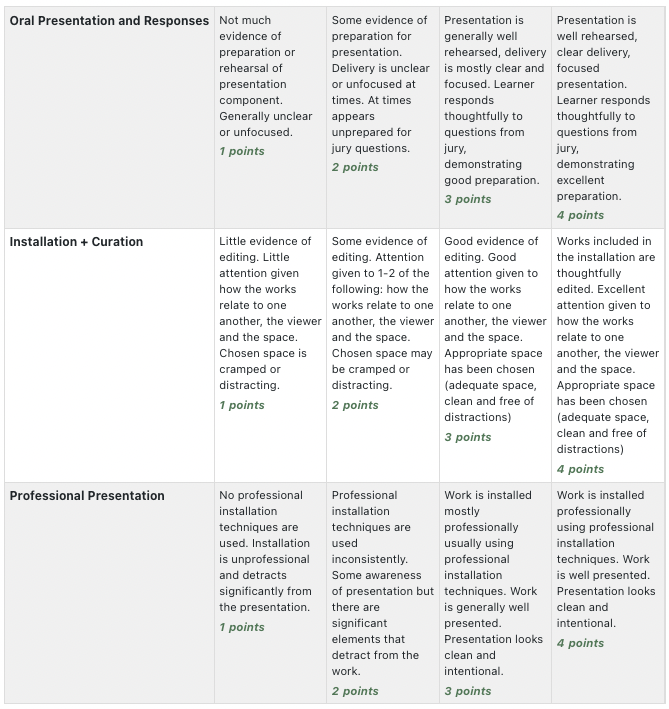
Assessment:
- Oral Presentation: Presentation is well rehearsed, clear deliver, focused. Learner responds thoughtfully to reviewer questions demonstrating thoughtful preparation.
- Installation + Curation: Works included in the installation are thoughtfully edited. Excellent attention given to how works relate to one another, the viewer and the space. Appropriate space has been chosen.
- Professional Presentation: Work is installed professionally using professional installation techniques. Presentation looks clean and intentional.
Final Review Rubric