
Schools can no longer function efficiently without a systems-thinking approach to the many complexities of the daily responsibility for educating future citizens. As the educational demands have increased, so has the need for more effective and diversified leadership approaches. Mental health issues in our classrooms, new wholesale curricular changes without structure, and transitioning leadership bring about a high degree of stress and disengagement from followers.
The Current Situation
My present work environment lacks a developed team approach in many areas and operates with weak systems. I hesitate to say it has no systems and is without any teams since some teachers continue to work together as they did before my arrival four years ago. Our current leader has a micro-managing top-down approach and seems particularly antagonistic this year which is causing people to limit involvement in the broader school-wide activities; isolation in classrooms is becoming very common again. Trust is needed so that each team—grade group, primary/intermediate, teachers and educational assistants (EAs), leader/follower—can control its own destiny and operate with the most freedom and the best speed of execution for that team (Galbraith, 2014, p. 97).
Zeeman’s presentation of “Senge’s Five Disciplines of Learning Organizations” (2017) reveal many missing elements in my current work environment. Shared Vision and Team Learning are two that seem particularly lacking and impactful at every level of our organization. If systems thinking is interrelated, we need to focus on long-term growth for our school community; since everything in a systems-thinking model is interconnected, it does not really matter where we begin to make those changes (Zeeman, 2017, para. 9).
Shared Vision
Our leader’s personal vision for our school is impeding the development of a shared vision. Since principals in our district are reassigned every five years, they seem to want to make a statement about their leadership in each school they govern. What the staff feel are necessary changes to make or what will most effectively meet the needs of the students can often take a suburban-sized back seat to the dictates of the principal. When people are not consulted, invited in, considered, or at times even ridiculed for their personal approaches, there is politeness but little buy-in to the leader’s initiatives. Work is challenging, and relationships are crumbling. If we could focus on pertinent data, we could devise more immediate plans to achieve our long-term goals (Hughes, Beatty, & Dinwoodie, 2014, p. 207).
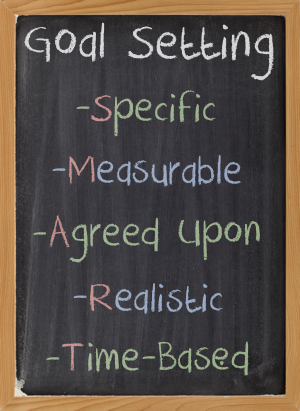
SMART goal setting includes everyone in the process (Haughney, 2014)
Inconsistent visioning is a bottle-neck to our school growth. We have such a range of staff with various years of experience all willing to work together, but we must fit into one model which isn’t working. We need to mentor one another and learn from one another to tie together all the wisdom for effective functioning. As Atha reiterates, “The smallest changes can produce large results; to the positive or negative” (2018, p. 5). “If your employees don’t have a sense of ownership, nothing truly great can occur” (Lepsinger, 2010, p. 14).
Team Learning
If we are to develop stronger team dynamics, our school will need to focus on authentic team learning (Zeeman, 2017, para. 7). This will provide the platform for the discipline of personal mastery to move toward our shared vision. Team members need to set aside some of their individualism to become a more fully integrated team member. My current organization has a large gap between the vision for our school and the current reality. We need to change how we are doing our work (Lepsinger, 2010, p. 37) so that we can create a balance between our short-term and long-term goals and develop a better team climate (Hughes et al., 2014, p. 215).
A balanced school team (Hastings, 2014)
A Better Vision
Some years ago my current school district brought in the Dufours to educate us on Professional Learning Communities (PLC). They inspired and made school teams seems possible and necessary for student success and for teachers to strengthen each other through team planning. “As educators develop their capacity to function as a PLC, they create a culture that stretches the hopes, aspirations, and performance of students and adults alike” (DuFour et al., 2004, p. 179). Schools of every level are under intense scrutiny and enormous accountability to educate future citizens and decision-makers. “Schools do not operate in a vacuum—they must serve the public” (DuFour & Eaker, 1998, p. 158). DuFour and Eaker promoted the development of mission, vision, and value so that each school can function as a team (DuFour & Eaker, 1998, p. 25). Creating a professional learning community within each school began to take shape, and then the logistics of releasing teachers to work together became too complicated, and there was no money to put towards team development. Just another great opportunity to make changes in a tired and work out system set aside for something more comfortable.
How can changes become necessary enough to maintain and nurture through the painful growing process? Growth necessitates change and is a sign of life. Atha encourages us not to lose hope when the system needs changing but is unable to handle the pressure of change (2018, p. 7). Finding the right options can happen through perseverance while keeping our focus on the long-term goals. Run the race that is before us. (Hebrews 12:1-3)
References
Atha, D. (2018). A systems-thinking primer: Seeing organizations in action. [Course learning activity 3.1]. Retrieved from https://create.twu.ca/ldrs501/unit-3-learning-activities/
DuFour, R., and Eaker, R. (1998). Professional learning communities: Best practices for enhancing student achievement. Bloomington, IN: Solution Tree.
DuFour, R., DuFour, R., Eaker, R., and Karhanek, G. (2004). Whatever it takes: How professional learning communities respond when kids don’t learn. Bloomington, IN: solution Tree.
Hastings, W. (2014). Image retrieved from http://waynehastings.blogs.com/.a/6a00d83451b74169e201156f930ac6970b-pi
Haughey, D. (2014). Smart goals. Retrieved from [October 17, 2018] https://www.projectsmart.co.uk/smart-goals.php
Hughes, R., Beatty, K., and Dinwoodie, D. (2014). Becoming a strategic leader: Your role in your organization’s enduring success. San Francisco, CA: Jossey-Bass.
Lepsinger, R. (2010). Closing the execution gap: How great leaders and their companies get results. San Francisco, CA: John Wiley & Sons.
Ungerer, M., Ungerer, G., and Herholdt, J. (2016). Navigating strategic possibilities: Strategy formulation and execution practices to flourish. Randburg: KR Publishing. Retrieved from
