by Mark Sprinkle
It is sometimes said that artists “lose control” of the meaning of their art once it moves beyond the studio into the public realm of the gallery. Indeed, the postmodern truism that all meaning is conditional and context-dependent seems especially applicable to non-verbal works that are, therefore, especially prone to being re-appropriated and filled with new meanings by each viewer. In response, many artists opt for remaining aloof from such negotiation, claiming either to be the sole source of meaning or, conversely, disavowing any interest in the process of signification once the painting leaves the studio or gallery. Both of these positions, however, accede to the idea that the artist/viewer relationship is one of profound separation and distance, rather than part of an integrated whole—that artistic “genesis” is a solitary, one-off event, whatever befalls the work of art once it enters the world.
To the contrary, this article outlines an ecological or evolutionary model of artistic genesis that does not simplify or denigrate the role of the original act of creation, but nevertheless presents the ways that the richness of a work of art develops progressively, within complex social relationships that include—but do not end with—the artist, and drawing attention to the way that the relationships of influence between artist and patron or buyer are and should be multi-directional. Based on a decade of ethnographic research and many additional years of my own practice as a professional painter, I suggest that the ability of paintings and other tangible works of art to help fix and recall personal, family, and cultural identity is most powerful when such signs are grounded in the physical context of daily life, the richness of meaning only fully realized as a collaboration between the artist and those who “make it their own” on an on-going basis, and in specific physical spaces.
The “ecology of signs” of the title, then, is the household, something I began investigating as an interesting and important context for art while researching alternative market spaces and strategies for artists working in the Atlanta, Georgia area in the mid-1990s.1 Since then I have been looking at the way the domestic space, rather than the gallery or museum, is the organizing context for similar artistic markets in other regions, as well. From the home studios where most of the art is made, to the home and quasi-home-like commercial spaces where it is shown and sold, and back to the private professional class houses in which it is re-integrated, “home” is both the practical and symbolic landscape in which art is understood. Furthermore, the ideology of art and artistic identity that drives this market bears attention as well, as it seems not primarily interested in the major theme of gallery-oriented art culture: that is, self-expression with regards to continuity or rupture with the art-historical narrative of Modernism.
I began to explore these issues by spending several years talking and listening and looking intently at both public and private spaces where art was displayed, in order to understand what the values and—just as importantly—the physical practices of this world were and are. How are the particular artworks that are found in it adapted to its specific character? How do they also reflect the social and interpersonal relations of the people that work and live in these spaces? The works and settings I describe below carry specific cultural markers of race and class, gender and even region, for a central goal of my original project was to understand how those features, rolled into the term “decorative” contribute to the dismissal of this art and these people as being beyond the pale of real, serious, meaningful creative work. My own case studies make it clear that art that seems easy to include in a domestic setting, especially when made by artists who have subordinated their careers to domestic and family roles along the way, is assumed to lack aesthetic depth. And, indeed, that such attitudes about art for and in the home are widespread is suggested by the terse statement of cultural hierarchy given in Figure 1, below, taken from a roadside billboard advertising an art and frame shop in Georgia. But teasing apart specific practices and places from the values others suppose must go with them is a complicated task, requiring that some common assumptions about both art and the home be put aside.

To that end, sociologists have attempted to survey the kind of artworks found in homes across different communities in a single region (Halle 1993), and to theorize the way objects in the home contribute to a sense of personal identity (Csikszentmihalyi and Rochberg-Halton 1981), and even to document such ideological issues as the “cultural cringe” that accompanies art-making in regions away from recognized cultural centers, especially by women (Plattner 1996). But what has been missing is a synthesis between the way artworks remain objects like any other in the home, and the way the cultural category of “art” sets them apart and enables them to do the complicated work of connecting the range of things and spaces and people in the home with each other, but also with the wider world of cultural symbols and practices outside. In short, my task remains establishing not whether art ought to “go with the sofa,” but understanding how it goes with the sofa yet still remains “art.”2
During this research and interpretive project I also discovered something that eventually led me to move from academic and museum work to being a full-time painter: this market provides a specific model for art and artists being integrated into a wider community than one made up mostly of other artists, while also being recognized as providing specific and important values to the community as artists. I rediscovered that social, personal, and even spiritual integration was the central aim of the domestic spaces I studied, and facilitating that experience of rich identity formation was one of the key roles of art and artists in the market, alongside and in concert with their basic attention to craft and the environment of things.
It was and is the common understanding between artists and others of the way artworks are experienced in homes that made their collaboration in the Atlanta market so successful, so here I’ll be outlining some essential practices of domestic painting. Centrally, I’ll describe what I’ve called intuitive vision3 for the way it includes both sight and a sort of “common sense” of how art relates to the phenomenology of living spaces, which in turn contribute to the formation and continuity of personal, family and community identities. In some respects I’m merely putting a new theoretical gloss on very traditional ways of interacting with artworks, so as I describe how paintings relate to these home spaces (and especially how people relate to each other through these works of art) the reader will likely recognize practices and habits from his or her own life, even if some of the specific style of images and environments pictured seem terribly quaint or sentimental, or unapologetically bourgeois. Finally, I’ll very briefly outline my sense of the hopefulness of this understanding and describe how I have tried to translate what I learned about the reconciling and connecting role of art and artists into my own artistic practice, especially with regards to my Christian faith, mainly by re-imagining art-making in terms of service and gift rather than autonomous creation.
Intuitive Vision
Before outlining the three main characteristics that describe the way that artworks are experienced in the domestic context, a brief account of intuitive vision’s more well-documented alternative is in order, as this other “mode of seeing” is the dominant and ever more-pervasive visual regime of the contemporary postmodern West. Taken for a way of knowing, really, the way we are accustomed to interacting with our contemporary visual culture presupposes the dominance of sight in the process of making the world intelligible to ourselves, and its variants include the formal order of linear perspective, what feminist film critic Laura Mulvey has described as the “logic of the gaze,” and the way that our current consumer economy seems to be predicated on an endless supply of images of new products and ever-changing visual brands and logos. Put another way, it moves us beyond “seeing is believing,” to “seeing is knowing,” and perhaps even “seeing is owning.”4
Art and cultural historians T. J. Clark (1984) and Griselda Pollock (1988) provide important models of the relationship between the visual and lived regimes of modernism (and now postmodernism) in their studies of the Parisian flâneur and French painting, describing how understanding the bourgeois male gaze implicit in many artworks of that period depends on tracing patterns of movement by individuals through social space of the 19th-century city. In that visual regime, the body served primarily to transport the man’s literal “wandering eye” to places where the products of a newly-industrialized economy and, especially, the bodies of women were made available for his consumption. The flâneur’s visual forays into public space were marked by the anonymity of himself and his gaze, but there was still the necessity of his physical presence.
Today, the “possession-by-seeing” aspect of modern culture is only more pervasive, and technology has made it possible for viewers to have both consumer products and women’s bodies displayed to them from positions of near-perfect anonymity, and without the necessity for any presence at all in the same physical space as the objects of their gaze. Indeed, even when we look at the more innocuous example of household scenes presented to us in magazines, books and websites about home decorating and architecture, we tend to assume that the meaning of the artworks and spaces depicted there are available to us via such dominant, primarily visual means as photographic and digital reproduction. In short, the postmodern gaze posits a mastering eye/I that stands apart from, dissects, consumes (and finally abstracts) physical space, objects, and even people—a visual relationship with the world epitomized by the incessant drive to have everything and everyone projected or displayed on a screen.
In continuity with modern visual practice and contrast with postmodern practice, the domestic mode of seeing I describe here as “intuitive vision” locates meaning in the relationships implied between the body, eyes, spaces, and identity of the viewer. It does not imply a stationary, order-imposing and possessive eye, but a body in motion, responding in many small ways to the successive instances, spaces, and objects presented to it along its course of movement through familiar rooms. This second mode restores the faculty of sight to its organic (though still privileged) place within the community of the senses within the body, helping the body itself understand its place in the lived environment. And unlike both modernism and postmodernism, this mode is keyed to reduce anonymity rather than facilitate it.
In what follows, I will describe the embodied ways in which art becomes enmeshed in the physical and symbolic context of domestic space in order to make identity visible—the way the intuitive mode of vision is invested in and invoked by particular objects (e.g., artworks) that serve as aids in navigating intimate cultural space by representing to the mind patterned experiences of the places of daily living, especially the particular and peculiar combinations of passage through and lingering in that mark life ‘at home.’
Quotidianeity
“Everyday” objects and habits like brushing your teeth before bed, or having a cup of coffee in the morning may be inconsequential when considered alone, but often seem fundamental in the context of a person’s “way of life.” Similarly, I use the term quotidianeity to describe how mundane-seeming artworks are valorized by being woven into the fabric of daily patterns, but also how the aesthetic autonomy of artworks as understood in traditional art-historical systems is subordinated to the lived aesthetic emerging from the everyday practice of domesticity. Whether a post-card is ennobled or a masterpiece humbled, in both cases artwork serves practical, quotidian identity.
Several factors may contribute to the valorization of an otherwise commonplace object. For one, such works are seldom without some pre-existing meaning and relational value, as an art-themed note-card may be kept because of the sentiment expressed inside, or a child’s drawing may be valued as a marker of the child’s personality at that stage in life more than because of technical skill demonstrated in its execution. This is the ever-present subjective quality I describe below. Nevertheless, weaving such ordinary aesthetic objects into the home so that they do real emotional work on an ongoing basis usually begins with the act of putting them in physical frames, and is completed by placing them in an experiential one: integrating them into the patterns of movement through the house, such that passing by them becomes part of the regular experience of living there. This is quintessentially true when both the works and the repetitive encounters occur in and are scaled to intimate spaces where the basic cyclical functions of life happen—kitchens, bathrooms, bedrooms, and even the small hallways that link them.
The valorizing effect of framing children’s artwork or even mass-produced graphic designs does have parallels in the long history of elevating the mundane or vulgar as “art” in avant-garde culture, whether the point is to lampoon hierarchies of art culture (as with Duchamp), or to critique either bourgeois propriety or consumer culture (as with Warhol). But while all these instances reinforce the idea that the attention of an artist imbues a thing with additional meaning, the critical difference between avant-garde strategies and this domestic valorization is that the latter lacks the ironic intent of the former. Instead of rendering objects into a kind of speech-act, the lavishing of attention on common things that occurs in the home helps the objects “take their place in the community of order” of the home, as Gaston Bachelard has said.5
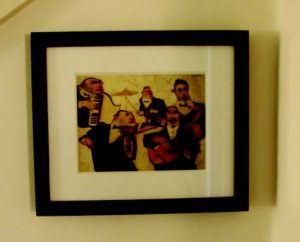
One example is the postcard shown [Figure 2] advertising an exhibition at a local art gallery, framed as “an unexpected gift” to the owner of the house by the gallery owner.6 The relationship between the two did not depend on a common love of art or even a visit to the exhibition advertised, but on a third person—one of the resident’s co-workers, who was at the time of the gift the gallery owner’s girlfriend. The gift was in response to several visits by the gallery owner to his girlfriend’s place of business, during which he saw that the owner, Mrs. McGill, liked the picture enough to keep the postcard on her desk. Once received, the framed card was brought home and has been placed in a hallway connecting the kitchen and the dining room of the 1920s-era house [Figure 3]. Bounded on one side by the staircase, the passage is a primary conduit between the informal rear and more formal forward rooms, but it is also on the course usually traced when moving from the kitchen onto the stairway itself and up to the second-floor bedrooms; the space is not the heart of the house, but it is certainly a major artery.
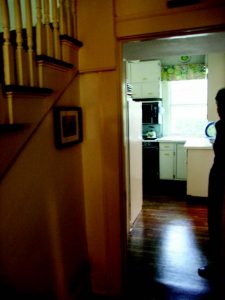
dining room. Mrs. McGill is pictured at the right-hand edge of the photo.
In its new context, the framed postcard enlivens an otherwise mundane (though constantly-used) passage with visual pleasure, but a pleasure that is also inextricable from its role as a reminder of satisfying friendships at work that have spilled into other areas of life, and into the home. Mrs. McGill noted that, “whenever I walk by here, I see it, and it makes me feel good because of my friendship—they’re now married.” 7 Thus, in the daily process of coming and going in the home, this “private” sphere is shot through with connections to the “public” life of the residents, so that what is reinforced is the home’s role as a staging ground for making new connections, rather than as a retreat or refuge from them. Seeing this framed card reminds the residents of the house that their personal identities are inseparable from their roles in forging and encouraging the relationships of others, as with the case of the romance mentioned above.
Quotidianeity works the other way, too, wherein the special attention and value given a “bona fide” artwork are minimized by the way it is practically experienced, and an alternative system for its valuation is substituted in its place. Figure 4 is a landscape by A.E. Backus, an artist with a long and successful career built on his depictions of the south Florida landscape.8 About 20” x 24,” it is nicely framed and lit by a picture light recessed into the ceiling of the family room at the rear of the house.

Contributing to the value placed on it by the resident is the fact that the work is by a “known artist,” here meaning both regionally “famous” and with a personal connection to the owner, Anna Morton who, herself, grew up in Florida. The fact that the resident’s father, recently deceased, was a long-time supporter and collector of his contemporary and contributed to the growth of his professional reputation is also a point of pride for the owner of the painting. Another layer is added to the object’s patina of personal and family history by the fact that this painting was a wedding present from Mrs. Morton’s father, and the then-young couple chose the artwork over a “more practical” and hardly less-expensive air conditioner. When also taking into account that the house in which it is displayed was the home of her parents, and had recently been renovated and inhabited by this second generation, it is easy to understand why the painting literally occupies a special place in the life of the Morton family.9
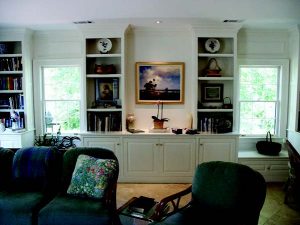
living room.
Yet even as this synergy of public valuation and private meaning would seem to indicate the painting should “command the room,” the daily practice of the space effectively integrates it in a different and—again—familiarized or domesticated way. The chairs in the family room are arranged as a conversational group, oriented more towards each other and even towards a large television on one side of the room than towards this landscape painting. Furthermore, the regular paths of entry and crossing in the room mean that one would never see it head-on when moving into the space. Lit as it usually is, it would rather seem to hover over the shoulders of those coming to or sitting in the room—noticed, but peripherally. Indeed, the layout of the artwork and room intentionally establish a different perspective as the primary way to engage the painting, in which the role of sight seems more equivocal.

At first glance, looking into the family room at the painting while standing at the kitchen sink [Figure 6] appears to restore the work’s visibility to prominence; here you can see that the painting is directly across and in full view of the window. But notice that the window is narrow enough that it excludes a view of the painting for anyone in the kitchen except the person actually standing at the sink; if a person can see the painting from here, she is in the midst of washing dishes, scrubbing vegetables, or getting someone a drink of water. The experience of appreciating the work is contiguous with rather than set apart from the routine chores of daily life. Second, even the specifically optical experience of the long view across the family room that usually privileges an artwork here serves to diminish the painting’s independent stature rather than increase it. Simply put, the distance makes the painting look small. In fact, viewed in context, it appears in scale with the smaller paintings that are most common in markets oriented towards art for inclusion into domestic spaces, and even with the framed family photos on the countertop in front of the sink. The combination of its placement in the physical frame of the room and the regular patterns of use of the family room and kitchen effectively domesticate the artwork’s formal qualities and diminish its claims for autonomy, but not its significance. When one considers that the chairs between the painting and the viewer are often occupied by close friends or members of the house, the painting seems even more like a theatrical backdrop for family scenes viewed and participated in from the kitchen sink. An important memorial symbol itself, the landscape is not the main player, yet provides the context—an allusion to historical and emotional depth—that sets the stage for the interpersonal roles rehearsed daily by those that actually live the room.
An even better analogy for the particular sort of historical, emotional background an artwork can add to the scene is that of a mirror, since a mirror gives a sense of depth (though only as deep as the space it reflects) in which the inhabitants can literally see themselves—an act of “self-reflection” that encompasses all the connotations of that word, both visual and psychological. Through such reflexivity, the room itself is expanded, the new “space” is visually linked to the physical room by the repetition of its shapes and colors as images, and—this is critical—the inhabitants are prompted to a heightened self-awareness of being in both the concrete and the imaged worlds simultaneously. Despite the often-decried superficiality of our visual age, seeing a thing (or oneself) depicted can actually make it seem more real, concrete, and tangible; and while paintings are not literal mirrors, experiencing art according to intuitive vision often evokes precisely this sort of reflexive experience: the artwork re-presents the whole social, interpersonal, practical space of the room in emblematic form, making it concisely available to the viewer. This dynamic reflexivity is at the heart of the visual connections made between artworks and the domestic spaces in which they hang.
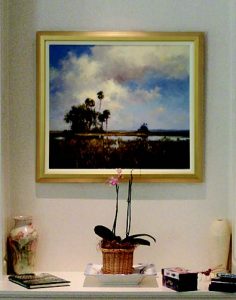
into the pictorial space of the scene, connecting it with the physical space of the “Florida room” where it hangs.
Looking again at the Florida landscape in context again [Figure 5], notice that the stem of the potted orchid that sits on the shelf below mimics the line of the palm trees in the painting, extending up and breaking the framed boundary of the painting, thus linking the pictorial space to the physical space of the room and connecting the scene of the Florida landscape with the “Florida room” in which it hangs. Neither the choice of the tropical orchid, nor its initial placement in front of the painting, nor even the angle to which it was turned were haphazard. All were chosen to bring the space of memory together with the space of current life, such that the care and even formality of this arrangement does not preclude using the countertop as a temporary repository for books, videos and other odds and ends of daily living. The arrangement and room—like the orchid itself—have been cultivated, and also domesticated [Figure 7].
Reflexivity is most clear, however, when what is pictured in art does directly correspond to objects in the same living space, such that the artwork becomes a sign for the relational practices occurring in the space and involving the concrete object pictured. Small still life paintings of blue and white china and other meal and hospitality-related objects dominate this market. But, the small painting almost hidden in Figure 8—though a somewhat unusual example—emphasizes the relational aspects of even this most visual quality of the intuitive mode [Figure 8].

The painting shows the homeowner’s Dachshund and sits in a prime location on the kitchen counter-top, sharing space with bills, car-keys, cell-phone accessories, and a couple of porcelain figurines. When the family is at home and in the kitchen, the dog is nearly always in the room with them, too, such that the owner could easily look from dog to painting and back again. What the painting makes visible—especially to the woman of the house—is not the dog per se, but the woman’s ongoing role as caretaker and nurturer of the dog and of all the other dependent members of the family, a role inscribed especially in this particular space, and amplified by the fact that it was commissioned by the husband and given at Mother’s Day.
Subjectivity
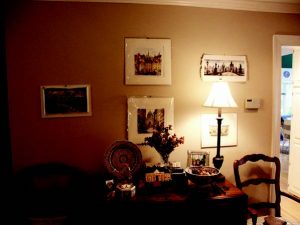
In the context of art in the home environment, Subjectivity means that the physical attributes of artworks are overlain with emotional and memorial associations that pre-exist the placement of the object in the physical context of the house. It also means that both intrinsic qualities of the work (what is pictured, for instance) and its contextualized role are geared to the task of supporting and shaping the residents’ own subjectivity, or identity. The importance of artworks painted or given by family members or friends is an example of this, but a more complex rendering of this dynamic can be found in the common practice of grouping objects, artworks, and photographs in something akin to family shrines, though without the kind of ritualized attention that term implies. These arrangements are tableaux of family history, suggesting the family is a living and changing thing [Figure 9].

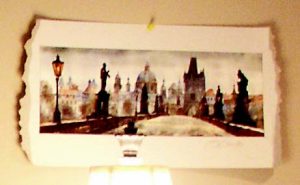
An example of the importance of subjective meanings is a set of five watercolors of Prague, brought back from there by Jill Ratliffe, the owner of one of the homes I visited. The trip was occasioned by her daughter’s participation in a school choral group invited to give performances in the Czech Republic, and Mrs. Ratliffe went as one of several adult chaperones. The paintings are placed to be seen every day on the central thoroughfare of the house, but on a side wall perpendicular to the main public visual axis that runs from the front door to the back of the living room, the view depicted in Figure 10. There is a subtle but significant difference between this off-axis placement and placing works in an out of the way spot, such as the dining room where the family seldom eats, or in a private space, such as the bedroom. These works are meant to be seen, but they are best seen when approached from the direction pictured in Figure 11, as an intimate to the house, coming down the long hallway from the bedroom wing towards the kitchen—just as the family does regularly in the course of daily life, passing the kids’ own framed artworks along the way.
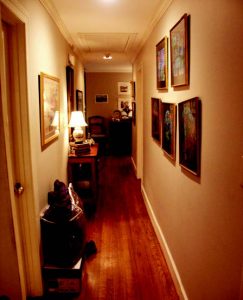
the Czech watercolors (visible at the far end of the hall) and the social center of the house. On the right are framed works by the family’s children.
The Czech paintings themselves are fairly small, so that the pictorial space in them is not readily apparent from any great distance, but must be approached up close to be noticed or understood; from anything beyond a few feet away, they are experienced as a group not just with each other, but also as part of an ensemble that includes the chest of drawers below them and the things sitting on top of the chest.
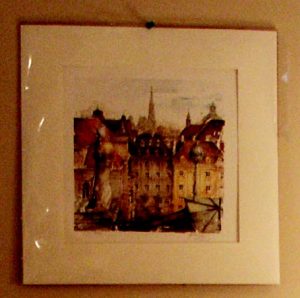
The representational space evoked by this group of paintings isn’t restricted to the physical space of the intersecting hallways, of course; it includes Mrs. Ratliffe’s spatial/relational memory of being in Prague with her daughter, as depicted in the images of the old city. The images themselves are similar to all souvenir paintings meant to evoke memories of travel, usually by picturing the landmark historical buildings or geographical features of the place. But it is important to note that these sites are often depicted more phenomenologically than architecturally, letting the human viewer’s perspective determine the scene [Figures 12, 13, and 14]. These paintings represent the experience of catching glimpses of Prague’s domes up and through the narrow streets of the city, seen between decidedly old-world buildings or across bridges. They are less about the buildings and monuments than “what it was like” to be in Prague. In this case, “what it was like” means specifically “being in Prague with my daughter,” the narrow medieval streets of Prague becoming, through art, a container for the never-past memories associated with the mother and daughter’s relationship.
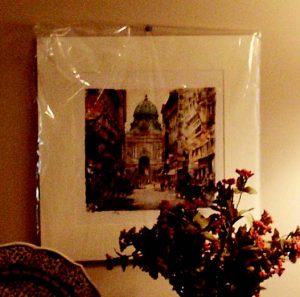

This dynamic of relational memory as subjective filter continues in the objects below the watercolors, which are also memorial in nature, evoking stories that are easily and readily told [Figure 15]. There are two photographs of the elder children at the time of their high-school graduations, a ceramic model of the house’s façade, and a clock inherited from the owner’s grandmother that has been recently “restored,” but that is now over-shiny—rendered “new and improved” rather than “like it was.” Mrs. Ratliffe’s obvious disappointment at how the “restoration” of the clock turned out suggests how important it is that the aesthetic qualities of an object or work correspond to (not to say “match”) its perceived meaning in the domestic context. Yet, though perhaps too brazenly, there is also nevertheless a visual echo between the gold clock and the accents of gold in the paintings, just as there is an echo between the architectural content of the paintings and the ceramic house. These patterns and visual connections are an aspect of reflexivity in the house that link the objects together and with the space of subjectivity.
The ceramic house façade bears more description since it was made as a school art-class assignment by the youngest daughter, just as each of the other Ratliffe children made such models when they were in the same grade as she. Mrs. Ratliffe logically connects this model with the others (already displayed together in another room), not only as an emblem of continuity and connection between her children, but also a marker of their individual subjectivities. The three models together represent the way each child literally and figuratively “sees” their shared home, and the fact that each particular subjectivity in the house is in relationship to the others. Thus, the very shape of this object serves to name the house as the locus where the family identity is negotiated and expressed. Moreover, that the newest one awaits eventual framing and placement with the others but currently remains part of this ensemble, is an indication of the fluidity and changeability, the always in-progress-ness of the house, too. These are not static environments, fixed in time once and for all, but are ecologies of signs. They are constantly changing, being filled with the emotional and physical clutter of living life, and in sharp contrast to the idea of “finished space” or decoration as the projected eye mastering the lived room.10
One more layer is added to this dynamic (as well as a reminder that this is a space for bodies in motion) when a viewer notices the petit-point bell-pull that hangs on the narrow wall directly across from the Czech watercolors, and two more paintings that hang on the bedroom hallway wall, almost on the corner (all visible in Figure 10). Like the Prague watercolors, these paintings were bought in commemoration of family times away from the house: one as a souvenir of a father-son college tour, the other to mark a family trip to the beach. The bell-pull connects several generations of Mrs. Ratliffe’s family because it had belonged to her mother, and had also (although not without some staining from smoke and water) survived a catastrophic fire in the family’s previous house that damaged the clock described above and destroyed nearly every one of the other artworks and pieces of furniture that had already been integrated into the family’s sense of home.
The importance of the few rescued items suggests that the subjective “space” evoked and experienced through these objects, though concretely rooted in the current structure, also contains the space of past homes. While the fire was an arbitrary judge as to which items might be retained by the Ratliffe family, the situation here nevertheless indicates the importance of small, portable objects which are carried from place to place and installed to truly “domesticate” the new home, especially in a culture that is as itinerant as is the contemporary U.S. (The analogy of Aeneas taking up his family lares and penates as he fled burning Troy seems particularly appropriate.)
This domesticating role can certainly be fulfilled by larger works, but small paintings and objects together seem to be more effective in this regard, perhaps because they are reciprocal with the body, can be diffused through the house more effectively, and because many of the pivot points of daily practice provide small spaces and moments which can be enriched by fleeting contact with objects of the past. Large works, by contrast, which require more space not just in terms of a larger piece of wall (over the sofa, over the mantelpiece) but also a greater viewing distance to be fully seen, have until recently seemed more often than not to present challenges for those moving into new houses: “Where are we going to hang that?”11
The combination of objects and images on and above the chest in the Ratliffes’ hallway, whether bought, inherited from or made by current or previous generations of the family, elicits and illustrates a feeling of collectively-lived and resilient family identity, with links both to the past and future; and though separated from it by a few feet, the bell-pull and the two paintings are nevertheless part of that interpersonal tableau, moving the focus of its identity-forming capacity from the periphery to the center of these intersecting hallways and axes of movement. The dynamism of the family’s identity and the resident’s role as Mother and chief cultivator of subjective space is re-activated each time this arrangement of artworks and objects is seen and passed through during the day. This crossroads of the home demonstrates how subjectivity as a component of intuitive vision is a quality of artworks geared for domestic space, but is also the goal and result of experiencing the artworks once they have been integrated into the richly specific arena of the home.
Living Rooms
By now it should be clear that the distinctive way of seeing here is not confined to the strictly visual; that is, the artworks evoke—even amplify—phenomenological space rather than merely pictorial space. To fully grasp how artworks acquire their full symbolic meaning requires that we see paintings and other objects not only in the domestic context, but as they are seen in the domestic context: often obliquely, sometimes in passing, and nearly always in reciprocal relation to the other objects and paths of movement in the house.
As Beck and Woods have argued, the arrangement of belongings within the frame of physical building (walls, doorways, corners) elicits patterns of movement in the home that are key not only to understanding how and what the objects there mean, but how the memory and history of the family is made both active and concrete (thus constantly renewed) through the objects. The juxtaposition of objects in a room produces different sequences in which they may be experienced depending on who is moving from where to where, such that a bit of family history or identity evoked by a particular object may be either amplified or contradicted by the moment of “who we are” evoked by the next object encountered. In their terms, artworks, houseplants and sofas not only “speak’ to the inhabitants (and each other), but do so in differing “tones of voice.”12
Paintings in the home, therefore, are less depictions of space than symbolic extensions of it, or even catalysts for experiencing the household itself as a richly evocative, symbolic, and representational space whose dual nature as both “structure” and “activity” is suggested by the word dwelling. For though we may expect to perceive paintings and the like as primarily visual objects, the mode of vision or way of seeing inherent to artworks conceived of in relation to the household environment (what I have called domestic painting) derives from and represents this embodied experience of inhabiting the terrain of contemporary domesticity of which the artwork is but one part. The eye that looks at paintings in this manner is thus re-integrated with the body in the whole process of daily life, but not at the expense of the works themselves. Artworks and the visual field are nevertheless playing a critical role in the experience of domesticity and identity. Such moments of aesthetic difference lift daily life above the level of mere routine, not because of some purported human need for beauty in the abstract, but because small artworks in this setting evoke and encode associations and memories of and for the inhabitant precisely through their visual qualities, as recognized through the particular visual/spatial habits of the home. Being clearly within and standing for but also standing out from the fabric of daily practice is that which makes these artworks meaningful rather than “merely decorative.”
What I’m describing, then, is a way of simultaneously relating to and producing the symbolically rich space of the home, turning on frequent though brief encounters between the viewer/resident and aesthetic objects that nearly glow with emotional and memorial associations, and that project this identity-illuminating light back into the domestic space, in order to emphasize the status of the home itself as the arena in which relationship (and therefore identity) is lived. Interpersonal relationships are experienced (literally embodied) in the regular patterns of interaction between members of a household. These patterns of seemingly-mundane events around the house, built up over time by the people who live there in the course of their daily interpersonal routines, define the space in which they occur as much as they are contained by that space. Therefore, the physical parameters of the home become synonymous not only with habitual movements and patterns of activity, but with the relational landscape of its inhabitants, as well.
In order to make this connection more tangible, palpable and manipulable, the landscape of identity thus defined is also focused through or invested in objects that represent the fabric of domestic life and identity more efficiently than trying to realize the complex of spaces and habits as a whole. The result is a “triangular dialectic” between space, practice, and aesthetic objects, in which each element is reflexive—mutually-defining and mutually-referential with the others, quotidian—having its meaning in repeated, everyday encounters (and also seeming otherwise common or ordinary), and subjective—the meaning of each space, practice, and object is dependent and even subordinated to the relational identity of the primary subject(s) of the space, expressed as its particular domesticity. 13
Artists and Integration
The role of the artist comes back to the fore when we recognize that art objects don’t only become part of the structural space and spatial practice of the home, they enlarge it. As aesthetic objects carry the distinctive meanings encoded by their makers in addition to the emotional and relational meanings of the owners, they enrich and expand the symbolic environment in which they are placed. Indeed, they expand the vocabulary with which identity is expressed. And that means that even in this most personal and allegedly “private” environment, there is room and need for engagement with community outside the home, especially with those of us who are particularly attuned by gift and discipline to the way image, symbol, and metaphor can stand for abstract ideas and experiences. It also suggests that the role of the artist is one that carries with it a responsibility to create work that is symbolically and aesthetically rich enough to facilitate this kind of expansion of possibility.
Yet the converse, is true, too: since artworks become part of domestic systems and are essentially re-created not once but many times in the life of a household, artworks fit most easily and richly into a scheme of meaning when the artist shares, or is at least familiar with, the culture of the art buyer. Artist and buyer need not be in precisely the same world, but an active engagement between the two creates a more natural synergy in this meaning-creation dynamic: a willingness to accept guidance on one hand and innovation on the other. When artists are positioned at the intersection of communities, artworks become means of connection and reconciliation, as well. In this last section of this essay, then, let me give an example of how I tried to work from this understanding of what art can do in specific family contexts and towards such a connecting role by providing an overlap between two different cultures with a shared interest in one set of symbols.

Figure 16 shows a painting that has become something of a signature image for me over the past few years and draws upon the world of sheep competitions at the State and other agricultural fairs, and more specifically still on the process of fitting. In the world of fairs and stock shows, fitting is the process by which a shepherd makes a sheep ready to be brought before the judge. With its several stages of washing, grooming, and finally covering the sometimes very uncooperative sheep to preserve the work that has been accomplished by its keeper, the contemporary practice of fitting is a suggestive analogy for the ongoing and active relationship between Christ and the members of his own flock; it also provides a way to bring forward into our decidedly un-pastoral culture the ancient, seemingly-familiar, but now somewhat alien imagery of shepherd and sheep.14
Over several years at the Virginia fair and on farms, I got to know a few shepherds as more than quaint holdovers from a romantic past, and came to appreciate the rich imagery of the practices of modern shepherds as sources for new work [Figures 17 and 18].



What building these relationships allowed me to do was make paintings that had symbolic legs, so to speak, in the shepherding community, but that also gave new possibilities to an imagery that was overly familiar in a domestic market where—in addition to sheep and shepherds—the range of accepted representations of Christian themes was often limited to angels, mysteriously well-lit village scenes, and portraits of Jesus.15 Figure 19 shows another example of work that I hoped would reinvigorate this particular symbolism, allowing it to do more and, I hope, richer work than it was doing before by linking these culturally (and geographically) disparate communities via their shared interest in the subject matter (sheep), but also in the shared dynamic of personal and family identity expression that artworks support in both domestic contexts.
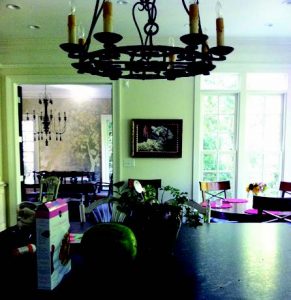
But again, seeing the paintings in this abstracted digital form obscures all but the traces of my original artistic intent, as opposed to showing how these concrete objects—not just images—are integrated into specific material and symbolic contexts. So Figure 20 shows the same painting in the house in Atlanta where it now resides, and according to the “normal” sort of visual practice with which we’re used to approaching framed work like this—the long view.
In this view the painting still retains a certain dignity and aloofness from the scene, even despite the cereal boxes and other tokens of daily life on the kitchen counter. But Figures 21 and 22 are photographs sent to me by the owners of the painting in the fall of 2010, showing art as part of life as it really happens. The first shows their daughter, Natalie, flush with victory in a family game of Monopoly, the second shows eldest son William celebrating his 13th birthday, with the painting just visible between the helium-filled mylar “1” and “3” balloons.


Accompanying the pictures was an e-mail note from Mr. Bell describing how they “see” the painting on a regular basis, and how, as both image and object, it is integrated into their lives. What I hope the reader can hear in that note, and what gives me hope for a practice of art that seeks to engage and be integrated into ordinary life rather than insist on it’s superiority to or detachment from it is how the couple have woven the image into their practice of being parents and followers of Christ. Neither my practice as a painter nor theirs as parents are glamorous, really, or earthshaking—but they are, I think, worthwhile. Here’s what Mr. Bell wrote:
Everyday breakfasts, dinners, talking about our days and activities, encouraging each other, challenging and correcting, playing games, celebrating milestones – Sherry and I loved the message within the painting “Fitting” of a master’s hand grooming and refining a loved creature. Placing the painting in the space where we invest the most time as a family seemed natural. As parents we can see the painting from our seats (our kids largely have their backs to the image when we sit down together). . . I know that my role is to spiritually lead my family, but the truth is I have a lot of areas in my life that need constant tending to, cleaning, and refinement. . . This work [is] constantly reminding us that God loves us (as parents) and has refinement to accomplish in our lives, as we are responsible to love our kids and be agents of refinement in theirs.16
So what does the placement of my painting in the Bell household, or more, it’s integration into the patterns of the family’s quotidian lives, say about the way meaning is created in and around works of art more generally, and the dynamic that obtains between painters and their “publics”? Looking at private houses as an important context for contemporary art may be justified merely by the fact that private homes consitute the largest commercial market for paintings. But more interesting is the fact that making work for the home presents an opportunity for art (and artists) to help forge integrated communities on many scales. Thinking about such a role for art helps redirect the question of artistic genesis from one of attribution and possession to one of attention and purpose. The question, then, is not “Where does art come from?” but “Where does art go?” or “What does it become?”
For my own part, I am not making great strides in becoming a household word as an artist in more than a few households, but I am seeing the potential and even promise of a life in art that is both intellectually engaged and concretely useful—a promise that can be summed up as follows: artists actually have both more freedom and more security when they perceive of themselves as co-creators or servants in a larger community, than when they insist on autonomy or even a “prophetic” role in their life and work. To paraphrase Tim Keller’s thoughts on our relationship to God, artists are most free when the freedom we seek is freedom for rather than freedom from.
Notes
- This research was the basis for my dissertation, “Picturing Home: Domestic Painting and the Ideologies of Art,” and the material on the way art is experienced in the domestic setting presented here can be found in an expanded form in Chapter IV: Intuitive Vision. A link to the full-text PDF version may be found on the author’s website.
- Chapters II and III of my “Picturing Home: Domestic Painting and the Ideologies of Art” are devoted to the ideological and methodological problems with previous attempts to address art in relation to the home, using the work of sociologists Pierre Bourdieu and Vera Zolberg as guides. Of the studies mentioned above, David Halle’s Inside Culture: Art and Class in the American Home (1993) has much to offer from the standpoint of intellectual aims and methodology of asking people what the art in their homes means to them. Yet in its attempt to apply some empirical rigor to research on art in real-world settings, the author leaves out much of the complexity of art as a cultural practice that bridges public and private discursive fields. On the contrary, Stuart Plattner’s High Art Down Home: An Economic Ethnography of a Local Art Market (1996) goes to the other extreme by focusing so explicitly on anti-domestic avant-garde ideology that privileges major art market cities like New York, that he takes its mystifications and definitions at face value, even when his own research seems to suggest other conclusions than those he draws about the contradictory relationship between avant-garde and “decorative” art, between the high-art market and the world of ordinary commerce.
- The Latin root intueor—“to look at attentively, to consider, contemplate”—gives us intuition and intuitive, which I have adopted to describe this mode of seeing precisely because to that original meaning of “intentional acuity” our contemporary usage adds a sense of natural, almost unwittingly-attained knowledge which is therefore (or nevertheless) taken to be true. Furthermore, although not the primary feature of my use of intuitive, also included here is a deliberate connotation that knowledge that we perceive as coming “out of thin air” is actually an inculcated understanding of the socially-derived rules and possibilities that sociologist Pierre Bourdieu has called habitus, or a “feel for the game,” and that Anthony Giddens has labeled “unconscious knowledge.”
- The references are to Mulvey’s seminal paper on the application of Lacanian psychoanalysis to feminist critique of film, “Visual pleasure and narrative cinema.” My general argument, though, is especially indebted to the work of French theorist Henri Lefebvre, whose The Production of Space (1992) argues that social space—both concrete and a matter of human relationships, constituted and manipulated by daily practice—is the real venue in which power is deployed under the regime of advanced capitalism, rather than in historical time as represented in the visual field (everything from building facades and linear perspective to the written word). Lefebvre argues that the West’s emphasis on conceptualized representations of space serves to obscure the activities of human beings in specific places: “Sight and seeing which in the Western tradition once epitomized intelligibility, have turned into a trap. . ..” (p. 76.)
- Bachelard, p. 67.
- Sharon McGill, interview by the author, Atlanta, GA, April 18, 2003. Note: Participants in the study were given pseudonyms to protect their privacy.
- Ibid.
- A. E. Bean Backus (1906-1990) was a self-taught artist and well-known figure in Ft. Pierce, north of Miami, and throughout Florida for much of his adult life His studio is now a Museum and Gallery: http://www.backusgallery.com/index.htm.
- Anna Morton, interview by the author, Atlanta, GA, June 3, 2003.
- Jill Ratliffe, interviews by the author, Atlanta, GA, April 24, 1995 and July 11, 2003. (This section utilizes material primarily from the second from two conversations with Mrs. Ratliffe).
- An unexpected additional downside to the residential construction bubble in Atlanta (and elsewhere) of the past few decades is that the emphasis on large suburban-style houses and tall, open spaces within them may be altering this dynamic to the detriment of this visual intimacy.
- Beck and Woods, p. 49. This is extremely similar to Csikszentmihalyi and Rochberg-Halton’s statement that “furniture [may be seen] . . . as a culturally defined “frame” for structuring the experiential living space . . its importance [is] as a means of establishing a sense of personal continuity and meaning in an otherwise impersonal environment” (Csikszentmihalyi and Rochberg-Halton, p. 102).
- This formulation parallels Lefebvre’s trio of terms spatial practice, representations of space, and representational space, which together comprise an action-discourse-meaning axis (or, in his words, a “lived—conceived—perceived triad”) that defines the different ways people relate to social space and its images. Representational space is the most fully-lived and meaningful sense of space, perceived through experience of “its associated images and symbols” by human subjects. This is the kind of space, says Lefebvre, “which the imagination seeks to change and appropriate. It overlays physical space, making symbolic use of its objects [and] tend[ing] towards more or less coherent systems of non-verbal symbols and signs” (Lefebvre, pp. 38-39).
- Indeed, the whole process and symbolism of fitting was the subject of an exhibition of the author’s paintings at Montreat College in North Carolina in 2008, and descriptions of the process and paintings can be found online at his website.
- The most familiar images of this sort are by Thomas Kinkaide (cottages and other idealized and inspirational subjects) and Warner Sallman (“portraits” of Jesus). Though not unrelated to my discussion of artists being connected to local communities, the issue of the aesthetic quality of their work and critiques of the marketing techniques by which it is distributed is treated at length and with passion by others in both academic writing and in on-line forums, so I will not discuss them at any length here. Still, it may be said that without a reassessment of the importance of the home as a venue for art and a commitment by contemporary artists to produce work for it, potential buyers are left with few obvious alternatives for artworks that seem to invite the kind of relational investment described above.
- Bell, W. Allen, e-mail message to author, September 25, 2010.
References
Author, “Picturing Home: Domestic Painting and the Ideologies of Art” (PhD diss., College of William & Mary in Virginia, 2004).
Bachelard, Gaston. The Poetics of Space. Boston: Beacon Press, 1994.
Bourdieu, Pierre. The Field of Cultural Production. New York: Columbia University Press, 1993.
Clark, T. J. The Painting of Modern Life: Paris in the Art of Manet and his Followers. London: Thames and Hudson, 1984.
Csikszentmihaly, Mihaly and Eugene Rochberg-Halton. The Meaning of Things: Domestic Symbols and the Self. New York: Cambridge University Press, 1981.
Giddens, Anthony. Central Problems in Social Theory: Action, Structure, and Contradiction in Social Analysis. Berkeley: University of California Press, 1979.
Lefebvre, Henri. The Production of Space. Translated by Donald Nicholson-Smith. Oxford: Blackwell, 1992.
Mulvey, Laura. “Visual pleasure and narrative cinema,” in Feminism and film theory. Ed. C. Penley. New York: Routledge, 1988
Pollock, Griselda. Vision and Difference: Femininity, Feminism and the Histories of Art. NewYork: Routledge, 1988.
Wood, Denis and Robert Beck. Home Rules. Baltimore: Johns Hopkins University Press, 1994.
All images provided by article author. If you believe use of these images have violated copyright, please contact us at vergearts@twu.ca.
This work is licensed under a Creative Commons Attribution-NonCommercial-NoDerivatives 4.0 International License.