By Kaia L. Magnusen
As a soldier during World War I, Neue Sachlichkeit (New Objectivity) artist Otto Dix experienced the devastation of the war firsthand. In the wake of the carnage and destruction wrought during World War I and in light of Friedrich Nietzsche’s existential philosophy, some in Germany experienced a crisis of faith. Dix, who carried both the Bible and one of Nietzsche’s works with him when he went to war, had an ambivalent relationship with Christianity, complicated by his Nietzschean cynicism. He created brutal images of dead soldiers and war cripples that shocked society during Germany’s chaotic Weimar Republic (1918-1933). Dix’s famed Der Krieg (War) triptych of 1929-1932 (Fig. 1) features three panels and a predella depicting unflinching scenes of the horrors of trench warfare.

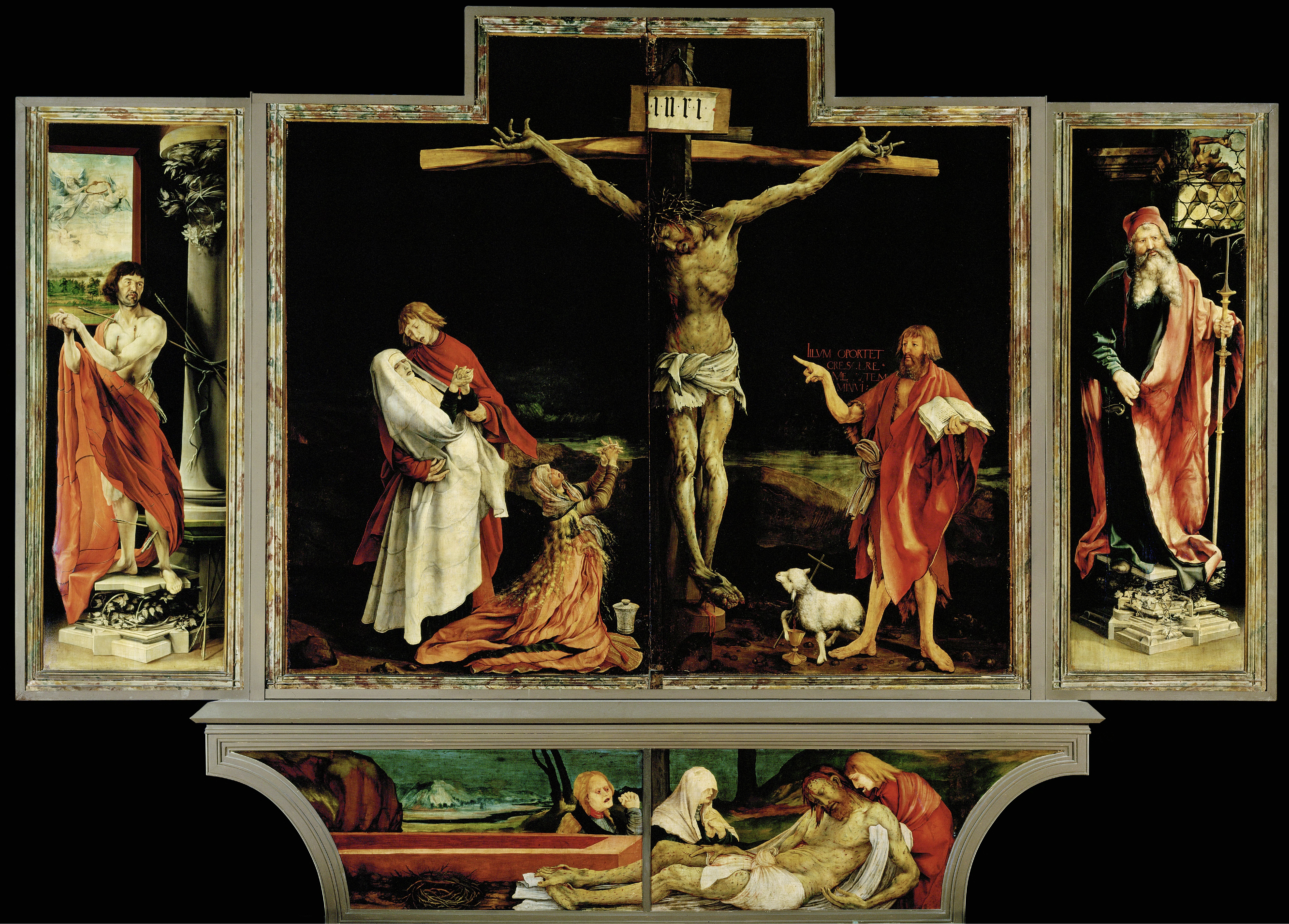
Dix utilized the format of a winged altarpiece to reinterpret Christian themes of death, resurrection and salvation through a Nietzschean lens. He accomplished this by foregrounding the cycle of life, death, and rebirth that aligns with the philosopher’s notion of “eternal recurrence.” He purposefully referenced well-known Christian religious art, especially Matthias Grünewald’s Isenheim Altarpiece (Fig. 2) of 1515, to comment critically on the apparent senselessness of the war and the growing disillusionment with official government propaganda that claimed German soldiers were martyrs for a just cause. In contrast to Christian altarpieces foregrounding beliefs in hope and redemption, Dix’s work elevates humanity at the expense of the divine by substituting the Nietzschean Übermensch for Christ and by asserting the supposed finality of death.
Despite Dix’s apparent existential bravado, however, certain telling remarks, recurring nightmares, and his late works featuring Christian subjects reveal a potential dissatisfaction with the pessimistic philosophy he substituted for religious faith. Thus, while Der Krieg clearly demonstrates Dix’s acceptance of Nietzschean ideas, his later interest in Christian imagery does not confirm a full acceptance of Christian doctrine but perhaps suggests a more nuanced, less hostile attitude toward this belief system and the subject matter associated with it.
However, Dix’s shift from being antagonistic to Christianity to depicting Christian, often Catholic, subject matter does not automatically indicate that the artist actually became a believer. Indeed, this paper does not make that assertion; rather, it contends that Dix’s engagement with Christian subject matter was not as straightforward and necessitates an interpretation that takes his knowledge of and interest in the Bible into account. Often, the religious images in Dix’s art are interpreted as being allegorical critiques of the social circumstances of the period or of the National Socialist regime.[1] While these themes may have had allegorical meanings, the sheer number of works with religious subject matter and Dix’s own statements suggest that his representation of saints and biblical subjects also had personal significance that complicates attempts to definitively interpret these works.[2]
As with many men of his generation, Dix’s worldview was inarguably affected by his experiences in World War I. He was called up as an Ersatz-Reservist (replacement reservist) and, in Dresden, he completed his initial training as an artilleryman. Then, in September 1915, he volunteered for service and, for the first years of the war, fought on the western front,[3] including the Second Battle of Champagne (autumn 1915) in France and the Battle of the Somme (1916-1917) in Flanders.[4] He spent winter 1917 on the eastern front in Belorussia and, beginning in 1918, was again stationed on the western front. As he was working class, he did not enter as an officer and had to work his way up through the ranks. He was wounded three times and, as a machine gunner, experienced some of the most brutal fighting in the war.[5] For his service, Dix received the Iron Cross Second Class and was eventually promoted to the rank of Vizefeldwebel (vice sergeant).[6] In late summer 1918, he decided to volunteer for a pilot training course and, consequently, went to Schneidebühl (Silesia) for training. As an aerial observer, he witnessed the bombed and devastated countryside firsthand.[7] He was still stationed at this training camp when the war ended in 1918.[8]
Prior to the start of the Great War, Dix became interested in the philosophical writings of famed German philosopher, Friedrich Nietzsche (1844-1900). In fact, Dix started reading Nietzsche’s works in 1911 when he was only twenty years old.[9] He found Nietzsche’s ideas to be so fascinating that, in 1912, he was inspired to create a life-size, green-tinted plaster bust of the philosopher — the only work of sculpture Dix is known to have created. The confident modeling of the head and facial features and the powerful forward thrust of the neck recalls the intense fervor and audacity of Nietzsche’s philosophy. [10] In 1923, this work was acquired for the Dresden City Art Collection because it was perceived to embody the spirit of Nietzsche and his philosophical perspective better than portraits created by other artists.[11]
Not only was Dix motivated to create a bust of the philosopher but he also carried a copy of one of Nietzsche’s books with him when he went to war and kept it with him for the duration of the conflict. Scholars cannot agree which particular book Dix brought with him but it was likely either Also sprach Zarathustra (Thus Spake Zarathustra, 1883-1891) or Die fröhliche Wissenschaft (The Gay Science, 1882).[12] He was so intrigued with Nietzsche’s ideology that he once claimed it was “the only correct philosophy.”[13] In addition to one of Nietzsche’s works, Dix also took a copy of the Bible with him to the front.[14] While he had been brought up Lutheran, it seems his engagement with Nietzsche caused him to question the tenets of the Christian faith.[15] By the time the war began, his interest in the Bible seemed more philosophical than religious. In fact, he remarked: “I am not a Christian because I can’t and won’t keep the great, essential commandment, ‘Follow me.’” [16]
After the war, his interest in Nietzsche’s works continued and he, along with other avant-garde artists with Expressionist leanings, took Nietzsche’s Dionysian individualism to extremes. Many of the works he created soon after the war’s end, including Prometheus—Grenzen der Menschheit (Prometheus—Limits of Mankind) and Ich DIX bin das A und das O (I Dix am the A and the O), both of 1919, were visual manifestations of Dix’s engagement with Nietzsche’s philosophical ideas.[17] After the immediate post-war works that overtly reference the philosopher’s ideas, however, the Nietzschean allusions in Dix’s works became more subtle and incorporated other elements, including Christian references and his simultaneous admiration for and competition with Old Master painters, including German artists such Matthias Grünewald.
In particular, Grünewald’s renowned Isenheim Altarpiece (1512-1516) clearly served as inspiration for Dix’s War (Triptych) (1929-1932). This work, similar to a medieval winged altarpiece, shows the unending cycle of death during World War I. This idea of a cycle is reinforced by the circular compositional structure and implied narrative that extends throughout the three panels and the predella.
In the left panel, faceless, interchangeable soldiers, who emerge from the trenches, carry their burdens—their military gear rather than crosses—and march off to slaughter. In the left foreground, a wheel, possibly a cannon wheel,[18] perhaps evoking the torture instrument associated with Catholic martyrs such as Saint Catherine of Alexandria as seen in the center panel of Lucas Cranach the Elder’s Triptych with the Martyrdom of Saint Catherine (1506), alludes to their impending deaths as martyrs for the cause of war. The death of Catherine of Alexandria, the patron saint of philosophers,[19] was ordered by Roman Emperor Maxentius[20] while the deaths of the German soldiers seen in the painting were effectively ordered by Kaiser Wilhelm, the German emperor who ruled during World War I.
Dix’s soldiers occupy the panel reserved for the martyred Saint Sebastian in Grünewald’s altarpiece. Sebastian, the patron saint of soldiers, was a soldier and commander of the praetorian guard of Diocletian, and was martyred by being shot with arrows. Grünewald depicts two angels descending to place the crown of martyrdom on the saint’s head;[21] their presence implies salvation from his earthly suffering. In Dix’s panel, foreboding clouds, like those painted by German Renaissance master, Albrecht Altdorfer, loom overhead. Their reddish coloration seems to portend bloodshed rather than deliverance from the ensuing battle during which bullets, instead of arrows, will pierce the bodies of the soldiers.
The center panel depicts total carnage. Even the landscape, which is marred by shell craters, has not escaped the violence. A soldier wearing a gasmask surveys the slaughter. Above him, a skeleton, representative of death, is clothed in tattered rags and is suspended from bent iron beams. With its outstretched right arm in a pose echoing the gesture of Grünewald’s John the Baptist, the skeleton points to the inverted figure of a dead man in the pose of the crucified Christ. The man’s ragged clothing recalls the tattered cloth draped around Christ’s hips.[22] The figure’s legs and feet are riddled with bullet holes and his gnarled left hand is marred by a seeping wound that references the splayed hand of Christ in the outer central Crucifixion panel of Grünewald’s Isenheim Altarpiece. Beneath the man’s hand, a wooden beam protruding from the muck further likens the figure to the image of Christ stretched out on the cross.
A gun with a bayonet —perhaps recalling the spear that pierced Christ’s side — rests to the left of the figure. Next to the weapon, a twisted, circular object that appears to be a coiled length of barbed wire evokes the crown of thorns. In fact, the decapitated head in the lower left corner of the central panel appears to be crowned with a loop of barbed wire (although this is rather difficult to make out in reproductions), an obvious reference to the crown of thorns. Here, the Crucifixion and its ultimate Christian meaning have, literally, been turned upside down. The Christ-figure is dead in a muck-filled trench just like the other soldiers and the skeletal figure makes it clear that death, not Resurrection, is the only possible outcome.
The right panel of Dix’s work departs the most significantly from the Isenheim Altarpiece whose right panel depicts St. Anthony Abbot, seemingly indifferent to the demon attempting to break through the glass window in the upper right corner. In Dix’s right panel, a hellish cloud swirls in the background while one soldier carries another man over the dead and dying. The position of these two figures resembles representations of the Descent of Christ from the Cross although, here, in place of a cross is a bomb-shattered tree. The steely survivor resembles Dix himself, which fits in with the painter’s Nietzschean ideology. If there is no God to save humanity, one has to save oneself. Here, the soldier, a self-portrait of Dix, saves himself and another soldier from the flaming disaster in the background while another combatant struggles to pull himself up out of the mud. In this heroic self-portrait, Dix portrays himself as possessing qualities, such as physical and mental strength and fearlessness amidst suffering, that are often associated with Nietzsche’s Übermensch.[23]
The “salvation,” if one can even call it that, offered in the right panel is either unsuccessful or temporary as indicated by the predella, which is clearly inspired both by Grünewald’s Entombment predella and Hans Holbein the Younger’s The Body of the Dead Christ in the Tomb (1520).[24] In Dix’s predella, three sleeping soldiers lie prone under a tarp that ironically recalls the canopy above the beautiful angelic concert accompanying Mary holding the Christ Child in the second view of the Isenheim Altarpiece’s central panel.[25] Instead of providing a celebratory setting, Dix’s tarp completes the circular composition of the triptych, which begins with the foreground soldier in the left panel, proceeds through the curvature of the dangling skeleton in the central panel, and continues with the heroic and prone figures in the right panel. As the circular composition suggests, the exhausted men of the predella will return to the front much like the soldiers in the left panel and the cycle of death will continue unabated. This seemingly unending cycle likely pertains to Nietzsche’s concept of “eternal recurrence,” which posits eternity as an endless repetition of events, including the most horrible. Nietzsche’s “this-worldliness” results in an atheistic type of non-transcendent eternity that the Übermensch should desire.[26]
Unlike the Isenheim Altarpiece, there is no Resurrection panel in Dix’s triptych. Indeed, there is no Christian God to whom one can appeal as, according to Nietzsche’s oft-repeated phrase, “God is dead” ” — meaning that, for him, man had killed the concept of God and the need for the Christian God whom Nietzsche found “unworthy” of belief.[27] In Nietzschean philosophy, acceptance of the supposed death of God brings emancipation from Christian notions of other-worldly redemption.[28] Rather than wallow in self-hatred caused by faith in a dead God who was unable to save anyone, Nietzsche argued that one must be the author of one’s own salvation by creating meaning for oneself; thus, there was the possibility, but not the guarantee, that self-loathing could be turned into acceptance and self-actualization.[29] In place of redemption by divine intervention, there is a self-affirmation and a type of salvation achieved by “internal transcendence”[30] that will occur in this world. Nietzsche believed that as life was characterized by pain Christianity was merely a deceitful anesthetic that impelled people to believe that salvation and the absence of pain were the same.[31] For the philosopher, Christian belief was self-deceit and any kind of religious belief compromised the sovereignty of the Übermensch. Instead of faith, the Übermensch realized that redemption came from the self not from an “external redeemer” in the Christian sense.[32] Consequently, he glorified the philosopher’s concept of eternity and endeavors to overcome himself through the “eternal return” of the same that will occur in the future.[33]
Despite this apparently confident visual declaration of his adherence to Nietzschean philosophy, for years after the war, Dix experienced recurring nightmares in which he endlessly crawled through ruined houses.[34] The nature of these nightmares seems to contradict Dix’s wartime Nietzschean-derived bravado and apparent acceptance of the “eternal recurrence” evidenced by the War (Triptych). In addition, distinct changes in his art are apparent after the Nazis came to power in 1933. That year, Dix was dismissed from his post as a professor at the Dresden Academy which he had held since 1926.[35] Consequently, Dix decided to move with his family to the southwestern part of Germany, near Lake Constance.[36] Traditionally, this region of Germany is Catholic, and this culture seemed to have an impact on Dix. He began to paint various biblical scenes and images of popular Catholic saints. This change of subject matter was noted by Dix’s friends, colleagues, and supporters, including Paul Westheim, the former editor of the avant-garde art journal, Das Kunstblatt. In a July 1939 letter to Georg Schmidt who, at the time, was the Director of the Kunstmuseum Basel, Westheim wrote, “In the last few weeks I’ve been told that Dix has become a Catholic…He has painted several St. Christophers and, at the moment, is painting a ‘Temptation of St. Anthony.’”[37]
Westheim seemed to doubt the sincerity of Dix’s supposed Catholicism, however, as the former editor claimed Dix only converted “out of protest, like many intellectuals at this time in the Third Reich” and asserted that Dix was critiquing the repressive regime “in disguised form.”[38] Indeed, even contemporary scholars typically interpret Dix’s Christian-themed paintings as anything but Christian. Instead, scholars are at pains to interpret them allegorically and politically. For instance, noted Dix scholar Fritz Löffler interprets Dix’s St. Christopher paintings and his painting of John on Patmos (1941) as “pictorial formulations of resistance” against the National Socialist regime.[39] For Löffler, Christopher carrying the Christ Child across a river means that the saint “bore the incarnation of the Logos, the Spirit, over all the perils of the time.”[40] Thus, he interprets the painting as an allegorical reference to the precarious state of affairs under the Nazis and leading up the Second World War. Similarly, the painting of Saint John writing the Book of Revelation is interpreted as an allegorical evocation of the coming apocalypse of war and the ultimate “destruction of the seven-headed beast,” which, although not explicitly stated, is seemingly implied by Löffler to reference Adolph Hitler and his regime.[41] Thus, for Löffler, Dix’s religious works simply mirror the troubles of the time at which he was painting them and continue the artist’s earlier-established penchant for social critique, thereby functioning as veritable pendants for his World War I images.[42]
Dix continued to make religious-themed works for the remainder of his life. Between 1938 and 1944, Dix painted six different versions of Saint Christopher,[43] one of which is currently in La Collezione d’Arte Religiosa Moderna at the Vatican,[44] and several images of Saint Anthony. Between 1945 and 1960, he painted more than forty images of the life of Christ and created numerous additional drawings related to Christ.[45] He also painted various biblical scenes including Saul and David (1946) and Job (1946). Dix’s thirty-three lithographs from the series Das Evangelium nach Matthäus (The Gospel of Matthew) were published in 1960 ” —although these too are similarly generalized as allegorical depictions of suffering.[46]
Yet, given the prevalence of Christian imagery in Dix’s post-war work and the sensitivity with which he treats the subjects, such areligious interpretations seem lacking and overly simplistic. If the principle of Occam’s razor can be applied to art, then perhaps the intellectual hoop-jumping required to categorically dismiss all of Dix’s religious images as mere “pretext for allegorical representations,”[47] unnecessarily complicate the issue. While it would be overstating the case to suggest that Dix actually converted to Christianity, the evidence suggests that, at least later in his life, he no longer possessed the hostility toward it that he demonstrated in his youth.
Indeed, in a transcribed conversation he had with friends in December 1963, Dix’s thoughts on religion seem more ambivalent than antagonistic. For instance, Dix clearly states that:
Most people, however, do not read the Bible … But we must read the Bible– read the Bible, as it is, in all its realism. The Old Testament also, we must read this: yes, what a book! It is the Book, one can say it, the Book, the Book of books, the Bible. Also on the historical level, the history of civilization, on the socio-historical level, in all respects, a grand book. Truly grand![48]
In this conversation, Dix speaks of Christ in historical rather than messianic terms but he does refer to the Bible as being “historically correct.”[49] The artist’s fascination with Christ and the Bible is evident even if one cannot make conclusive claims about Dix’s own belief system one way or the other. The most apt statement about Dix’s later relationship with religious faith comes from the artist himself: “I do not know if I am a believer or an atheist, or whatever else.”[50]
Thus, in light of Dix’s own words, it seems reasonable to interpret his many religious paintings as being indicative of his religious irresolution. While his early interest in the philosophy of Friedrich Nietzsche clearly affected his thinking and art around the years of the Great War, the trauma of the war and the difficulties of the post-war situation in Germany seemed to have troubled his once-confident commitment to existentialist philosophy as Nietzschean ideals become less apparent in his work. Dix may have intended some of his religious works to function as allegories pertaining to the political and social situation of the time; yet, it is possible that these works demonstrate a genuine interest in the biblical subject matter being depicted. He might not have genuinely believed but, the frequency with which he turned to religious imagery belies a kind of mental and artistic preoccupation with the subject matter.
Despite the prevalence of religious themes in Dix’s later work, however, copies of Nietzsche’s Also sprach Zarathustra, Die fröhliche Wissenschaft, Morgenröte (The Dawn), Der Wille zur Macht (The Will to Power), Götzen-Dämmerung (The Twilight of the Idols), Der Antichrist (The Antichrist), and the Dionysos-Dithyrambe (Dithyrambs of Dionysus) still remained in Dix’s personal library at the time of his death in 1969.[51] The idiosyncratic nature of Dix’s interest in both the Bible and Nietzsche is demonstrated by two lithographs created in the 1960s. One, Die Kreuzigung (The Crucifixion) is part of the lithographic series, Matthäus Evangelium, which illustrates the Gospel of Matthew. In it, Dix expressionistically renders the suffering Christ who is frontally placed on a cross and who gazes directly at the viewer while John and the Virgin Mary weep beneath him. The other lithograph, Die Kreuzigung (Nietzsche) (The Crucifixion [Nietzsche]) depicts a defiant and distorted Nietzsche hanging on a cross rendered at such an oblique angle that its form is difficult to perceive; no other figures are present to react to the philosopher’s plight. Faced with such images, one wonders who was ultimately “dead” for Dix: God or Nietzsche? Once again, the artist’s words seem to provide the most accurate, albeit understated, assessment of the situation: “These are very complicated ideas to untangle.”[52]
Notes
[1] Fritz Löffler, Otto Dix, Life and Work (New York and London: Holmes and Meier Publishers, Inc., 1982), 117. In his discussion of the allegorical meanings of Dix’s biblical images and depictions of saints, Löffler also mentions Gerhard Pommeranz-Liedtke and Otto Conzelmann as having ideas similar to his own.
[2] In Otto Dix 1898-1969 (Köln: Taschen, 2012), Eva Karcher briefly discusses Dix’s late religious works. Specifically, she mentions Dix’s images of Christ’s passion and notes the depiction of suffering and human frailty in relation to Dix’s interest in realism
[3] Ingo Herrmann, comp. “Biography: 1914-1923,” in Otto Dix, ed. Olaf Peters (Munich, Berlin, London and New York: Prestel-Verlag, 2010), 235.
[4] Anne Marno, “The reception of Otto Dix’s painting The Cripples (1920) in Yael Bartana’s film Degenerate Art Lives (2010),” in Disability and Art History, eds. Ann Millett-Gallant and Elizabeth Howie (New York: Routledge, 2016), 119.
[5] Jay Winter, War Beyond Words (Cambridge: Cambridge University Press, 2017), 17.
[6] Herrmann, “Biography: 1914-1923,” 235.
[7] Linda F. McGreevy, The Life and Works of Otto Dix: German Critical Realist (Ann Arbor, MI: UMI Research Press, 1975), 19. As a soldier, Dix fought in the trenches. He survived mustard gas attacks while serving in the Champagne province in France. He was wounded on several occasions and, as a result of his injuries, he briefly stayed in a French military hospital. When the war finally ended, he was serving guard duty at a Silesian training camp.
[8] Hermann, “Biography: 1914-1923,” 235.
[9] McGreevy, The Life and Works of Otto Dix, 11. In one of Sarah Twohig O’Brien’s footnotes for her essay “Dix and Nietzsche” in Tate Gallery’s exhibition catalogue Otto Dix 1891 – 1969 (1992), she mentions that Otto Griebel, who was a fellow student of Dix’s prior to World War I, claimed that Dix began reading Nietzsche in 1909.
[10] Sarah O’Brien Twohig, “Dix and Nietzsche,” in Otto Dix 1891 – 1969, ed. Keith S. Hartley (London: Tate Gallery, 1992), 40. In his essay, “Intransigent Realism,” found in the Neue Galerie’s Otto Dix exhibition catalogue (2010), Olaf Peters contests the date of Dix’s Nietzsche bust. Although the date is usually given as 1912, Peters suggests that, instead, the work likely dates from 1914.
[11] Ibid. The bust was acquired by Dr. Paul Ferdinand Schmidt. It was esteemed as being one of the most impressive works of modern art in the collection until the Nazis confiscated it in 1937. O’Brien Twohig notes that in addition to his bust of Nietzsche three other works by Dix were chosen by the Nazis and art dealers to be included in the auction of one hundred twenty-five works held in 1939 in Lucerne, Switzerland. Dix’s bust of Nietzsche was not sold at the auction but its location is unknown and it was, presumably, destroyed.
[12] Sabine Rewald, “Skat Players,” in Glitter and Doom: German Portraits from the 1920s, ed. Sabine Rewald (New York: The Metropolitan Museum of Art, 2006), 57. Rewald asserts that Dix either took Die fröhliche Wissenschaft or Also Sprach Zarathustra with him. Linda McGreevy suggests it was Die fröhliche Wissenschaft. On one of the inside cover pages of his copy of Also Sprach Zarathustra, which is in the possession of the Otto Dix Stiftung, Dix signed his name in pen and dated it 1914. He signed it again in pencil but he did not date it. As the date Dix wrote in this book coincides with the start date of World War I, one can speculate that Also Sprach Zarathustra was the Nietzsche book Dix took with him to war.
[13] Diether Schmidt, Otto Dix im Selbstbildnis (Berlin: Henschelverlag Kunst und Gesellschaft, 1978), 280. Dix’s full quote about Nietzsche is “Das war die einzig richtige Philosophie.” This translates to “That was the only correct philosophy.” Neither the date nor the specific context of Dix’s quote is indicated.
[14] Maria Tatar, Lustmord: Sexual Murder in Weimar Germany (Princeton: Princeton University Press, 1995), 85.
[15] Keith Hartley, “Pieta,” in Otto Dix 1891 – 1969, ed. Keith S. Hartley (London: Tate Gallery, 1992), 66.
[16] Keith Hartley, “The Temptation of St. Anthony,” in Otto Dix: 1891 – 1969 (London: Tate Gallery, 1992), 202.
[17] James A. Van Dyke, “Otto Dix’s Philosophical Metropolis,” Otto Dix, ed. Olaf Peters. (Munich, Berlin, London and New York: Prestel-Verlag, 2010), 183. Here, Van Dyke quotes Rainer Beck’s Otto Dix—Dix kosmischen Bilder—Zwischen Sehnsucht und schwangerem Weib, Dresden, 2003. In the footnotes of his essay, Van Dyke mentions that, in Dix’s copy of Der Wille zur Macht, the artist made notes on aphorism 900 which remarks on Prometheus.
[18] Frédérque Goerig-Hergott, ed. Otto Dix: le Retable d’Issenheim (Colmar: Musée Unterlinden, 2016), 46.
[19] Cynthia Stollhans, St. Catherine of Alexandria in Renaissance Roman Art: Case Studies in Patronage (New York: Routledge, 2017), 66.
[20] Geoffrey Abbott, Execution: The Guillotine, the Pendulum, the Thousand Cuts, the Spanish Donkey, and 66 Other Ways of Putting Someone to Death (New York, NY: St. Martin’s Press, 2006), 40.
[21] Goerig-Hergott, Otto Dix: le Retable d’Issenheim, 46.
[22] Ibid, 50.
[23] Robert C. Solomon and Kathleen M. Higgins, eds. Reading Nietzsche (Oxford: Oxford University Press, 1988), 168. Although scholars debate the precise interpretation of Nietzsche’s understanding of the Übermensch, Bernd Magnus notes that the read of this figure as embodying certain ideal traits is “standard.” See Bernd Magnus, “Perfectibility and Attitude in Nietzsche’s Übermensch,” The Review of Metaphysics 36, no. 3 (Mar. 1983): 633-659.
[24] Goerig-Hergott, Otto Dix: le Retable d’Issenheim, 52.
[25] Ibid.
[26]J. Harvey Lomax, “Nietzsche and the Eternal Recurrence,” Philosophy Now, no. 29 (Oct. / Nov. 2000), 20.
[27] Friedrich Nietzsche, The Gay Science (North Chelmsford, MA: Courier Corporation, 2012), 155.
[28] Robert R. Williams, Tragedy, Recognition, and the Death of God: Studies in Hegel and Nietzsche (Oxford: Oxford University Press, 2012), 323.
[29] Roy Jackson, Nietzsche and Islam (New York: Routledge, 2007), 60.
[30] Giles Fraser, Redeeming Nietzsche: On the Piety of Unbelief (New York: Routledge, 2013), 87.
[31] Ibid, 90.
[32] Williams, Tragedy, Recognition, and the Death of God, 326.
[33] Lomax, “Nietzsche and the Eternal Recurrence,” 20.
[34] Winter, War Beyond Words, 17.
[35] Keith Hartley, “Dresden, 1927-1933” in Otto Dix 1891 – 1969, ed. Keith S. Hartley (London: Tate Gallery, 1992), 169, 171.
[36] Ibid, 171.
[37] Hartley “The Temptation of St. Anthony,” 203.
[38] Ibid.
[39] Löffler, Otto Dix, Life and Work, 105-106.
[40] Ibid, 105.
[41] Ibid, 106.
[42] Ibid, 105-106.
[43] Ibid, 105.
[44] James Elkins, On the Strange Place of Religion in Contemporary Art (New York: Routledge, 2004), 14.
[45] Keith Hartley, “Large Resurrection of Christ II” in Otto Dix 1891 – 1969, ed. Keith S. Hartley (London: Tate Gallery, 1992), 218.
[46] Charlene Spretnak, The Spiritual Dynamic in Modern Art: Art History Reconsidered, 1800 to the Present (New York: Palgrave Macmillan, 2016), 105.
[47] Goerig-Hergott, Otto Dix: le Retable d’Issenheim, 24. All English translations from the French are my own.
[48] Ibid, 256. Dix’s conversation was originally translated from German into French by Michel Vallois.
[49] Ibid.
[50] Ibid, 255.
[51] The volumes of Nietzsche’s works that were in Dix’s library at the time of his death are in the archive of the Otto Dix Stiftung in Bevaix, Switzerland. These works are found in four volumes. Also Sprach Zarathustra, Die fröhliche Wissenschaft and Morgenröte are individual volumes. Morgenröte was published by C.G. Naumann Verlag in Leipzig in 1906. Also Sprach Zarathustra and Die fröhliche Wissenschaft were both published by Alfred Kröner Verlag in Leipzig in 1906. One volume contains Der Wille zur Macht, Götzen-Dämmerung, Der Antichrist and Dionysos-Dithyrambe. It was published by C.G. Naumann Verlag in Leipzig in 1906. All of the books contain Dix’s signature in pencil on the inside page facing the back of the cover page. Also Sprach Zarathustra also contains an additional signature in pen and is dated 1914 in Dix’s handwriting.
[52] Goerig-Hergott, ed. Otto Dix: le Retable d’Issenheim, 255.
Works Cited
Abbott, Geoffrey. Execution: The Guillotine, the Pendulum, the Thousand Cuts, the Spanish Donkey, and 66 Other Ways of Putting Someone to Death. New York, NY: St. Martin’s Press, 2006.
Elkins, James. On the Strange Place of Religion in Contemporary Art. New York: Routledge, 2004.
Fraser, Giles. Redeeming Nietzsche: On the Piety of Unbelief. New York: Routledge, 2013.
Goerig-Hergott. Frédérque, ed. Otto Dix: le Retable d’Issenheim. Colmar: Musée Unterlinden, 2016.
Hartley, Keith. “Dresden, 1927-1933.” In Otto Dix 1891 – 1969, edited by Keith S. Hartley, 169-71. London: Tate Gallery, 1992.
___.“Large Resurrection of Christ II.” in Otto Dix, Life and Work, edited by Keith S. Hartley, 218. London: Tate Gallery, 1992.
___. “Pieta.” In Otto Dix 1891 – 1969, edited by Keith S. Hartley, 66. London: TateGallery, 1992.
___ “The Temptation of St. Anthony,” In Otto Dix 1891 – 1969, edited by Keith S.Hartley, 202-04. London: Tate Gallery, 1992.
Herrmann, Ingo, comp. “Biography: 1914-1923.” In Otto Dix, edited by Olaf Peters, 234-41. Munich, Berlin, London and New York: Prestel-Verlag, 2010.
Jackson, Roy. Nietzsche and Islam. New York: Routledge, 2007.
Löffler, Fritz. Otto Dix, Life and Work. New York and London: Holmes and Meier Publishers, Inc. 1982.
Lomax, J. Harvey. “Nietzsche and the Eternal Recurrence.” Philosophy Now, no. 29 (Oct. /Nov. 2000): 20-22.
Marno, Anne. “The reception of Otto Dix’s painting The Cripples (1920) in Yael Bartana’s film Degenerate Art Lives (2010).” In Disability and Art History, edited by Ann Millett-Gallant and Elizabeth Howie, 119-31. New York: Routledge, 2016.
McGreevy, Linda F. The Life and Works of Otto Dix: German Critical Realist. Ann Arbor, MI: UMI Research Press, 1975.
Nietzsche, Friedrich, The Gay Science. North Chelmsford, MA: Courier Corporation, 2012.
Rewald, Sabine. “Skat Players,” In Glitter and Doom: German Portraits from the 1920s, edited by Sabine Rewald, 54-57. New York: The Metropolitan Museum of Art, 2006.
Schmidt, Dieter. Otto Dix im Selbstbildnis. Berlin: Henschelverlag Kunst und Gesellschaft, 1978.
Solomon, Robert C. and Kathleen M. Higgins, eds. Reading Nietzsche. Oxford: Oxford University Press, 1988.
Spretnak, Charlene. The Spiritual Dynamic in Modern Art: Art History Reconsidered, 1800 to the Present. New York: Palgrave Macmillan, 2016.
Stollhans, Cynthia. St. Catherine of Alexandria in Renaissance Roman Art: Case Studies in Patronage. New York: Routledge, 2017.
Tatar, Maria. Lustmord: Sexual Murder in Weimar Germany. Princeton: Princeton University Press, 1995.
Twohig, Sarah O’Brien. “Dix and Nietzsche,” In Otto Dix 1891 – 1969 edited by Keith S. Hartley, 40-48. London: Tate Gallery, 1992.
Van Dyke, James A. “Otto Dix’s Philosophical Metropolis.” In Otto Dix, edited by Olaf Peters, 179-97. Munich, Berlin, London and New York: Prestel-Verlag, 2010.
Williams, Robert R. Tragedy, Recognition, and the Death of God: Studies in Hegel and Nietzsche. Oxford: Oxford University Press, 2012.
Winter, Jay. War Beyond Words. Cambridge: Cambridge University Press, 2017.
Kaia L. Magnusen is an Assistant Professor of Art History at the University of Texas at Tyler specializing in modern and contemporary art, especially the art of the Neue Sachlichkeit.
This work is licensed under a Creative Commons Attribution-NonCommercial-NoDerivatives 4.0 International License.