By John Skillen
I have been fortunate to have spent much of the past twenty years in the historic cliff-top town of Orvieto in the central Italian region of Umbria, amidst settings rich with pre-modern artworks still in situ—in the settings for which they were made to do their work. I have been particularly struck by the sizable proportion of canonical masterworks of European art (certainly from 1250 to 1500) that are directly associated with the two new monastic orders founded almost simultaneously by saints Francis and Dominic in the early thirteenth century.[1] (These include artworks commissioned for these orders’ monasteries or in other settings under clear Franciscan or Dominican influence.)
Those works of art in Franciscan and Dominican settings deemed important by modern art historians have received plenty of attention. But the broader question of why and how the visual arts were so broadly welcomed in the preaching, teaching, and devotional practices of the mendicant orders, and used ubiquitously in the places designated for their missional works, has received insufficient scholarly attention.[2]
Franciscan and Dominican defense of visual imagery in the life of the church follows the standard formula used since the time of Pope Gregory the Great: images are properly valuable for instructing, for remembering, for inspiring. Thomas Aquinas defended the use of sacred images “on three grounds: first, as a lesson in the secrets of the faith for the unlettered; second, as visual reminders of the mystery of the Incarnation and of the example of the saints; and third, as an especially effective stimulus to devotion.”[3] Bonaventure activates the three virtues of visual images in his prologue to The Tree of Life (Lignum Vitae), whose purpose is “To enkindle in us this affection, to shape this understanding, and to imprint this memory …” (p.119).[4] The Latin: “in nobis accendatur affectus, formetur cogitates, imprimatur memoria.”
Bonaventure’s Tree of Life is one of the two brief but influential thirteenth-century devotional treatises, both written within a generation of the founders, that will be the focus of this essay. The other is De Modo Orandi (the modes of prayer, nine of them) written by a Dominican friar about the bodily comportment of St. Dominic at prayer. Both treatises received high-profile visual representation by famous Florentine artists in the Franciscan monastery of Santa Croce and in the Dominican monastery of San Marco.
First, a very few words on the early history of these two new orders.
Francis was the preacher-evangelist, embodying the Good News of God’s love in his tireless care for the poor, the sick, the discouraged. Dominic was the preacher-teacher, defending the faithful from the wounds of heresies, building up the body with the meat of sound doctrine—who, in Dante’s phrases in Paradiso, “became a teacher so renowned that he began to travel through the vineyard … fighting against the errors of the world … both with learning and with zeal” (canto XII, ll. 85-86, 94-97, trans. Hollander).
While living in the traditional manner in small communities obedient to a shared rule of life, these new orders cultivated a socially-engaged outward focus towards serving the needs of those in the world around them. In contrast with the stability of place in the Benedictine tradition, their founders imagined and followed largely peripatetic missions—a direct response to Jesus’s sending out the disciples on preaching missions with no second cloak, begging for their food (Luke 10:1-12; Matthew 10:5-12); hence the nomenclature of the two new “mendicant” or begging orders.
The rapid and remarkable spread of the two orders introduced complexities, conflicts, and compromises. Nevertheless, the movements birthed by these two charismatic and scandal-free figures are regularly credited with bringing spiritual renewal to church and society. Their missions were different but not in conflict; two sides of the same coin.
I follow Dante in saying so. In cantos 11 and 12 of Paradiso, Dante invents the attractive strategy of having each of the orders’ greatest theologians recount the lives of the founders of the opposite order. In narrating the life of Francis, the Dominican Thomas Aquinas begins:
I shall speak of one, since praising one,
whichever one we choose, is to speak of both,
for they labored to a single end. (XI, 40-42, trans. Hollander)
St. Bonaventure writes in parallel fashion in his biography of St. Dominic:
It is fitting that, in naming one, we name the other
so that, just as they were joined as one in combat
with a single goal, their fame should shine as one. (XII, 34-36)
Together, they offered up a sort of one-two punch delivering love and cultivating knowledge; or, as Dante writes:
One [Francis] was all seraphic in his ardor,
the other [Dominic], by his wisdom, was on earth
resplendent with cherubic light. (XI, 37-39)
Dante’s pair of characterizing features—Francis with the ardor of love, Dominic with the zeal of learning—stands as a leitmotif for distinguishing between the two in all discussions since, this one included.
The Franciscans appreciated the power of the arts to stimulate the affective side (accendatur affectus) of loving God and our neighbors. The Dominicans more typically used the arts to give visual form to ideas and to cultivate intellectually rigorous forms (formetur cogitates) of meditation. Each valued the capacity of visual images to aid memory. Our pair of devotional treatises reflect these two characteristic orientations.
St. Bonaventure’s Tree of Life (Lignum Vitae) presents brief devotions on the life of Christ, divided into the three “mysteries” of Christ’s Origin, Passion, and Glorification, each with an equal number of subsections and episodes.[5] (A chart of the table of contents can be found in endnote 5.) In fact, the parallels of organization and of grammar, syntax, and rhetorical form are intentional: “I have bound it together with a few ordered and parallel words to aid the memory,” writes Bonaventure in his introduction.
But the cross of Christ serves as the hinge of the whole. The prologue begins with the verse from Galatians: “With Christ I am nailed to the Cross.” A “disciple of Christ,” writes Bonaventure, “who desires to conform perfectly to the Savior of all men crucified for him, should, above all, strive with an earnest endeavor of soul to carry about continuously, both in his soul and in his flesh, the cross of Christ until he can truly feel in himself what the Apostle said above” (p. 119).
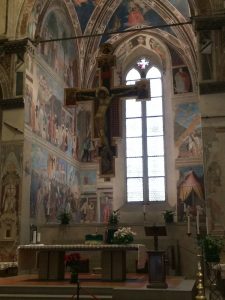
Certainly St. Francis’s own devotion to the cross—rewarded in his receiving of the stigmata two years before his death when he made a retreat to La Verna on the feast-day of the Exaltation of the Cross—inspired the general Franciscan devotion to the Cross. Hence the Franciscan adoption of the narrative of salvation history found in the Legend of the Holy Cross, which traces the genealogy of the tree from which the cross was fashioned back to the tree in Eden.[6] The two monumental fresco cycles of this story are both found in Franciscan monastery churches: Taddeo Gaddi’s in Santa Croce in Florence and Piero della Francesca’s in San Francesco in Arezzo.
Bonaventure immediately re-figures the Cross as the “salvation-bearing tree,” which he explicitly invites the reader to visualize:
Picture in your mind a tree … ordered in such a way that in the first or lower branches the Savior’s origin and life are described; in the middle his passion; and in the top, his glorification. … From each of these branches hangs a single fruit. So there are, as it were, twelve branches bearing twelve fruits according to the mystery of the tree of life. (p.120)
A few examples show the explicitly affective direction of a style intended to stimulate the emotions appropriate to the scene.
“Oh, if you could feel in some way the quality and intensity of that fire sent from heaven …” (p. 127)
“Now, then, my soul, embrace that divine manger; press your lips upon and kiss the boy’s feet. Then in your mind keep the shepherds’ watch, marvel at the assembling host of angels, join in the heavenly melody, singing with your voice and heart: “Glory to God in the highest …” (p. 129)
“Together with [the Magi] … adore, confess and praise this humble God lying in the manger.” (p. 130)
“Rejoice, then, with that blessed old man [Simeon] and the aged Anna … Let love overcome your bashfulness; let affection dispel your fear …” (p. 131)
“Do not, then, leave the mother and Child as they flee into Egypt … O, how you would weep if with devotion you could look upon so venerable a lady … in a foreign country with so tender and handsome a little boy …” (p. 132)
“O human heart, you are harder than the hardness of rocks, if at the recollection of such great expiation you are not struck with terror, nor moved with compassion nor shattered with compunction nor softened with devoted love.” (p. 154)
“O my God, good Jesus … grant … that I may ponder them faithfully in my mind and experience toward you, my God crucified and put to death for me, that feeling of compassion …” (p. 158)
That’s Franciscan devotion in a nutshell.
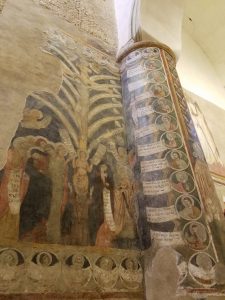
It may seem inevitable that a written text that calls on the reader to “picture in your mind” would prompt physical visualization in painted visual images. In fact, such representation-in-art of Bonaventure’s Tree of Life can be found in a number of places, including the church of San Giovenale in Orvieto itself. But the largest monumental image, still intact, is the fresco painted by Taddeo Gaddi around 1360 in the dining hall of the mother Franciscan monastery of Santa Croce in Florence. The fresco not only “represents” the text but gives it to us, with the first phrase of each of the twelve “fruits” presented as scrolls contained by the fruit.
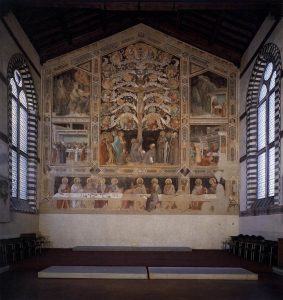
The choice of Last Suppers on the end wall of monastic refectories is ubiquitous, deliberately locating the community-at-table inside the event—in time using the new art of perspective to merge the spaces into one. The refectory in Santa Croce has its Last Supper, but placed above it is the Tree of Life, with a decorative
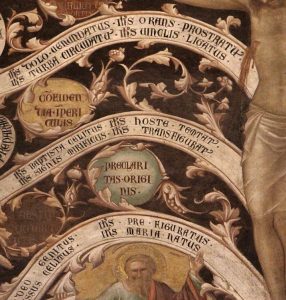
border that separates the scenes. Still, the Tree-as-Cross seems almost to grow out of the Last Supper, adding another layer to the resonance. The community’s dining together activates the (typological) framework of the eating-to-our-death in Eden of the forbidden fruit, and the eating of the Tree of Life in the restored Eden of Christ’s kingdom, made possible by the “eating of my flesh” in the sacrament.
DE MODO ORANDI (THE MANNER OF PRAYER)
Not unlike Bonaventure’s Tree of Life in genre, length, and purpose, The Manner of Prayer (De Modo Orandi) is a key devotional treatise in the Dominican tradition, written by an anonymous author sometime between 1260 and 1288, very probably for the community of Dominican nuns in the Monastery of St. Agnes at Bologna.[7]
The author writes not as a singular eavesdropper on Dominic’s private prayer, but rather gives voice to what all those around Dominic regularly saw, namely, a consistent fittingness of the postures and gestures to nine precise spiritual attitudes. A deep bow from the waist embodies Reverence; prostration his Humility; flagellation his Penitence; repeated genuflection his Compassion; standing upright with hands before chest his Meditation; standing with arms outstretched his Imploring God; standing with arms held directly overhead his Ecstasy; reading as his Recollection; and conversation (while walking) his Enthusiasm for Preaching.[8]
A few brief excerpts give a flavor of the whole, beginning with the First Way of prayer:
the beginning of his devotion: bowing deeply … before the altar as if Christ, whom the altar signifies, were really and personally present … standing with his body erect, [Dominic] would bow his head and his heart humbly before Christ his Head, considering his own servile condition and the outstanding nobility of Christ, and giving himself up entirely to venerating Him.
The Second Way:
St. Dominic also often used to pray by throwing himself down on the ground, flat on his face, and then his heart would be pricked with compunction, and he would blush at himself and say, sometimes loudly enough for it actually to be heard, the words from the gospel, ‘Lord, be merciful to me a sinner.’
The Sixth Way:
Dominic was also seen praying with his hands and arms spread out like a cross, stretching himself to the limit and standing as upright as he possible could.
The Seventh Way:
He was also often found stretching his whole body up towards heaven in prayer, like a choice arrow shot straight up from a bow. He had his hands stretched right up above his head, joined together or slightly open as if to catch something from heaven.
Dominic’s emotional engagement is everywhere highlighted in the writer’s description. “He would weep and groan passionately, and then say, ‘I am not worthy to look upon the height of heaven because of the greatness of my sin’” (typically, as here, quoting the Psalmist or a passage from Scripture).
And yet Dominic is described by the author as ever the teacher:
This way of prayer he taught more by the example of his practice than by what he said …And the holy master taught the brethren to pray like this both by his words and by his example … He taught the brethren to do this [bow humbly before the altar, the cross] whenever they passed before a crucifix showing the humiliation of Christ …Sometimes wanting to teach the brethren with what reverence they ought to pray …He exhorted the young men too, saying to them …
That is, De Modo Orandi (unlike Bonaventure’s Tree of Life) is not about the work of directly evoking those emotions in the reader while reading. Rather, it is a teaching manual for devotion, in which the reader imitates the teacher.[9] The implication is: do what Dominic does and eventually you will feel what Dominic feels. Once your body’s comportment is adequate to the matter, your affective response, having been trained by the master, will match the body’s response.
Interestingly, in the preface to the treatise, the author comments on the circular influence between body and spirit:
…we must say something about the way of praying in which the soul uses the members of the body in order to rise more devotedly to God, so that the soul, as it causes the body to move, is in turn moved by the body, until sometimes it comes to be in ecstasy like Paul, sometimes in agony like our Savior, and sometimes in rapture like the prophet David. The blessed Dominic used often to pray like this.…This manner of prayer stirs up devotion, the soul stirring the body, and the body stirring the soul. Praying this way used to make St. Dominic dissolve utterly into weeping, and it so kindled the fervor of his good will that his mind could not prevent his bodily members from showing unmistakable signs of his devotion. (p. 94)
The mind orders the emotions, but the proper comportment of the body has an important role in activating the appropriate emotion.
Such an instructional booklet could be written without pictures; the descriptions are precise. And yet, as with the Franciscan Tree of Life, the highly visualized description of Dominic at prayer invited visual illustration, which it received first in manuscripts of the treatise, and then, with the assumption of familiarity with the text, in independent painted images.
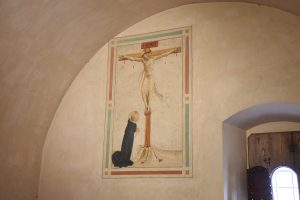
The masterful use of De Modo Orandi in art is that of Fra Angelico, resident friar placed in charge of the interior decoration of the reformed Dominican monastery of San Marco, whose renovation in the 1430’s and ‘40’s was underwritten by Cosimo de Medici. William Hood is the scholar who has recovered our recognition of what would have been obvious to the generation of friars for whom Fra Angelico did his work. Together, the frescoes in the corridor where the novices were assigned present a systematic visual exercise in reading and practicing Dominic’s modes under the gaze of the picture on the wall. Every cell has a simple image of a crucifixion (boring to most modern visitors to the monastery), without any details of setting, with St. Dominic or an exemplary Dominican at the foot of the cross exhibiting one of the modes or postures of prayer.[10]
In a certain sense, the cell frescoes operate in the same manner as the treatise. Just as the treatise focuses the reader’s attention not on his own interior state at the moment but on the comportment and affective expression of St. Dominic, so the occupant of the cell imitates the comportment of the model in the fresco, thereby training his own body to become the vessel of the appropriate emotion. The spiritual discipline does not assume a prior affective maturity on the part of the young friar; rather, it is intended to train the novice so that the appropriate emotional state kicks into gear when beholding a scene from the scriptural text and sacred history.
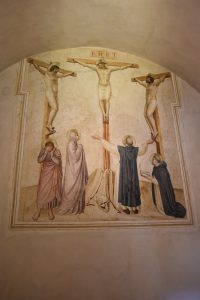
The cells in the novices’ corridor operate like the training exercises (we might say) of a young athlete or a ballet dancer. But Fra Angelico puts the same gestures to work in a wide variety of episodes depicted in the lives of Christ and his Mother and his disciples in the corridors for the mature friars—who, now well trained, can be expected to associate their manner of prayer in direct response to the episode at hand. [photos]
What I have set before us, all too briefly, are Franciscan and Dominican Arts of Devotion that (a) could and did stand alone as written texts readable without illustration, but which (b) invite reading as memorable visualization, and (c) were in fact given visual form in painting as an aid to memory that instructs the intellect and stimulates the affections, these once being held as the chief purposes of the visual arts.
Are Franciscan and Dominican arts of devotion relevant for us in our own time? I think so. We need art that instructs, reminds, and inspires communities turned to service. We need spiritual exercises, visio divina, strengthening of memory.
I might observe that the emotive orientation of Francis more naturally appeals to the “feeling” orientation of contemporary culture and churchly practice, while providing a disciplining of emotion to be commensurate with the actions of Christ. Yet I might also say that the rigors of bodily and mental comportment of the Dominican visio divina may be the more needful in an age of slouching, of weak attention span, of poor memory, and of weakness of will. As Dante emphasized, we need both.
Notes
[1] The Franciscan monastery Santa Croce in Florence is chock-full of masterworks, as are the two main Dominican monasteries, Santa Maria Novella and San Marco. The Basilica in Assisi, burial place of St. Francis, is of course filled wall-to-wall on two levels with artworks by significant painters in the 14th century. A favorite of mine is Benozzo Gozzoli’s scenes from the life of Francis—including the touching depiction of the supposed embrace of Francis and Dominic—in the apse of the church of the Franciscan monastery in Montefalco. Orvieto itself contains two works of art with direct Franciscan and Dominican influence. The parish church of San Giovenale contains an important fresco (although significantly deteriorated) of the Tree of Life directly illustrative of the treatise by St. Bonaventure discussed in this essay. And the monumental fresco cycle in the San Brizio Chapel of the cathedral depicting of the End Times and the Last Judgment, begun around 1450 by Fra Angelico and completed fifty years later by Luca Signorelli, has an obvious presence of Dominican friars (since the Dominicans played a central role in refuting the gnostic heresies of the Cathars, who had a presence in Orvieto). Indeed, Signorelli’s contract itself required him to work closely with the “masters of the sacred page,” almost certainly referring to the theologian-friars at the Dominican monastery in town—where Thomas Aquinas himself taught and wrote for several years in the 1260s. And Bonaventure was born nearby in Cività da Bagnoregio.
[2] Chapters 5 and 6 (“The Sacred Setting” and “Sites of Devotion”) in Evelyn Welch’s Art in Renaissance Italy (Oxford, UK: Oxford University Press, 1997) is readily accessible and gives a good general introduction, but not limited to Franciscan and Dominican sites and settings.
Rab Hatfield’s essay, “The Tree of Life and the Holy Cross: Franciscan Spirituality in the Trecento and Quattrocento” in the volume Monasticism and the Arts, edited by Timothy Verdon (Syracuse, 1984), 133-60, is an important source for my discussion of the Tree of Life.
The essays in the collection The Art of the Franciscan Order in Italy, edited by William R. Cook (Brill Academic Publishers, 2005) provide a wide set of approaches. The essay, for instance, by Beth Mulvaney, “The Beholder as Witness: the Crib at Greccio in the Upper Church of San Francesco, Assisi and Franciscan Influence on Late Medieval Art in Italy,” gathers the “evidence of how crucial visual imagery was to devotional practices,” citing Jill Bennett’s argument that “Franciscan devotional practices, in particular, developed imagery encoded with devices or symbols designed to offer models of devotional practice and to encourage an affective personal response from the viewer to enhance meditation on aspects of the image important to Franciscan spirituality” (in an essay in Art History 24 (2001): 1-16).
Sanctity Pictured: the art of the Dominican and Franciscan orders in Renaissance Italy, edited by Trinita Kennedy, is the catalog of the exhibition by that name at the Frist Center for the Visual Arts in 2014. Kennedy’s Introduction and Amy Neff’s essay “Painting, devotion, and the Franciscans” are helpful but cursory. My essay runs directly counter to Neff’s comment that “it would be a misleading oversimplification to categorize separate types of images with separate types of religious activity” (42).
Louise Bourdua’s The Franciscans and Art Patronage in Late Medieval Italy (Cambridge, UK: Cambridge University Press, 2004) is a treatment of three churches in northern Italy, full of details about the circumstances of their decoration, but with minimal attention to how these works of art were used, and why they were commissioned in the first place.
William Hood’s magisterial study of Fra Angelico at San Marco provides an account of the various uses of visual imagery in early Dominican tradition; I cite his discussion of the Manners of Prayer later in my essay.
[3] Aquinas’s statement is cited by Peter Humfrey in The Altarpiece in Renaissance Venice (New Haven: Yale University Press, 1993), 57; its source is in Aquinas’s IV Sententiarum, 1.3. The same defense is repeated by two later Dominicans, both cited by Michael Baxandall in Painting and Experience in Fifteenth Century Italy, 2nd edition (Oxford: Oxford University Press, 1988), 41). In the thirteenth-century Catholicon, John of Genoa writes: “Know that there were three reasons for the institution of images in churches. First, for the instruction of simple people, because they are instructed by them as if by books. Second, so that the mystery of the incarnation and the examples of the Saints may be the more active in our memory through being presented daily to our eyes. Third, to excite feelings of devotion, these being aroused more effectively by things seen than by things heard.” In a sermon published in the late fifteenth century, the Dominican preacher Michele da Carcano states that “images of the Virgin and the Saints were introduced for three reasons. First, on account of the account of the ignorance of simple people, so that those who are not able to read the scriptures can yet learn by seeing the sacraments of our salvation and faith in pictures…. Second, images were introduced on account of our emotional sluggishness; so that men who are not aroused to devotion when they see them, as if actually present, in pictures. For our feelings are aroused by things seen more than by things heard. Third, they were introduced on account of our unreliable memories … Images were introduced because many people cannot retain in their memories what they hear, but they do remember if they see images.” See my discussion in Putting Art (back) in its Place (Peabody, MA: Hendrickson Publishers, 2016), pp. 9-11.
[4] Bonaventure’s Tree of Life is included in the volume Bonaventure (Classics of Western Spirituality, published by Paulist Press, 1978), 119-175. Likewise, The Nine Ways of Prayer of St. Dominic is found in the companion volume of Classics of Western Spirituality titled Early Dominicans, 94-103.
[5] Diagram of the sections of The Tree of Life:
Diagram of the Sections of the Tree of Life
[6] Rab Hatfield (in the essay cited in Endnote #2) details the Franciscan attraction to the long typological tradition of connecting the Tree of Life in the Garden, whose fruit becomes newly available on the Tree of the Cross, and fulfilled in the Tree of Life “which bare twelve manner of fruits, and yielded her fruit every month” described in Revelation (chap. 22).
[7] See the web-based compendium of resources created by the Order of the Preachers for the likelihood that “The Nine Ways of Prayer of St. Dominic was written by an anonymous author, probably at Bologna, sometime between 1260 and 1288. The source of his information was Sister Cecilia of the Monastery of St. Agnes at Bologna.” https://opcentral.org/resources/2014/02/17/the-nine-ways-of-prayer-of-st-dominic/
[8] The article “Art and Devotion in the San Marco Monastery” in the on-line Renaissance Culture Wikipedia Project, provides a convenient chart of the Manners of Prayer. See http://rencult.pbworks.com/w/page/8064821/Art%20and%20Devotion%20in%20the%20San%20Marco%20Monastery
The text of De Modo Orandi can be found on several websites; I recommend these three:
https://www.fisheaters.com/stdominic9ways.html
https://www.nashvilledominican.org/our-vowed-life/st-dominic/nine-ways-of-prayer/
https://opcentral.org/resources/2014/02/17/the-nine-ways-of-prayer-of-st-dominic/
Dominic Modes of Prayer Diagram
[9] The Dominican Simon Tugwell underlines this aspect in his Introduction to the Classics of Western Spirituality volume on Early Dominicans: Selected Writings (Paulist Press, 1982). His description of Humbert of Romans’ Treatise on the Formation of Preachers applies to Dominic himself: “We find none of the dramatic fervor or emotional intensity that is characteristic of the Cistercian writers [or of the Franciscan]. Though he, like them, no doubt wishes to encourage the zeal and enthusiasm of his brethren, he sets about it, not by composing fervor-inos [sic], but by presenting his exposition as clearly as he can; he appeals to the emotions strictly by way of the mind” (p. 3).
[10] See especially pp. 200-207 in Hood’s comprehensive study of Fra Angelico in San Marco (Yale University, 1993).
John Skillen is the director of the Orvieto-based Studio for Art, Faith & History of Gordon College where for many years he taught medieval and Renaissance literature
This work is licensed under a Creative Commons Attribution-NonCommercial-NoDerivatives 4.0 International License.