By Kaia L. Magnusen
Throughout human history, the achievement and maintenance of good health has been a primary and universal concern. Both now and in the past, visual imagery has played a crucial role in establishing and reinforcing standards of illness and wellness.[1] Although contemporary people seem to perceive an intellectual divide between the arts and the sciences, this rift was not firmly established in the past. For instance, under the guild system that existed throughout the Middle Ages and the Renaissance, both artists and physicians belonged to the Guild of St. Luke, as this apostle was a physician by trade but also, according to legend, painted a portrait of the Virgin Mary and the Christ Child.[2] Obviously, contemporary medicine and the sciences dealing with issues of human health are more advanced and complex than in the past. However, there is still a unique visual dialogue that exists between the arts and the sciences and by examining visual imagery pertaining to health and illness, specifically works of art and visual culture concerning the nineteenth century cholera outbreaks and Diego Rivera’s Vaccination panel in his Detroit Industry fresco, one can gain a deeper, more nuanced understanding of aspects of health, including disease epidemics, and disease prevention.
Although the bubonic plague, or the Black Death, is probably the most well-known pandemic, other outbreaks of virulent diseases have occurred throughout history and have been represented in art and visual culture. Another particularly deadly outbreak of disease, occurred during the nineteenth century when cholera pandemics spread throughout the world.[3] Cholera is an acute infection of the intestinal tract caused by an infectious bacterium known as Vibrio cholerae. This motile, Gram-negative bacterium is most often found and spread in places with insufficient water treatment, poor sanitation, and inadequate hygiene. The usual source of infection is by drinking water or eating food contaminated by the cholera bacterium. In its severe form, cholera leads to rapid, extreme dehydration due to the loss of body fluids. This causes electrolyte imbalance and shock and, if untreated, can cause death within a few hours. [4] Currently, antibiotics and vaccines exist but, in the nineteenth century, this was not the case and cholera was regarded as a terrible, potentially fatal disease. The cholera pandemic that lasted from 1829 to 1851 was especially deadly and affected every continent except for Antarctica.[5] As it swept through Europe, France attempted to prepare by equipping its hospitals and imposing various sanitary measures. Despite these measures, the country was ravaged by the disease. Between March and April 1832, almost 13,000 Parisians died from cholera. By September 1832, approximately 18,000 people in Paris and more than 100,000 people throughout France had succumbed to the disease.[6]
The concern over cholera was so great that many escaped cities in which an outbreak had occurred in order to avoid contamination.[7] Indeed, cholera epidemics coincided with the rapid growth of large, industrial European cities so some felt there must be an environmental connection between cities, which were often dirty and overcrowded and whose buildings were often poorly ventilated. [8] Cholera, in particular, was associated with dirty, crowded urban areas so people associated less heavily populated rural areas with health and assumed they would be less likely to contract the disease in the countryside.
For example, in 1830s, many people retreated to the countryside in order to escape the recent cholera outbreak sweeping the city of Marseilles. Cholera reached Marseille in 1834 and the outbreak continued into 1835. A recurrence of the disease occurred in 1849 and resulted in the deaths of 2, 252 people.[9] The people of Marseille were gripped with terror and a veritable stampede of people fleeing the city occurred.
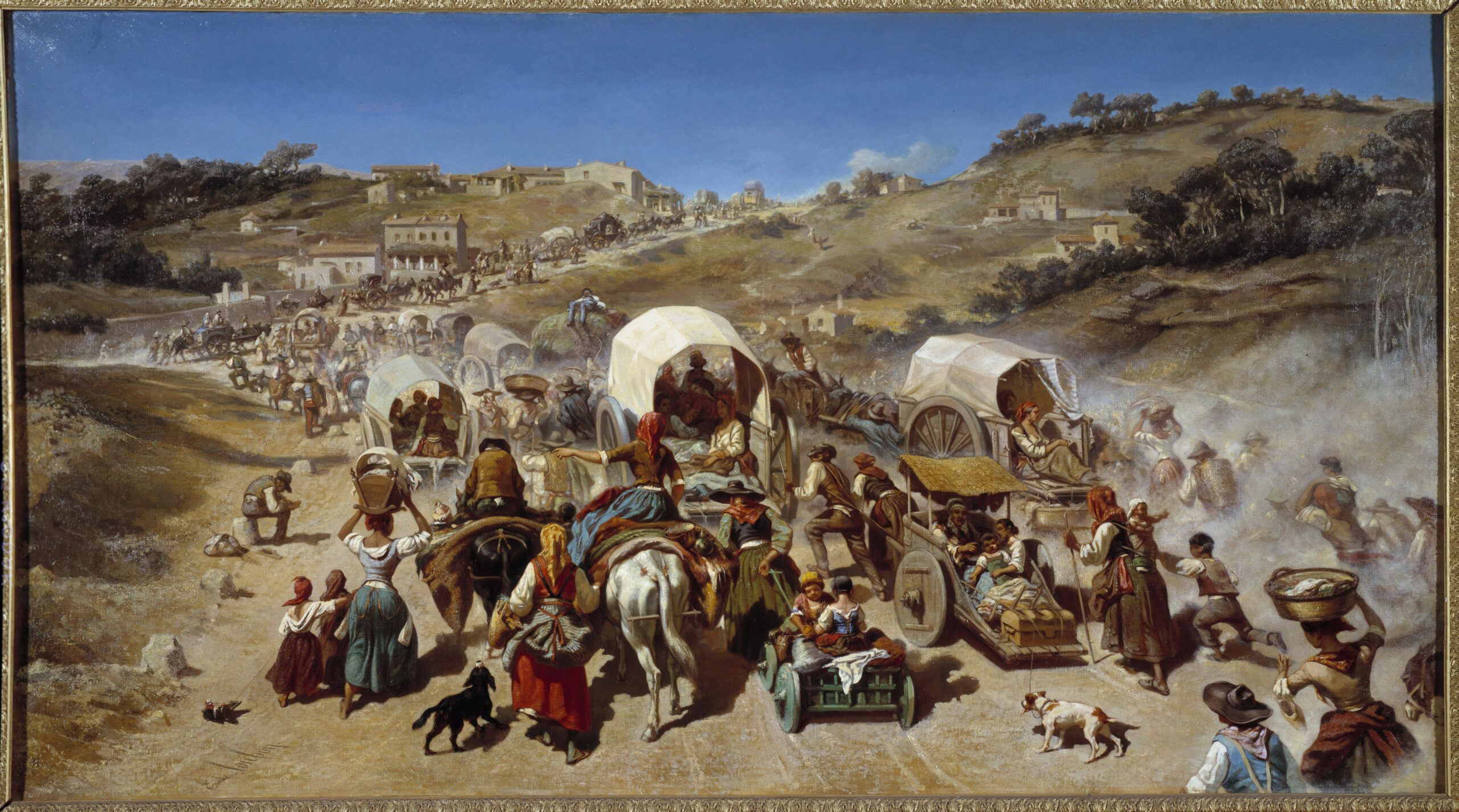
In his 1850 painting, The Flight of the People during the Cholera Epidemic in Marseille (L’Emigration pendant le cholera à Marseille) (fig. 1), French landscape painter Émile Loubon (1809-1863) depicts a frenzied mass of people hastily departing the city in order to seek refuge in the surrounding countryside of Aix-en-Provence.[10] The road in Loubon’s painting is cluttered with heavily laden carts and wagons and the clouds of dust rising up from the ground suggest the urgency with which the figures flee.
Usually only middle- and upper-class people had the financial means to flee to other areas that were potentially unaffected by the disease. Poorer individuals lacked the financial resources necessary to escape so they often had no choice but to remain in cholera-stricken areas. Some among the privileged classes blamed the poor for causing or disseminating the disease, while some working class individuals accused the rich or the government of poisoning the poor and lying about cholera. This situation exacerbated existing class tensions and these frustrations occasionally resulted in violence, rebellions, and property destruction.[11] Although Loubon’s painting does not actually depict any violence, it and others like it provide visual evidence of the widespread panic and sheer desperation caused by such outbreaks.
The anxiety caused by the fear of contracting cholera was such that people donned a variety of preventative garments in order to ward off infection. These garments included protective masks and bodily coverings to prevent direct contact with infected people or items. The intense fear caused by the possibility of infection resulted in some individuals going to extreme lengths to prevent infection. Artists, such as the creator of print published in England in 1832 depicting a comical “cholera preventative costume,” satirized the actions some took to avoid becoming infected (fig. 2).[12] Great Britain was not spared the cholera pandemics that swept through Europe. Between 1831 and 1832, at least 32,000 people in Great Britain perished from cholera; according to some estimates, the death toll was actually closer to 50,000.[13] Thus, the intense fear of contagion demonstrated by the figure in the print would have been understood by nineteenth-century viewers.
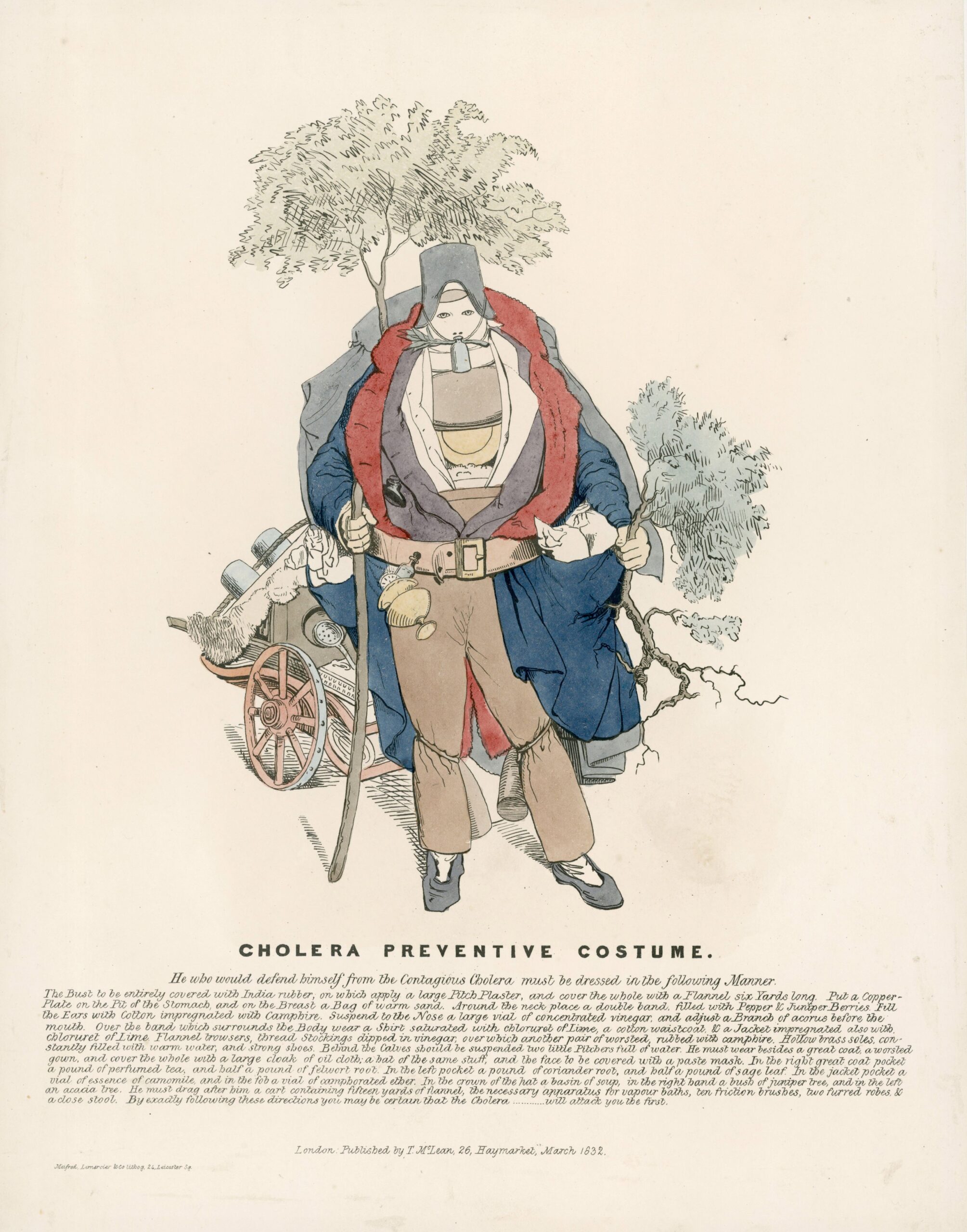
The satirical print highlights the excessive, yet ineffective, measures the man undertakes. According to the print’s caption, the man’s chest is covered with protective rubber and a copper plate shields his stomach. He carries an acacia branch in his left hand and holds a large juniper branch in his right. A glass vial containing vinegar and small twig with leaves are affixed under his nose. His ears are plugged with cotton that has been soaked in camphor. A pitcher of water is tied behind each of his calves. The man’s pockets are filled with various herbs and strong-smelling tea.[14] At the time, physicians and scientists were not aware of microbes and germs so some believed that noxious smells or fumes, especially sewage fumes, called miasmas, caused cholera. According to miasma theory garbage, rotting matter, and swamps released hazardous emanations and created a toxic atmosphere, which resulted in miasmas and, in turn, caused diseases like cholera. Avoiding contact with these harmful miasmas was believed to be one way to prevent cholera infection.[15] Thus, the use of various perfumed or strongly scented items, including camphor and peppermint oil, was believed to ward off or somehow cure cholera.[16]
However, the last sentence of the print’s lengthy caption indicates that “by exactly following these directions you may be certain that the cholera…will attack you the first.”[17] Thus, despite the deadly nature of the disease, the print mocks the hysterical levels of distress that caused some to resort to rather outlandish means or dubious methods to prevent infection. Despite the obvious satire, the attire depicted in the print and the attitudes it suggests are indicative of the serious degree of alarm and the desire for protection that arises during outbreaks, especially when there is no cure and the causes of the disease or the manner in which it spreads are not known.
In fact, fear of the disease and frustration with government officials, doctors, and hospital workers, resulted in seventy-two incidents of violence or “cholera riots” in Great Britain between 1831 and 1833. Anxiety and mistrust resulted in the circulation of rumors that the elites had manufactured or were otherwise utilizing the disease to eliminate the poor and large crowds congregated to attack hospitals.[18] Proposals to build cholera hospitals or burial grounds also met with riots and protests by those who lived in the vicinity of the proposed locations and those who offered to sell their land for such purposes were threatened or assaulted.[19] Cholera violence was, however, not limited to Great Britain and France. Throughout the nineteenth century, violent incidents related to cholera outbreaks also occurred in Germany, Russia, Italy, and other countries affected by the disease.[20] The existing social tensions during that period potentially exacerbated the spread of the disease by fueling popular unrest against and attacks on the authorities and those involved in the medical profession.[21]
These images pertaining to the spread of cholera and the attendant social issues that accompanied this epidemic are still relevant because, although some people tend to think of cholera as a disease of the past, there has been an ongoing global cholera pandemic in Asia, Africa and Latin America for the last four decades. While cholera is fairly rare in industrialized countries, cases continue to be reported in countries such as the United States and are often the result of people traveling to countries in which the disease is a common problem. In 2011, a total of fifty-eight countries reported a cumulative total of almost 600,000 cases of cholera, including almost 8,000 deaths caused by the disease. Even today, if left untreated, twenty-five to fifty percent of cholera cases worldwide can be fatal. The typical treatment for cholera is the aggressive replacement of fluids and electrolytes. Currently, two oral cholera vaccines are available; however, they are not approved for use in the United States, nor do these vaccines replace standard preventative measures such as proper hygiene and sanitation and avoiding contaminated water and food.[22]
The sheer panic caused by cholera in the nineteenth century and represented by various European artists during that time may not inspire an emotional reaction by people in industrialized nations as cholera cases in those countries are more infrequent and tend not to be regarded as cause for serious alarm. However, the terror caused by cholera outbreaks in the past is analogous to the hysteria recently seen in certain countries over the deadly infection caused by the Ebola virus. Ebola virus disease, also known as Ebola Hemorrhagic Fever, infects humans and primates and is caused by various species of the Filoviridae virus.[23] The name, Ebola, comes from the Ebola River, which is near the town Yambuku in the Democratic Republic of the Congo (DRC), previously Zaire, where the first outbreak of the disease was identified.[24]
While scientists have not definitely identified the host reservoir for Ebola virus, bats or non-human primates, including chimpanzees and gorillas, are suspected.[25] It is unknown how the virus initially infects a human, but contact with bats or non-human primates may be etiologic. Human to human spread then occurs based on direct contact with infected bodily secretions. [26] The Ebola virus is not airborne and it “is not transmitted by aerosol droplets from sneezing or respiration.”[27] Early diagnosis of Ebola is difficult because initial signs and symptoms are non-specific. A history of exposure to a known Ebola patient or to potentially infected animals is a crucial piece of information in making an early diagnosis. Lab tests can detect the Ebola virus in the blood, but usually only after the onset of a fever.[28]
The prognosis for patients with Ebola virus infection is poor; Ebola virus often kills its host within seven days of infection.[29] The morbidity and mortality rate for Ebola is high, but variable depending on which Ebola species is causative. The most lethal of the five known Ebolavirus species is Zaire ebolavirus, which can have a mortality rate as high as ninety percent.[30] Sudan ebolavirus has a mortality rate of about fifty percent.[31] Most Ebola-related procedures focus on minimizing the spread of the disease and emphasize avoiding outbreak areas, potentially infected animals, and the bodily fluids of infected persons. Consequently, many healthcare workers wear specifically designed personal protective equipment (PPE), including hooded suits, gloves, face masks, googles, and boots created from impermeable synthetic materials, that completely cover the body and help prevent exposure to the virus.[32] Interestingly, the suits worn to reduce exposure to the Ebola virus resemble the “cholera preventative costume” that was satirized in 1832 for being ridiculous and unnecessary. However, while some in the nineteenth century regraded such measures as excessive, medical aid workers combating Ebola are right to be concerned about the possibility of infection. Given the difficulty of strictly isolating infected bodily secretions and items that have come in contact with them, health care workers are at high risk for contracting Ebola.[33]
On August 8, 2019, NewLink Genetics Corp. announced that the U.S. Food and Drug Administration “accepted Merck & Co.’s Biologics License Application (BLA) and granted priority review for the investigational Ebola vaccine (V920).”[34] On August 12, 2019, it was reported that two experimental monoclonal antibody drugs decrease the mortality rate of people infected with the Ebola virus.[35] In December 2019, the U.S. Food and Drug administration announced its approval of “Ervebo, the first FDA-approved vaccine for the prevention of Ebola virus disease (EVD), caused by Zaire ebolavirus in individuals who are eighteen years of age and older.”[36] According to the WHO, “in May 2020, the European Medicines Agency recommended to grant marketing authorization to a second new vaccine delivered in two doses called Zabdeno (Ad26.ZEBOV) and Mvabea (MVA-BN-Filo) for individuals one year and older.”[37] The development of vaccines to potentially prevent EVD is a dramatic development because, in most cases, treatment is basically supportive to prevent dehydration and electrolyte imbalance, maintain oxygen levels and blood pressure, and to try to control bleeding or secondary infections.[38]
Just as the cholera outbreaks during the nineteen hundreds caused widespread alarm, the Ebola outbreaks in West Africa in 2014 and in the DRC in 2018 and 2019 have caused considerable international concern. The primary countries involved in the 2014 Ebola outbreak, which was the largest in history, were Guinea, Sierra Leone and Liberia but Nigeria and Mali were also affected.[39] Over 11, 300 people were killed during this outbreak, which lasted until 2016.[40] The 2019 outbreak, the second-largest Ebola outbreak, is currently ongoing and, as of April 10, 2020, has killed 2, 273 people.[41] Initially, Ebola virus disease was thought to be limited to equatorial Africa but the spread of the virus has proven this claim wrong.[42] These Ebola outbreaks have caused panic in non-African countries, including the United States, because, in 2014, multiple infected patients boarded planes and arrived in other countries which were previously unaffected by the outbreak.[43] In addition, several nurses and other medical staff members whose job was to treat Ebola patients were subsequently infected.[44] For instance, in Dallas, Texas in 2014, several hospital workers were infected in this way leading to a certain level of regional panic on top of that which occurred at the national level.[45]
However, rather than welcoming medical personnel, some in the DRC have greeted aid workers with hostility and violence instead. Between January and April 2019, there were 119 attacks on health centers and those responding to the Ebola crisis; in eighty-five of these attacks, health workers were injured or killed.[46] Unfortunately, attacks have continued on Ebola treatment centers and health workers in the DRC resulting in additional injuries and deaths.[47] Due to local mistrust of authorities, misinformation, and the activities of various militia groups, there has been resistance to and further threats of violence against health care workers who seek to provide vaccines and proper medical care.[48] These acts of violence against authorities and health professionals recall the cholera riots of the nineteenth century and suggest that various underlying socio-political and economic factors, rather than simply fear of the disease, are apparently exacerbating the Ebola epidemic in Africa just as these forces intensified the societal breakdowns that occurred during the cholera pandemics of the nineteenth century.
Although the near hysterical levels of concern in 2014 were largely drummed up by the media, a CDC spokeswoman admitted, “We let our guard down a little bit” with regard to Ebola protocols in preparedness.[49] According to a 2018 report issued by the U.S. Department of Health and Human Services Office of Inspector General, seventy-one percent of hospital administrators admitted that during the 2014 Ebola crisis their hospitals were not prepared to receive Ebola patients.[50] In the wake of the 2014 outbreak, heated debates ensued about the World Health Organization’s (WHO) handling of the situation and its delay in declaring a public health emergency.[51] Arguments over specific treatments, protocol breaches, quarantine, and travel restrictions also occurred.[52] In 2014, the United States Congress released $750 million dollars in order to fight the Ebola outbreak.[53] However, in 2016, President Barack Obama diverted $510 million in Ebola funding to battle the Zika virus instead.[54] Although the levels of concern about the 2019 outbreak seem less than during the 2014 outbreak and despite the existence of experimental vaccines, the current outbreak in the DRC has not been effectively contained.[55] In June 2019, the WHO claimed that the recent Ebola outbreak did not warrant a declaration of a global emergency.[56] However, that same month, it was reported that the virus had spread into Uganda.[57] On July 17, 2019, the WHO finally declared the Ebola outbreak in the DRC a global public health emergency.[58]
After this declaration was made, UNICEF admitted that the likelihood of Ebola spreading to neighboring nations was high but still urged countries bordering the DRC to “keep their borders open” and to refrain from implementing any travel restrictions lest such actions harm the communities in the outbreak zone that rely on “international trade and commerce.”[59] Despite the assurances of the WHO, UNICEF, and various other medical and humanitarian organizations that precautionary measures to prevent the spread of the virus have increased, there is still international concern that the world is, yet again, unprepared for the current Ebola outbreak, especially in light of the COVID-19 pandemic, which began in late 2019.[60]
Although many hoped the deadly outbreak was finally near its end, on April 10, 2020, a new case of Ebola was reported in the eastern DRC. This new case was reported just three days before the country was expected to announce the official end of the epidemic.[61] The country had not seen a new Ebola case in forty-two days and had pivoted some of their efforts from fighting Ebola to battling Coronavirus disease (COVID-19). Forty-two days without a new case must elapse before the Ebola outbreak can be declared over. These unexpected circumstances have exposed some of the flaws in the worldwide response to public health emergencies. Regarding the onset of the COVID-19 pandemic in the midst of the Ebola virus outbreak, Michael Ryan, Executive Director of the WHO’s Health Emergencies Programme, remarked: “Maybe that’s our lesson for COVID-19: There is no exit strategy until you’re in control of the situation. You must always be ready to start again… never be surprised.”[62]
Unfortunately, since 2020, the DRC has experienced multiple Ebola outbreaks. The DRC Ministry of Health (MoH) announced additional outbreaks of the disease on February 7, 2021[63] and then again on October 8, 2021. The October 2021 outbreak was declared over on December 16, 2021,[64] but in April 2022 yet another outbreak was announced.[65] It was declared over on July 4, 2022, but on August 21, 2022, the MoH of the DRC announced that a new, laboratory-confirmed case of EVD had been detected.[66] That outbreak, the DRC’s fifteenth Ebola outbreak since 1976, was declared over on September 27, 2022 “after the burial of the [patient who was the] only confirmed case.”[67] Thankfully, this outbreak was small and did not spread beyond the Beni health zone in the North Kivu province. However, as of September 2022, the source of the outbreak had yet to be determined. The WHO admits that due to various pressures on the country’s health system and resources “gaps remain in the [DRC’s] capacity to recover, prepare for, and respond to outbreak.” [68] Thus, even though a variety of risk reduction measures are in place, it is possible, if not likely, that the country will experience another outbreak of EVD in the future.
As evidenced by the Ebola and COVID-19 pandemics, outbreaks inspire discussions about preventative measures, including vaccines and their effectiveness. As the history of art demonstrates, the representation of the prevention of disease is attendant with the depiction of disease. This can be seen in the Detroit Industry fresco cycle, which was painted in the Garden Court of the Detroit Institute of Arts by Mexican muralist, Diego Rivera, between July 1932 and March 1933.[69] This work is considered the finest example of Mexican mural art in the United States and Rivera thought it was the best work of his career. Although this work was intended to be a tribute to the automotive industry and to the industrial labor force of Detroit, he included a variety of other elements, including a scene depicting the vaccination of an infant (fig. 3). This scene, found in the upper right of the north wall, demonstrates the beneficial aspects of scientific and medical advances. The partially swaddled infant is held up by a blonde nurse while a benevolent doctor uses a needle to vaccinate the child against smallpox. In the background, three scientists in lab coats lean over medical equipment while conducting research. In the foreground surrounding the baby are a horse, sheep and a bull. These animals might seem incongruous but they represent the source of many vaccines and serums. [70]
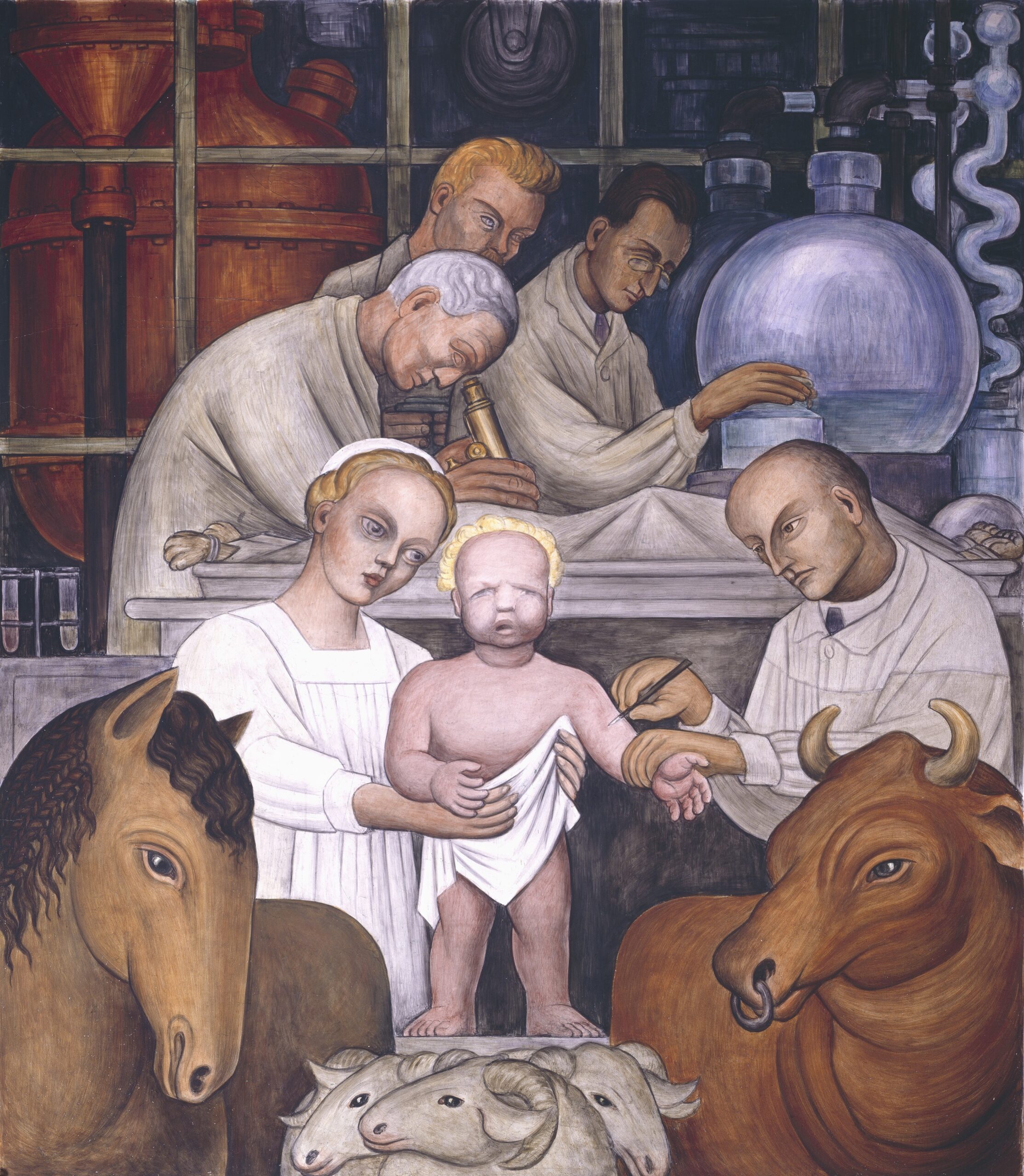
Rivera was an atheist who believed in the superiority of science over religion but the iconography of this panel was directly inspired by religious images of the Nativity created by Old Master painters, such as famed Spanish artist Diego Velázquez. [71] The vaccinated infant, the nurse and the doctor take the place of the Christ Child, the Virgin Mary, and Joseph. The three doctors or scientists in the background may reference Louis Pasteur, Ilya Metchnikoff, and Robert Koch, who were pioneers in the field of bacteriology. These figures allude to the Magi, who are usually shown in a group of three. The animals reference the livestock guarded by the shepherds.[72] These religious references created controversy when the mural was first unveiled and some even felt this specific panel was blasphemous.[73] It is debatable whether Rivera intended this panel to be intentionally inflammatory or if he was simply indifferent to the potential objections of religious viewers. Regardless, with the Vaccination panel he intended to convey his own faith in this aspect of science and to offer a hopeful message about the positive results such new advances could have. For Rivera, who was especially fascinated by medical science, groundbreaking advances in vaccines were nothing short of miraculous and, referencing the birth of Christ, was an effective way to evoke the magnitude of these life-saving serums. [74

Below the vaccination scene, Rivera painted an image of a healthy human embryo in its sac floating above an egg, indicating a previous stage of development (fig. 4). The gestating embryo is surrounded by red and white blood cells, multiplying chromosomes, and by disease-causing bacteria. These bacteria reference the experiments of the three scientists shown in the Vaccination panel.[75] Thus, when the Vaccination panel and the Healthy Human Embryo panel are viewed together, they suggest the human life cycle and extol the virtues of medical advances that create medicines, such as vaccines, that protect babies who will grow into children who can be free of certain diseases because of inoculations. Together, these images of the beneficial aspects of medical research and scientific advancement provide a hopeful message about the ways in which modern medicine can contribute to overall human well-being and the betterment of society.[76]
Rivera’s positive portrayal of the scientific and medical breakthroughs leading to vaccines is still relevant today because, recently, there have been very public disagreements about vaccines, especially the vaccination of children. For many years, there was minimal controversy over vaccines and many people, including Rivera, were impressed and grateful for the power of vaccines to prevent and, ultimately, eliminate diseases. For instance, smallpox epidemics raged throughout the world for hundreds of years and people were rightly terrified of contracting this horrible disease. However, today, most people have no fear of this disease and primarily think of it as a historical ailment. This attitude is largely because smallpox has been so widely vaccinated for that, today, it basically only exists in viral cultures in research labs and it is the best example of eradicating a disease by vaccination. Similarly, polio was a distinct concern for people even into the nineteen-fifties and some people were crippled and lost motor function as a result of contracting the disease. Today, polio has been greatly reduced but not completely eliminated worldwide as a result of vaccination programs.
Despite these vaccination success stories, in recent years there has been controversy over the supposed link between vaccines and autism in children. Certain vaccines, including the MMR vaccine for measles, mumps, and rubella, are given to children between twelve to fifteen months of age[77] and the first signs of autism often appear at twelve to eighteen months of age.[78] This is purely a coincidence but it has caused some concern about a possible link between vaccines and the development of autism.[79] An erroneous study has also fueled the rise of the contemporary anti-vaccination movement comprised of individuals, the so-called “anti-vaxxers,” who refuse to vaccinate their children.[80] Even though the original study which initially fueled the debate was debunked and subsequently retracted, the debate continues to linger. A 1998 study published in the journal The Lancet largely started the concern about the supposed link between the MMR vaccine and autism; however, in 2012, The Lancet retracted the study citing a potential conflict of interest on the part of, Andrew Wakefield, the lead author.[81]
Since the publication of the 1998 study, numerous additional international studies have confirmed the safety of vaccines and have repeatedly denied that there is any link between vaccines and autism.[82] In subsequent studies, medical and scientific researchers, including those at the Centers for Disease Control, have not found any connection between autism and childhood vaccines. Since 2003, there have been nine CDC-funded studies and many other studies not funded by the CDC in both the United States and Europe which have shown no causal link between vaccines or their ingredients and Autism Spectrum Disorder (ASD).[83] Furthermore, in 2004, ten of the twelve original authors disavowed the interpretation of the 1998 study and claimed there was “no causal link” between the MMR vaccine and autism.[84] In addition, in 2011, the editors of the British Medical Journal declared Wakefield’s article about the supposed link between autism and the MMR vaccine to be “fraudulent.”[85] Journalist Brian Deer investigated Wakefield’s research and found evidence of falsification. Evidently, Wakefield changed facts about the patients’ medical histories and misreported data in order to support his claims. He has repeatedly declined opportunities to replicate his paper’s findings or to retract them. He also refused to participate in his co-author’s 2004 retraction of the study. Despite being stripped of both his medical and academic credentials, Wakefield still continues to advocate for his discredited views.[86]
In the medical community, it is largely accepted that the 1998 study was inaccurate and has been thoroughly debunked. In addition, the results of a study performed by researchers at the Statens Serum Institute in Copenhagen, Denmark published in 2019 in the Annals of Internal Medicine indicate that the MMR vaccine does not increase the risk of autism.[87] In fact, the study found that children who received no vaccinations whatsoever were seventeen percent more likely to be diagnosed with autism than children who received the medically recommended vaccinations.[88] Furthermore, the results of a recent study involving over two million people in five different countries indicate that the risk of developing autism spectrum disorder (ASD) is eighty-percent determined by inherited genetic factors, not environmental ones.[89]
Unfortunately, concerns about the supposed connection between the MRR vaccine and autism has fueled a serious international measles outbreak and there has been a thirty percent increase in the number of global cases of measles.[90] Measles is extremely contagious and ninety percent of people who are unvaccinated will become infected if exposed to the measles virus.[91] The United States is currently in the midst of the worst measles outbreak in twenty-five years. The measles virus seems to have primarily spread among school-age children whose parents decided to forgo the MMR vaccine.[92] In 2000, the disease was actually eliminated from the U.S., meaning that according to the Center for Disease Control (CDC), it was no longer “endemic (constantly present)” in that country.[93] However, travelers from other countries have periodically brought the disease back into the U.S.[94] The 2019 outbreak seems to have begun in New York City when an unvaccinated child traveled abroad, became infected with measles, returned to the U.S., and infected other children, many of whom were also unvaccinated. Between January 1 and December 31, 2019, 1,282 cases of measles were confirmed in thirty-one states.[95] In January 2019, officials in the state of Washington declared a State of Emergency due to the severity of the measles outbreak there[96] and, due to the prevalence of anti-vaxxers in that state, many in the American media blamed the anti-vaccine crusaders for the outbreak.[97] The fact that over ninety percent of the measles cases in the U.S. involve unvaccinated children has contributed to the censuring of anti-vaxxers.[98]
The pattern of an unvaccinated international traveler bringing back the disease and exposing others has continued in 2020. For instance, in January 2020, an international traveler, who was confirmed to have measles, arrived as the Los Angeles International Airport and potentially exposed numerous people to the disease.[99] In February 2020, another international traveler, who was not vaccinated, exposed multiple local residents to measles and at least four of them were later confirmed as having measles.[100] As of May 7, 2020, twelve cases of measles had been confirmed in seven states and the District of Columbia.[101]
The measles outbreak is occurring outside the United States as well. According to the WHO, over 34,000 people in forty-two European countries were infected with the disease in the first two months of 2019.[102] In May 2019, new reports indicated that over 100,000 cases of measles had been reported in forty-seven of the fifty-three countries in Europe since the beginning of 2018. WHO officials attributed the ongoing spread of the disease to “non-immunized or under-immunized individuals.”[103] For 2019, the CDC confirmed that more than 500,000 cases of measles in over 180 countries were reported. In 2016, the WHO declared the United Kingdom to be “measles free,” meaning that none of the countries’ cases originated in the UK, but it lost that status because of the 2019 outbreak. Although measles is not usually fatal, it can cause life-threatening complications.[104] In 2017, the CDC estimated that 110,000 people died of measles; in 2018, that number was estimated at 140,000.[105]
Outbreaks of measles have also affected various countries in Asia and Africa.[106] Although the media coverage of the DRC has almost exclusively focused on Ebola, in June 2019, health officials there declared a measles epidemic and announced that the disease has actually killed more people than Ebola. As of August 9, 2019, over 165,000 suspected cases of measles had been reported in the DRC. Of these cases, over 3,200 were fatal[107] and over two-thirds of them occurred among children under age the age of five. [108] Sadly, this outbreak has escalated and, as of April 2020, over 330,000 suspected cases of measles had been reported and more than 6,200 people in the DRC, including 5,3000 children, have died as a result of measles.[109] Through various international and local efforts, eighteen million children under the age of five were vaccinated in 2019; however, the overall number of people who received vaccinations remained low.[110] In the DRC in 2019, measles killed approximately three times more people in one week than the Ebola virus.[111] As a result, health workers in the DRC began coordinating their efforts to vaccinate people against measles and deliver Ebola-related aid.[112] However, the violence directed against medical workers assisting with the Ebola outbreak extends to those trying to provide measles vaccines. Thus, “the containment response” for both diseases is, regrettably, “being stalled.”[113] In addition, the recent coronavirus pandemic and ongoing outbreak of polio and cholera have further complicated the response to the measles outbreak. The existing health system in the DRC is weak and the onslaught on multiple simultaneous disease outbreaks is overwhelming the already fragile system, which is struggling with a lack of funds, medical supplies and equipment, and health facilities. The impending recession caused by the coronavirus will likely result in additional difficulties for the DRC’s already overwhelmed health system.[114]
Although measles is a highly contagious disease, the vaccine is over ninety-seven percent effective.[115] The fact that so many people have fallen ill with this preventable disease has caused alarm in the medical community. WHO even included “vaccine hesitancy” on its list of “ten threats to global health in 2019” and reaffirmed its commitment to provide vaccines and “credible information on vaccines” to people worldwide.[116] Despite any lingering controversy, “childhood vaccines protect children from a variety of serious and potentially fatal illnesses including diphtheria, measles, meningitis, polio, tetanus and whopping cough.” [117] Although “any vaccine [may] cause side effects, usually, these side effects are minor…”; rare, more serious side effects can happen but vaccines are safer than a child’s first exposure to serious diseases[118] and thwart vulnerability “to potentially serious diseases that could otherwise be avoided.”[119] The fact that many of these “diseases seem uncommon…is…because vaccines are doing their job,” which is to prevent individuals from contracting these diseases in the first place.[120]
Vaccine hesitancy includes complacency. The success of vaccinations in almost eliminating certain diseases has potentially caused some people to become complacent. When diseases, such as measles, become less common, some people cease to believe these illnesses are a threat and are thus less likely to receive vaccinations or vaccinate their children.[121] For vaccine complacent individuals, the supposed risks of vaccines outweigh the risks of contracting diseases that their communities have not experienced in years. Even health care providers who do not have firsthand experience treating patients with diseases such as measles might also become complacent in advocating for these vaccinations, which can amplify nonvaccination behavior.[122]
Decreased vaccinations have also been a side effect of the coronavirus pandemic. In May 2020, the CDC published a report indicating that many Americans avoided routine doctor visits due to the pandemic. Based on immunization data for babies and toddlers between one-month and twenty-four months old collected from the state of Michigan, the CDC noted that the state’s stay-at-home order, which was intended to curb the spread of the virus, had the unintended side-effect of affecting the number of people who were given routine vaccinations. In all age groups, the number of people who received routine vaccinations declined and the CDC warned that this decline will potentially leave children and communities vulnerable to diseases that could otherwise be prevented by vaccines.[123] This concern is not limited to the United States. The WHO issued a similar warning and announced that travel restrictions have resulted in vaccine shortages for some countries; other countries have temporarily postponed providing vaccinations and other health-related services. While these measures are intended to halt the spread of the coronavirus, the unforeseen consequence will likely be an increase in the number of cases of diseases, such as measles and polio that are preventable with vaccines.[124]
As the artists and images discussed in this paper demonstrate, art and visual culture highlight health-related problems, anxieties about diseases, and discussions about medical treatments that have existed for centuries. For modern-day people, including art historians and those involved in the medical profession, it is interesting to look back at these images to note the similarities and differences between people’s perspectives and the various technologies and methods used throughout time. Indeed, while it can be easy to look at medical-related images that were created in the past and forget their relevance to contemporary life, it is important to remember the lessons about human nature and scientific advancements taught to us by history and illustrated for us by the art and visual culture of past eras. In The Life of Reason (1905-1906), philosopher George Santayana wrote, “Those who cannot remember the past are condemned to repeat it.”[125] While this is true, it does not adequately represent the full picture. Those who neglect to study history and the various social, cultural and even medical aspects of history depicted in art and visual culture miss out on the opportunity to construct important bridges between the past and the present and to use those links to further illuminate important issues that are just as relevant to people today, especially in the wake of the coronavirus pandemic, as they were hundreds of years ago and in the more recent past.
[1] Laurinda Dixon, “Introduction- Visual Prescriptions: In Sickness and in Health,” in In Sickness and in Health: Disease as Metaphor in Art and Popular Wisdom, ed. Laurinda S. Dixon (Newark: University of Delaware Press, 2004), 9.
[2] Ibid, 10.
[3] Richard J. Evans, “Epidemics and Revolutions: Cholera in Nineteenth Century Europe,” Past & Present, no. 120 (Aug. 1988): 125.
[4] S.L. Kotar and J.E. Gessler, Cholera: A Worldwide History (Jefferson, NC: McFarland, 2014), 6-8.
[5] Stephen W. Lacey, “Cholera: Calamitous Past, Ominous Future,” Clinical Infectious Diseases 20, no. 5 (May 1995): 1410.
[6] Nina Athanassoglou-Kallmyer, “Blemished Physiologies: Delacroix, Paganini, and the Cholera Epidemic of 1832.” The Art Bulletin 83, no. 4 (Dec. 2001): 686. In 1832, the population of Paris was approximately 785,000. 35,000 people in Paris had become ill with cholera but 18,000 of them died.
[7] Emile Zola, The Mysteries of Marseille, ed. Andrew Moore, trans. Edward Vizetelly (New York: Mondial, 2008), 297-298.
[8] J.N. Hays, The Burdens of Disease: Epidemics and Human Response in Western History (New Brunswick, NJ: Rutgers University Press, 2009), 142-143.
[9] R. Barbieri and M. Drancourt, “Two Thousands Years of Epidemics in Marseille and the Mediterranean Basin,” New Microbes and Infections 26, no. 1 (Nov. 2018): S7.
[10] Gabriel P. Weisberg, “Cholera as Plague and Pestilence in Nineteenth Century Art,” in In Sickness and in Health: Disease as Metaphor in Art and Popular Wisdom, ed. Laurinda S. Dixon (Newark: University of Delaware Press, 2004), 83.
[11] Dominique Buchillet, “Epidemic Diseases in the Past: History, Philosophy, and Religious Thought,” in Encyclopedia of Infectious Diseases: Modern Methodologies, ed. Michel Tibayrenc (Hoboken, NJ: Wiley, 2007), 523. Some felt that the symptoms of cholera (vomiting, diarrhea, convulsions) were similar to the symptoms of poisoning, which gave rise to rumors that the disease was simply a cover story to mask the mass poisoning of the poor by the rich, the government, medical doctors, etc.
[12] “Cholera Preventive Costume,” Wellcome Collection, accessed September 1, 2019, https://wellcomecollection.org/works/zh9s7sb4.
[13] Amanda J. Thomas, Cholera: The Victorian Plague (Barnsley, UK: Pen and Sword History, 2015), 104.
[14] “Cholera Preventive Costume.”
[15] William Coleman and I. Edward Alcamo, Cholera (New York: Infobase Publishing, 2009), 9.;
[16] Kotar and J.E. Gessler, Cholera, 66; John Rutherfurd Russell et al, eds., The British Journal of Homoepathy 40 (London: Maclachlan, Stewart and Company, 1882): 303. In response to a question by E.W. Berridge, M.D., the Journal’s editors note that Dr. Hahnemann recommended using camphor against cholera because it supposedly “destroyed the animated miasma of which he considered the contagion of cholera consisted.”
[17] “Cholera Preventive Costume.”
[18] Samuel K. Cohn, Jr. Epidemics: Hate and Compassion from the Plague of Athens to AIDS (Oxford, UK: Oxford University Press, 2018), 163-164.
[19] Pamela K. Gilbert, Cholera and Nation (Albany, New York: State University of New York Press 2008), 58-59.
[20] Cohn, Jr., Epidemics, 183, 200, 330, 400.
[21] Evans, “Epidemics and Revolutions,” 136.
[22] Centers for Disease Control and Prevention, “General Information,” Cholera – Vibrio cholerae infection, last modified May 11, 2018, http://www.cdc.gov/cholera/index.html. Specifically the cases of cholera number 589, 854 and the number of deaths numbers at 7,816.
[23] Centers for Disease Control and Prevention, “What is Ebola Virus Disease?,” Ebola (Ebola Virus Disease), last modified November 5, 2019, http://www.cdc.gov/vhf/ebola/index.html.
[24] Adnan I. Qureshi, Ebola Virus Disease: From Origin to Outbreak (Amsterdam: Elsevier Science, 2016), 25.
[25] Ibid, 168-169.
[26] Centers for Disease Control and Prevention, “What is Ebola Virus Disease?,” Ebola (Ebola Virus Disease), last modified November 5, 2019, http://www.cdc.gov/vhf/ebola/index.html.
[27] Barry S. Hewlett and Bonnie L. Hewlett, Ebola, Culture, and Politics: The Anthropology of an Emerging Disease (Boston: Cengage Learning, 2008), 159
[28] Centers for Disease Control and Prevention, “Diagnosis,” Ebola (Ebola Virus Disease), last modified November 5, 2019, https://www.cdc.gov/vhf/ebola/diagnosis/index.html.
[29] Hewlett and Hewlett, Ebola, Culture, and Politics, 159.
[30] Nicholas J. Beeching, Fenech Manuel, and Catherine F. Houlihan, “Ebola virus disease,” BMJ 349 (Dec. 10, 2014), http://dx.doi.org.ezproxy.uttyler.edu:2048/10.1136/bmj.g7348. The five species of Ebolavirus are Bundibugyo, Sudan, Zaire, Reson, and Tai Forest.
[31] Centers for Disease Control and Prevention, “Ebola Virus Distribution Map: Cases of Ebola Virus Disease in Africa Since 1976,” Ebola (Ebola Virus Disease) (June 29, 2019), https://www.cdc.gov/vhf/ebola/history/distributionmap.html
[32] Jason Beaubien, “Gear Wars: Whose Ebola Protective Suit in Better?” NPR (Oct. 25, 2014), https://www.npr.org/sections/goatsandsoda/2014/10/25/358898029/gear-wars-whose-ebola-protective-suit-is-better.
[33] “Ebola Hemorrhagic Fever.”
[34] Chris Lange, “Will This Ebola Vaccine Be the Next Big Thing?.” Microsoft News (Aug. 18, 2019), https://www.msn.com/en-us/money/companies/will-this-ebola-vaccine-be-the-next-big-thing/ar-AAHu4QQ.
[35] AFP and Amelia Wynne, “Ebola ‘is curable’: Two drugs radically boost survival rates for terrifying disease, World Health Organization study finds,” Daily Mail (Aug. 12, 2019), https://www.dailymail.co.uk/news/article-7350709/Two-Ebola-drugs-increase-survival-rates.html. The two drugs are REGN-EB3 and mAb114.
[36] U.S. Food and Drug Administration, “First FDA-approved vaccine for the prevention of Ebola virus disease, marking a critical milestone in public health preparedness and response,” U.S. Food and Drug Administration press release (Dec. 19, 2019), https://www.fda.gov/news-events/press-announcements/first-fda-approved-vaccine-prevention-ebola-virus-disease-marking-critical-milestone-public-health,.
[37] World Health Organization, “Is there a vaccine against Ebola virus disease?,” Ebola virus disease: Vaccines (Jan. 11, 2020), https://www.who.int/news-room/questions-and-answers/item/ebola-vaccines.
[38]Centers for Disease Control and Prevention, “Treatment,” Ebola (Ebola Virus Disease), last modified November 5, 2019, https://www.cdc.gov/vhf/ebola/treatment/index.html.
[39] Agata Blaszczak-Boxe, “The deadly history of Ebola outbreaks,” CBS News (Aug. 11, 2014) https://www.cbsnews.com/news/the-deadly-history-of-ebola-outbreaks/
[40] Centers for Disease Control and Prevention, “CDC Releases Detailed History of the 2014-2016 Ebola Response in MMWR,” Centers for Disease Control and Prevention press release (July 7 2016), https://www.cdc.gov/media/releases/2016/p0707-history-ebola-response.html.
[41] The Telegraph Foreign Staff, “New Case of Ebola in DR Congo two days before WHO set to announce end to outbreak.” The Telegraph (Apr. 10, 2020), https://www.telegraph.co.uk/news/2020/04/10/new-case-ebola-two-days-set-announce-end-outbreak/. The 2019 outbreak is the tenth outbreak of Ebola virus disease in the DRC.
[42] Qureshi, Ebola Virus Disease, 24.
[43] “Ebola plane travel scare has officials on edge,” CBS News (July 29, 2014). https://www.cbsnews.com/news/ebola-plane-travel-scare-has-officials-on-edge/; Mark Berman, “Health-care worker with Ebola flew on commercial flight a day before being diagnosed,” The Washington Post (Oct. 15, 2014). https://www.washingtonpost.com/news/post-nation/wp/2014/10/15/ebola-stricken-nurse-flew-on-a-passenger-plane-a-day-before-being-diagnosed/?noredirect=on&utm_term=.205f71bc1eaf.
[44] Thomson Reuters, “Ebola outbreak: Infected British health-care worker returns to U.K., Canadian Broadcasting Company (Aug. 24, 2014). https://www.cbc.ca/news/health/ebola-outbreak-infected-british-health-care-worker-returns-to-u-k-1.2745330; Rick Jervis and John Bacon, “‘Breach in protocol’ caused second U.S. Ebola infection,” USA Today (Oct. 12, 2014). https://www.usatoday.com/story/news/nation/2014/10/12/texas-health-care-worker-ebola/17147449/.
[45] Meghan Keneally, “Second Nurse with Ebola Arrives at Emory,” ABC News (Oct. 15, 2014), https://abcnews.go.com/Health/nurse-ebola-arrives-emory/story?id=26212955.
[46] Sara Newey, “UK scrambles to boost aid as Congo’s Ebola crisis ‘spirals dangerously out of control,’” The Telegraph (May 20, 2019). https://www.telegraph.co.uk/global-health/science-and-disease/safe-burials-risk-congos-ebola-crisis-hits-tipping-point/.
[47] Saleh Mwanamilongo, “Ebola Treatment Center in Congo is Attacked Again; 1 Dead,” U.S. News (March 9, 2019), https://www.usnews.com/news/world/articles/2019-03-09/ebola-treatment-center-in-congo-is-attacked-again-1-dead; Nurith Aizenman, “Why Health Care Workers in the Ebola Hot Zone are Threatening to Strike,” National Public Radio (April 25, 2019). https://www.npr.org/sections/goatsandsoda/2019/04/25/717079729/why-health-workers-in-the-ebola-hot-zone-are-threatening-to-strike.
[48] Al-Hadji Kudra Maliro, “City in Congo’s Ebola outbreak attacked by militia; 8 dead,” AP News (May 8, 2019). https://www.apnews.com/88e7470b6b0440e081a253671f6e9c14.
[49] Lena H. Sun, Brady Dennis, and Elahe Izadi, “Dallas Ebola case spurs concern about hospital readiness,” The Washington Post (Oct. 2, 2014). https://www.washingtonpost.com/national/health-science/dallas-ebola-case-spurs-concern-about-hospital-readiness/2014/10/03/4afa10b2-4b30-11e4-a046-120a8a855cca _story.html?utm_term=.1c5f
b616375c. The CDC spokeswoman was Abbigail Tumpey.
[50] Suzanne Murrin, “Hospitals Reported Improved Preparedness for Emerging Infectious Diseases After the Ebola Outbreak,” U.S. Department of Health and Human Services: Office of Inspector General (Oct. 2018), no page. https://www.oig.hhs.gov/oei/reports/oei-06-15-00230.pdf.
[51] Sarah Bosely, “Ebola is all but over, but the postmortem is just getting started,” The Guardian (Sept. 30, 2015). https://www.theguardian.com/world/2015/sep/30/ebola-inquest-un-united-nations-world-health-organisation; Sarah Boseley, “Experts criticise WHO delay in sounding alarm over Ebola outbreak,” The Guardian (Nov. 22, 2015), https://www.theguardian.com/world/2015/nov/22/experts-criticise-world-health-organisation-who-delay-ebola-outbreak.
[52] Julia Steenhuysen, “U.S. CDC head criticized for blaming ‘protocol breach’ as nurse gets Ebola.” Reuters (Oct. 12, 2014), https://www.reuters.com/article/us-health-ebola-usa-nurse-idUSKCN0I206820141013.
[53] Kristina Peterson, “Congress Releases Funding to Aid Fight Against Ebola,” The Wall Street Journal (Oct. 10, 2014), https://www.wsj.com/articles/congress-releases-funding-to-aid-fight-against-ebola-1412959345
[54] Gregory Korte, “As Congress stalls funding, White House will move Ebola funds to Zika,” USA Today (April 6, 2016), https://www.usatoday.com/story/news/politics/2016/04/06/congress-stalls-funding-white-house-move-ebola-funds-zika/82697046/.
[55] Nadia Drake, “The world’s second-biggest Ebola outbreak is still raging. Here’s why.” National Geographic (May 24, 2019), https://www.nationalgeographic.com/science/2019/04/worlds-second-biggest-ebola-outbreak-still-raging-heres-why-hot-zone/.
[56] “Ebola outbreak still not a global emergency, World Health Organization says,” CBS News (June 14, 2019), https://www.cbsnews.com/news/ebola-outbreak-global-emergency-world-health-organization-congo-uganda-live-updates-2019-06-14/.
[57] Jasmine Aguilera, “Ebola has killed 1,300 in DRC and It Just Crossed the Border to Uganda. Here’s What to Know About the Outbreak,” Time (June 14, 2019), https://time.com/5606544/ebola-outbreak-drc-uganda/.
[58] Nicholas Bariyo, “Ebola Epidemic in Congo Declared a Global Health Emergency,” The Wall Street Journal (July 17, 2019), https://www.wsj.com/articles/ebola-epidemic-in-congo-deemed-a-global-health-emergency-11563386422.
[59] “Ebola Crisis in DRC Declared a Public Health Emergency,” Forbes (July 17, 2019), https://www.forbes.com/sites/unicefusa/2019/07/17/ebola-crisis-in-drc-declared-a-public-health-emergency/#2f85e7927785
[60] Sarah Newey, “World must ‘step up’ in the fight against an escalating outbreak,” The Telegraph (Apr. 16, 2019), https://www.telegraph.co.uk/global-health/science-and-disease/world-must-step-fight-against-escalating-ebola-outbreak/; Lawrence Gostin, et al. “Ebola in the Democratic Repulic of the Congo: time to sound a global alert?,” The Lancet 393, no. 10172 (Feb. 16, 2019): 617-620.
[61] The Telegraph Foreign Staff, “New Case of Ebola.”
[62] Associated Press, “New Ebola Case in Congo, Days Before Outbreak’s Expected End.” U.S. News and World Report (April 10, 2020), https://www.usnews.com/news/world/articles/2020-04-10/new-ebola-case-in-congo-days-before-outbreaks-expected-end.
[63] “MSF responds in North Kivu to twelfth Ebola outbreak in DRC,” Medecins Sans Frontieres (Feb. 25, 2021), https://www.msf.org/msf-responds-north-kivu-twelfth-ebola-outbreak-drc.
[64] “DRC’s thirteenth Ebola outbreak,” Medecins Sans Frontieres (Dec. 20, 2021), https://www.msf.org/drc-ebola-outbreak-crisis-update.
[65] “New Ebola outbreak declared in the Democratic Republic of Congo,” UN News (April 23, 2022), https://news.un.org/en/story/2022/04/1116762.
[66] World Health Organization “Outbreak at a glance,” Ebola virus disease – Democratic Republic of the Congo. (Aug. 25, 2022), https://www.who.int/emergencies/disease-outbreak-news/item/2022-DON404.
[67] World Health Organization, “Situation at a glance,” Ebola Virus Disease – Democratic Republic of the Congo (Sept. 29, 2022), https://www.who.int/emergencies/disease-outbreak-news/item/2022-DON411.
[68] Ibid.
[69] Terry Smith, Making the Modern: Industry, Art, and Design in America (Chicago: University of Chicago Press, 1993), 203. This fresco cycle, which consists of twenty-seven panels, was funded by Henry Ford’s son, Edsel. The murals were intended to pay homage to the industrial accomplishments of Detroit, Michigan.
[70] Dorothy McMeekin, Science and Creativity in the Detroit Murals (East Lansing, MI: Michigan State University Press, 1985), 25.
[71] Niria E. Leyva-Gutiérrez, “Painting the Revolutionary Body: Anatomy and the Remaking of Mexican History in the Murals of Diego Rivera,” in Visualizing the Body in Art, Anatomy, and Medicine Since 1800, ed. Andrew Graciano (New York: Routledge, 2019), 163.
[72] McMeekin, Science and Creativity in the Detroit Murals, 26.
[73] Smith, Making the Modern, 241.
[74] Leyva-Gutiérrez, “Painting the Revolutionary Body,” 159.
[75] Ibid, 164. The disease-causing bacteria are related to tetanus, anthrax, typhoid, diphtheria, cholera, and tuberculosis.
[76] Within the scheme of the mural as a whole, the Vaccination panel is countered by The Manufacture of Poison Gas panel in the upper left of the north wall. Just as the Vaccination panel shows the positive aspects of scientific progress, the Poison Gas panel, in which men wearing hazardous materials suits create mustard gas. Below this image, the panel Cells Suffocated by Poison Gas demonstrate the terrible effects of the eponymous material and contrast with the Healthy Human Embryo panel that is below the Vaccination scene.
[77] Centers for Disease Control and Prevention, “What is MMRV Vaccine?,” Vaccines and Preventable Diseases, last modified March 28, 2019, https://www.cdc.gov/vaccines/vpd/mmr/public/index.html#what-is-mmr.
[78] National Institute of Child Health and Human Development, “When do children usually show symptoms of autism?,”Autism Spectrum Disorder (ASD), last modified January 31, 2017, https://www.nichd.nih.gov/health/topics/autism/conditioninfo/symptoms-appear.
[79] Stephen Adams, “New fears over MMR link to autism,” The Telegraph (July 8, 2007). https://www.telegraph.co.uk/ news/uknews/1556766/New-fears-over-MMR-link-to-autism.html.
[80] Paige Winfield Cunningham, “Who are the anti-vaxxers?,” The Washington Examiner (March 2, 2015). https://www. washingtonexaminer.com/who-are-the-anti-vaxxers. In England and the United States in both the 1970s and 1980s, anti-vaccine activists crusaded against the pertussis vaccine, which they claimed caused permanent brain damage in children. The controversy over the pertussis vaccine resulted in the modern anti-vaccine movement, which began in England and then gained a foothold in America. See Paul A. Offit, Deadly Choice: How the Anti-Vaccine Movement Threatens Us All (New York: Basic Books, 2015).
[81] “A Statement by the Editors of The Lancet.” The Lancet (Feb. 23, 2004), no page, https://www.thelancet.com/pb-assets/Lancet/extras/statement20Feb2004web.pdf.
[82] American Academy of Pediatrics, “Vaccine Safety: Examine the Evidence,” (April 2013), no page, https://www.aap.org/en-us/Documents/immunization_vaccine_studies.pdf. .
[83] Centers for Disease Control and Prevention, “Autism,” Vaccine Safety, last modified March 26, 2020, https://www.cdc.gov/vaccinesafety/concerns/autism.html.
[84] Simon H. Murch, Andrew Anthony, David H. Casson, Mohsin Malik, Mark Berelowitz, Amar P. Dhillon, Michael A. Thomson, Alan Valentine, Susan E. Davies, and John A. Walker-Smith. “Retraction of an Interpretation.” The Lancet 363, no. 9411 (March 6, 2004): 750.
[85] Fiona Godlee, Jane Mith, and Harvey Marcovitch, “Wakefield’s article linking MMR vaccine and autism was fraudulent: Clear evidence of falsification of data should now close the door on this damaging vaccine scare,” British Medical Journal 342, no. 7788 (Jan. 8, 2011): 64. In 2011, Godlee was the editor in chief of the British Medical Journal; Smith was the deputy editor and Marcovitch was the associate editor.
[86] Ibid, 65.
[87] Isaac Stanley-Becker, “Measles vaccine doesn’t cause autism, says a decade-long study of half a million people,” The Washington Post (March 5, 2019). https://www.washingtonpost.com/nation/2019/03/05/measles-vaccine-doesnt-cause-autism-says-new-decade-long-study-half-million-people/?noredirect=on&utm_term=.20c133c16e88.
[88] Reuters, “Another study finds no link between autism and measles, mumps and rubella vaccine.” NBC News (March 4, 2019), https://www.nbcnews.com/health/kids-health/another-study-finds-no-link-between-autism-measles-mumps-rubella-n979176.
[89] Catherin Peason, “Genetics By Far the Biggest Factor in Autism Risk, Study Says,” The Huffington Post (July 17, 2019), https://www.huffpost.com/entry/autism-genetics-risk_l_5d2f51aee4b0a873f645a519.
[90] World Health Organization, “Ten threats to global health in 2019,” (Mar. 21, 2019), https://www.who.int/vietnam/news/feature-stories/detail/ten-threats-to-global-health-in-2019.
[91] Centers for Disease Control and Prevention, “Global Measles Outbreaks,” Global Health, last modified March 6, 2020, https://www.cdc.gov/globalhealth/measles/globalmeaslesoutbreaks.htm.
[92] “Measles outbreak spreads to Oklahoma as U.S. reports 41 new cases,” Reuters (May 20, 2019), https://www.reuters.com/article/us-usa-measles-idUSKCN1SQ1LU
[93] Centers for Disease Control and Prevention. “Questions about Measles” Measles (Rubeola), last modified May 17, 2019, https://www.cdc.gov/measles/about/faqs.html. The CDC defines “elimination” as “the absence of continuous disease transmission for twelve months or more in a specific geographic area.”
[94] “Measles outbreak spreads to Oklahoma.”
[95] Centers for Disease Control and Prevention, “Cases and Outbreaks,” Measles (Rubeola), last modified May 2 2020, https://www.cdc.gov/measles/cases-outbreaks.html
[96] Vanessa Romo, “Washington State Officials Declare State of Emergency as Measles Outbreak Continues,” National Public Radio (Jan. 28, 2019), https://www.npr.org/2019/01/28/689549375/washington-state-officials-declare-state-of-emergency-as-measles-outbreak-contin.
[97] Tom Howell, Jr. “Health officials devise new ways to immunize Americans after ‘anti-vaxxers’ drive measles outbreak,” The Washington Times (Feb. 18, 2019), https://www.washingtontimes.com/news/2019/feb/18/anti-vaxxers-drive-measles-outbreak-cdc-seeks-new-/.
[98] Howell, Jr. “Health officials devise new ways to immunize Americans.”
[99] City News Service, “New Measles Case Confirmed at LAX and Brentwood Pharmacy,” NBC Los Angeles (Jan. 20, 2020), https://www.nbclosangeles.com/news/new-measles-case-confirmed-at-lax-and-brentwood-pharmacy/2295043/.
[100] Priscilla Vega, “International visitor with measles infects 4 L.A. County residents,” Los Angeles Times (Feb. 5, 2020), https://www.latimes.com/california/story/2020-02-05/international-visitor-with-measles-infects-4-l-a-county-residents.
[101] Centers for Disease Control and Prevention, “Cases and Outbreaks.”
[102] Kate Kelland, “WHO issues warning as measles infects 34,000 in Europe this year,” Reuters (May 7, 2019), https://www.reuters.com/article/us-health-measles-europe/who-issues-warning-as-measles-infects-34000-in-europe-this-year-idUSKCN1SD0SA?feedType=RSS&feedName=healthNews.
[103] Gemma Mullin, ‘Unprecedented’ 100,000 hit by European Measles outbreak spreading at ‘alarming’ rate,” The Sun (May 10, 2019), https://www.thesun.co.uk/news/9044342/measles-outbreak-europe-spread-deadly-disease/.
[104] Michelle Roberts, “Why is the UK seeing a rise in measles cases?,” BBC News (Aug. 20, 2019), https://www.bbc.com/news/health-49394170. Italy, France, Greece, Ukraine, Romania, and Georgia have also experienced recent measles outbreaks.
[105] Centers for Disease Control and Prevention, “Global Measles Outbreaks.”
[106] World Health Organization, “New measles surveillance data from WHO,” Immunization, Vaccines and Biologicals (Aug. 12, 2019), https://www.who.int/immunization/newsroom/new-measles-data-august-2019/en/. As of August 2019, outbreaks of measles were ongoing in Angola, Cameroon, Chad, Kazakhstan, Nigeria, Sudan, South Sudan, the Philippines, and Thailand.
[107] Jeremy Rossman and Matthew Badham, “Measles is Now Killing More People in the DRC than Ebola,” Newsweek (Aug. 19, 2019), https://www.newsweek.com/measles-killed-more-drc-ebola-1460138.
[108] “Ebola Crisis in DRC,” Forbes.
[109] Radina Gigova, “DRC’s health system is ‘on life support’ as it fights several killer diseases, including coronavirus,” CNN World (Apr. 22, 2020), https://www.cnn.com/2020/04/22/africa/drc-coronavirus-killer-diseases-intl/index.html.
[110] World Health Organization. “Deaths from Democratic Republic of the Congo measles outbreak top 6000.” WHO Africa (Jan. 7, 2020). https://www.afro.who.int/news/deaths-democratic-republic-congo-measles-outbreak-top-6000.
[111] Rossman and Badham, “Measles.”
[112] “Ebola Crisis in DRC,” Forbes.
[113] Rossman and Badham, “Measles.”
[114] Gigova, “DRC’s health system is ‘on life support.’”
[115] John Bacon, “Measles cases continue record climb, reaching 764 in 23 states,” USA Today (May 6, 2019), https://www.usatoday.com/story/news/nation/2019/05/06/measles-outbreak-disease-booming-reaching-764-cases-23-states/1118412001/.
[116] “Ten threats to global health in 2019.”
[117] Mayo Clinic Staff, “Childhood vaccines: Tough questions, straight answers,” Infant and Toddler Health, The Mayo Clinic, last modified May 22, 2019, https://www.mayoclinic.org/healthy-lifestyle/infant-and-toddler-health/in-depth/vaccines/art-20048334.
[118] Centers for Disease Control and Prevention, “Why Are Childhood Vaccines so Important?,” Vaccines & Immunizations, last modified May 16, 2018, https://www.cdc.gov/vaccines/vac-gen/howvpd.htm.
[119] Mayo Clinic Staff, “Childhood vaccines.”
[120] Ibid.
[121] Michelle Roberts, “Why is the UK seeing a rise in measles cases?.”
[122] Pierre Van Damme and Timo Vesikari, eds. Pediatric Vaccines and Vaccinations: A European Textbook (Cham, Switzerland: Springer International Publishing, 2017), 30-31.
[123] Berkeley Lovelace, Jr., “CDC warns of possible measles outbreak as vaccinations for children fall during coronavirus pandemic,” CNBC (May 18, 2020), https://www.cnbc.com/2020/05/18/coronavirus-cdc-warns-of-possible-measles-outbreak-as-vaccinations-for-children-fall-during-pandemic.html.
[124] Berkeley Lovelace, Jr., “WHO warns that ‘children will die’ as coronavirus pandemic postpones vaccinations against other diseases,” CNBC (Apr. 27, 2020), https://www.cnbc.com/2020/04/27/who-warns-that-children-will-die-as-coronavirus-pandemic-postpones-vaccinations-against-other-diseases.html.
[125] David Reff, In Praise of Forgetting: Historical Memory and its Ironies (New Haven, CT: Yale University Press), 58.
Works Cited
Adams, Stephen. “New fears over MMR link to autism.” The Telegraph (July 8, 2007). https://www.telegraph.co.uk/ news/uknews/1556766/New-fears-over-MMR-link-to-autism.html.
AFP and Amelia Wynne. “Ebola ‘is curable’: Two drugs radically boost survival rates for terrifying disease, World Health Organization study finds.” Daily Mail (Aug. 12, 2019). https://www.dailymail.co.uk/news/article-7350709/Two-Ebola-drugs-increase-survival-rates.html.
Aguilera, Jasmine. “Ebola has killed 1,300 in DRC and It Just Crossed the Border to Uganda. Here’s What to Know About the Outbreak.” Time (June 14, 2019) .https://time.com/5606544/ebola-outbreak-drc-uganda/.
Aizenman, Nurith. “Why Health Care Workers in the Ebola Hot Zone are Threatening to Strike.” National Public Radio (April 25, 2019). https://www.npr.org/sections/goatsandsoda/2019/04/25/717079729/why-health-workers-in-the-ebola-hot-zone-are-threatening-to-strike.
American Academy of Pediatrics. “Vaccine Safety: Examine the Evidence.” (April 2013), no page. https://www.aap.org/en-us/Documents/immunization_vaccine_studies.pdf.
Associated Press. “New Ebola Case in Congo, Days Before Outbreak’s Expected End.” U.S. News and World Report (April 10, 2020). https://www.usnews.com/news/world/articles/2020-04-10/new-ebola-case-in-congo-days-before-outbreaks-expected-end.
Athanassoglou-Kallmyer, Nina. “Blemished Physiologies: Delacroix, Paganini, and the Cholera Epidemic of 1832.” The Art Bulletin 83, no. 4 (Dec. 2001): 686-710.
Bacon, John. “Measles cases continue record climb, reaching 764 in 23 states.” USA Today (May 6, 2019),. https://www.usatoday.com/story/news/nation/2019/05/06/measles-outbreak-disease-booming-reaching-764-cases-23-states/1118412001/.
Barbieri, R. and M. Drancourt. “Two Thousands Years of Epidemics in Marseile and the Mediterranean Basin.” New Microbes and Infections 26, no. 1 (Nov. 2018): S4-S9.
Bariyo, Nicholas. “Ebola Epidemic in Congo Declared a Global Health Emergency.” The Wall Street Journal (July 17, 2019). https://www.wsj.com/articles/ebola-epidemic-in-congo-deemed-a-global-health-emergency-11563386422.
Berman, Mark. “Health-care worker with Ebola flew on commercial flight a day before being diagnosed.” The Washington Post (Oct. 15, 2014). https://www.washingtonpost.com/news/post-nation/wp/2014/10/15/ebola-stricken-nurse-flew-on-a-passenger-plane-a-day-before-being-diagnosed/?noredirect=on&utm_term=.205f71bc1eaf.
Blaszczak-Boxe, Agata “The deadly history of Ebola outbreaks.” CBS News (Aug. 11, 2014). https://www.cbsnews.com/news/the-deadly-history-of-ebola-outbreaks/.
Bosely, Sarah. “Ebola is all but over, but the postmortem is just getting started.” The Guardian (Sept. 30, 2015). https://www.theguardian.com/world/2015/sep/30/ebola-inquest-un-united-nations-world-health-organisation.
Boseley, Sarah. “Experts criticise WHO delay in sounding alarm over Ebola outbreak.” The Guardian (Nov. 22, 2015). https://www.theguardian.com/world/2015/nov/22/experts-criticise-world-health-organisation-who-delay-ebola-outbreak.
Beaubien, Jason. “Gear Wars: Whose Ebola Protective Suit in Better?” NPR (Oct. 25, 2014). https://www.npr.org/sections/goatsandsoda/2014/10/25/358898029/gear-wars-whose-ebola-protective-suit-is-better.
Beeching, Nicholas J. Fenech Manuel, and Catherine F. Houlihan. “Ebola virus disease.” BMJ 349 (Dec. 10, 2014). http://dx.doi.org.ezproxy.uttyler.edu:2048/10.1136/bmj.g7348.
Buchillet Dominique. “Epidemic Diseases in the Past: History, Philosophy, and Religious Thought.” In Encyclopedia of Infectious Diseases: Modern Methodologies, edited by Michel Tibayrenc, 517-524. Hoboken, NJ: Wiley, 2007.
Centers for Disease Control and Prevention. “Autism,” Vaccine Safety. Last modified March 26, 2020. https://www.cdc.gov/vaccinesafety/concerns/autism.html.
Centers for Disease Control and Prevention. “Cases and Outbreaks.” Measles (Rubeola), Last modified May 2, 2020. https://www.cdc.gov/measles/cases-outbreaks.html.
Centers for Disease Control and Prevention, “CDC Releases Detailed History of the 2014-2016 Ebola Response in MMWR,” Centers for Disease Control and Prevention press release (July 7 2016). https://www.cdc.gov/media/releases/2016/p0707-history-ebola-response.html.
Centers for Disease Control and Prevention. “Diagnosis.” Ebola (Ebola Virus Disease). Last modified November 5, 2019. https://www.cdc.gov/vhf/ebola/diagnosis/index.html.
Centers for Disease Control and Prevention, “Ebola Virus Distribution Map: Cases of Ebola Virus Disease in Africa Since 1976,” Ebola (Ebola Virus Disease). Last modified June 29, 2019. https://www.cdc.gov/vhf/ebola/history/distributionmap.html.
Center for Disease Control and Prevention. “General Information.” Cholera – Vibrio cholerae infection. Last modified May 11, 2018. http://www.cdc.gov/cholera/index.html.
Centers for Disease Control and Prevention. “Global Measles Outbreaks.” Global Health., Last modified March 6, 2020. https://www.cdc.gov/globalhealth/measles/globalmeaslesoutbreaks.htm.
Centers for Disease Control and Prevention. “Questions about Measles.” Measles (Rubeola). Last modified May 17, 2019. https://www.cdc.gov/measles/about/faqs.html.
Centers for Disease Control and Prevention. “Treatment.” Ebola (Ebola Virus Disease). Last modified November 5, 2019. https://www.cdc.gov/vhf/ebola/treatment/index.html.
Centers for Disease Control and Prevention. “What is Ebola Virus Disease?,” Ebola (Ebola Virus Disease.” Last modified November 5, 2019. http://www.cdc.gov/vhf/ebola/index.html.
Centers for Disease Control and Prevention. “What is MMRV Vaccine?.” Vaccines and Preventable Diseases. Last modified March 28, 2019. https://www.cdc.gov/vaccines/vpd/mmr/public/index.html#what-is-mmr.
Centers for Disease Control and Prevention. “Why Are Childhood Vaccines so Important?.” Vaccines & Immunizations. Last modified May 16, 2018. https://www.cdc.gov/vaccines/vac-gen/howvpd.htm
“Cholera Preventive Costume.” Wellcome Collection. Accessed September 1, 2019. https://wellcomecollection.org/works/zh9s7sb4.
City News Service. “New Measles Case Confirmed at LAX and Brentwood Pharmacy.” NBC Los Angeles (Jan. 20, 2020). https://www.nbclosangeles.com/news/new-measles-case-confirmed-at-lax-and-brentwood-pharmacy/2295043/.
Cohn, Jr., Samuel K. Epidemics: Hate and Compassion from the Plague of Athens to AIDS. Oxford, UK: Oxford University Press, 2018.
Coleman, William and I. Edward Alcamo. Cholera. New York: Infobase Publishing, 2009.
Cunningham, Paige Winfield. “Who are the anti-vaxxers?.” The Washington Examiner (March 2, 2015). https://www. washingtonexaminer.com/who-are-the-anti-vaxxers.
Dixon, Laurinda “Introduction- Visual Prescriptions: In Sickness and in Health.” In In Sickness and in Health: Disease as Metaphor in Art and Popular Wisdom, edited by Laurinda S. Dixon, 9-20. Newark: University of Delaware Press, 2004.
Drake, Nadia. “The world’s second-biggest Ebola outbreak is still raging. Here’s why.” National Geographic (May 24, 2019). https://www.nationalgeographic.com/science/2019/04/worlds-second-biggest-ebola-outbreak-still-raging-heres-why-hot-zone/.
“DRC’s thirteenth Ebola outbreak,” Medecins Sans Frontieres (Dec. 20, 2021), https://www.msf.org/drc-ebola-outbreak-crisis-update.
“DR Congo medics arrested over death of Ebola Doctor.” BBC News (Aug. 8, 2019), https://www.bbc.com/news/world-africa-49276219.
“Ebola outbreak still not a global emergency, World Health Organization says.” CBS News (June 14, 2019). https://www.cbsnews.com/news/ebola-outbreak-global-emergency-world-health-organization-congo-uganda-live-updates-2019-06-14/.
“Ebola plane travel scare has officials on edge.” CBS News (July 29, 2014). https://www.cbsnews.com/news/ebola-plane-travel-scare-has-officials-on-edge/.
Evans, Richard J. “Epidemics and Revolutions: Cholera in Nineteenth Century Europe.” Past & Present, no. 120 (Aug. 1988): 123-146.
Gigova, Radina. “DRC’s health system is ‘on life support’ as It fights several killer diseases, including coronavirus.” CNN World (Apr. 22, 2020). https://www.cnn.com/2020/04/22/africa/drc-coronavirus-killer-diseases-intl/index.html.
Gilbert, Pamela K. Cholera and Nation. Albany, New York: State University of New York Press 2008.
Godlee, Fiona, Jane Mith, and Harvey Marcovitch. “Wakefield’s article linking MMR vaccine and autism was fraudulent: Clear evidence of falsification of data should now close the door on this damaging vaccine scare.” British Medical Journal 342, no. 7788 (Jan. 8, 2011): 64-66.
Gostin, Lawrence, Alexandra Phelan, Alex Godwin Coutinho, Mark Eccleston-Turner, Ngozi Erondu, Oyebanji Filani, Tom Inglesby, Rebecca Katz, Allan Maleche, Jennifer B. Nuzzo, Oyewale Tomori, and Matthew Kavanagh. “Ebola in the Democratic Repulic of the Congo: time to sound a global alert?.” The Lancet 393, no. 10172 (Feb. 16, 2019): 617-620.
Hays, J.N. The Burdens of Disease: Epidemics and Human Response in Western History. New Brunswick, NJ: Rutgers University Press, 2009.
Hewlett, Barry S. and Bonnie L. Hewlett. Ebola, Culture, and Politics: The Anthropology of an Emerging Disease. Boston: Cengage Learning, 2008.
Howell, Jr., Tom. “Health officials devise new ways to immunize Americans after ‘anti-vaxxers’ drive measles outbreak.” The Washington Times (Feb. 18, 2019). https://www.washingtontimes.com/news/2019/feb/18/anti-vaxxers-drive-measles-outbreak-cdc-seeks-new-/.
Jervis, Rick and John Bacon. “‘Breach in protocol’ caused second U.S. Ebola infection.” USA Today (Oct. 12, 2014). https://www.usatoday.com/story/news/nation/2014/10/12/texas-health-care-worker-ebola/17147449/.
Kelland, Kate. “WHO issues warning as measles infects 34,000 in Europe this year.” Reuters (May 7, 2019). https://www.reuters.com/article/us-health-measles-europe/who-issues-warning-as-measles-infects-34000-in-europe-this-year idUSKCN1SD0SA?feedType=RSS&feedName=healthNews.
Keneally, Meghan. “Second Nurse with Ebola Arrives at Emory.” ABC News (Oct. 15, 2014). https://abcnews.go.com/Health/nurse-ebola-arrives-emory/story?id=26212955.
Korte, Gregory. “As Congress stalls funding, White House will move Ebola funds to Zika.” USA Today (April 6, 2016). https://www.usatoday.com/story/news/politics/2016/04/06/congress-stalls-funding-white-house-move-ebola-funds-zika/82697046/.
Kotar, S.L. and J.E. Gessler, Cholera: A Worldwide History. Jefferson, NC: McFarland, 2014.
Lacey, Stephen W. “Cholera: Calamitous Past, Ominous Future.” Clinical Infectious Diseases 20, no. 5 (May 1995): 1409-1419.
Lange, Chris. “Will This Ebola Vaccine Be the Next Big Thing?.” Microsoft News (Aug. 18, 2019). https://www.msn.com/en-us/money/companies/will-this-ebola-vaccine-be-the-next-big-thing/ar-AAHu4QQ.
Leyva-Gutiérrez, Niria E. “Painting the Revolutionary Body: Anatomy and the Remaking of Mexican History in the Murals of Diego Rivera.” In Visualizing the Body in Art, Anatomy, and Medicine Since 1800, edited by Andrew Graciano, 159-179. New York: Routledge, 2019.
Lovelace, Jr., Berkeley. “CDC warns of possible measles outbreak as vaccinations for children fall during coronavirus pandemic.” CNBC (May 18, 2020). https://www.cnbc.com/2020/05/18/coronavirus-cdc-warns-of-possible-measles-outbreak-as-vaccinations-for-children-fall-during-pandemic.html.
Lovelace, Jr., Berkeley. “WHO warns that ‘children will die’ as coronavirus pandemic postpones vaccinations against other diseases.” CNBC (Apr. 27, 2020). https://www.cnbc.com/2020/04/27/who-warns-that-children-will-die-as-coronavirus-pandemic-postpones-vaccinations-against-other-diseases.html.
Maliro, Al-Hadji Kudra. “City in Congo’s Ebola outbreak attacked by militia; 8 dead.” AP News (May 8, 2019). https://www.apnews.com/88e7470b6b0440e081a253671f6e9c14.
Mayo Clinic Staff. “Childhood vaccines: Tough questions, straight answers.” Infant and Toddler Health, The Mayo Clinic. Last modified May 22, 2019. https://www.mayoclinic.org/healthy-lifestyle/infant-and-toddler-health/in-depth/vaccines/art-20048334.
McMeekin, Dorothy. Science and Creativity in the Detroit Murals. East Lansing, MI: Michigan State University Press, 1985.
“Measles outbreak spreads to Oklahoma as U.S. reports 41 new cases.” Reuters (May 20, 2019). https://www.reuters.com/article/us-usa-measles-idUSKCN1SQ1LU.
“MSF responds in North Kivu to twelfth Ebola outbreak in DRC,” Medecins Sans Frontieres (Feb. 25, 2021), https://www.msf.org/msf-responds-north-kivu-twelfth-ebola-outbreak-drc.
Mullin, Gemma. ‘Unprecedented’ 100,000 hit by European Measles outbreak spreading at ‘alarming’ rate.” The Sun (May 10, 2019). https://www.thesun.co.uk/news/9044342/measles-outbreak-europe-spread-deadly-disease/.
Murch, Simon H. Andrew Anthony, David H. Casson, Mohsin Malik, Mark Berelowitz, Amar P. Dhillon, Michael A. Thomson, Alan Valentine, Susan E. Davies, and John A. Walker-Smith. “Retraction of an Interpretation.” The Lancet 363, no. 9411 (March 6, 2004): 750.
Murrin, Suzanne. “Hospitals Reported Improved Preparedness for Emerging Infectious Diseases After the Ebola Outbreak.” U.S. Department of Health and Human Services: Office of Inspector General (Oct. 2018), no page. https://www.oig.hhs.gov/oei/reports/oei-06-15-00230.pdf
Mwanamilongo, Saleh. “Ebola Treatment Center in Congo is Attacked Again; 1 Dead.” U.S. News (March 9, 2019). https://www.usnews.com/news/world/articles/2019-03-09/ebola-treatment-center-in-congo-is-attacked-again-1-dead.
National Institute of Child Health and Human Development. “When do children usually show symptoms of autism?,”Autism Spectrum Disorder (ASD). Last modified January 31, 2017. https://www.nichd.nih.gov/health/topics/autism/conditioninfo/symptoms-appear.
“New Ebola outbreak declared in the Democratic Republic of Congo,” UN News (April 23, 2022), https://news.un.org/en/story/2022/04/1116762.
Newey, Sara. “UK scrambles to boost aid as Congo’s Ebola crisis ‘spirals dangerously out of control.’” The Telegraph (May 20, 2019). https://www.telegraph.co.uk/global-health/science-and-disease/safe-burials-risk-congos-ebola-crisis-hits-tipping-point/.
Newey, Sarah. “World must ‘step up’ in the fight against an escalating outbreak.” The Telegraph (Apr. 16, 2019). https://www.telegraph.co.uk/global-health/science-and-disease/world-must-step-fight-against-escalating-ebola-outbreak/
Offit, Paul A. Deadly Choices: How the Anti-Vaccine Movement Threatens Us All. New York: Basic Boos, 2015.
Peason, Catherin. “Genetics By Far the Biggest Factor in Autism Risk, Study Says.” The Huffington Post (July 17, 2019). https://www.huffpost.com/entry/autism-genetics-risk_l_5d2f51aee4b0a873f645a519.
Peterson, Kristina. “Congress Releases Funding to Aid Fight Against Ebola.” The Wall Street Journal (Oct. 10, 2014). https://www.wsj.com/articles/congress-releases-funding-to-aid-fight-against-ebola-1412959345.
Qureshi, Adnan I. Ebola Virus Disease: From Origin to Outbreak. Amsterdam: Elsevier Science, 2016.
Reff, David. In Praise of Forgetting: Historical Memory and its Ironies. New Haven, CT: Yale University Press.
Reuters. “Another study finds no link between autism and measles, mumps and rubella vaccine.” NBC News (March 4, 2019). https://www.nbcnews.com/health/kids-health/another-study-finds-no-link-between-autism-measles-mumps-rubella-n979176.
Roberts, Michelle. “Why is the UK seeing a rise in measles cases?.” BBC News (Aug. 20, 2019). https://www.bbc.com/news/health-49394170.
Romo, Vanessa. “Washington State Officials Declare State of Emergency as Measles Outbreak Continues.” National Public Radio (Jan. 28, 2019). https://www.npr.org/2019/01/28/689549375/washington-state-officials-declare-state-of-emergency-as-measles-outbreak-contin.
Rossman, Jeremy and Matthew Badham. “Measles is Now Killing More People in the DRC than Ebola.” Newsweek (Aug. 19, 2019). https://www.newsweek.com/measles-killed-more-drc-ebola-1460138.
Russell, John Rutherfurd John James Drysdale, Robert Ellis Dudgeon, and Richard Hughes eds. The British Journal of Homoepathy 40. London: Maclachlan, Stewart and Company, 1882: 303.
Smith, Terry. Making the Modern: Industry, Art, and Design in America. Chicago: University of Chicago Press, 1993.
Stanley-Becker, Isaac. “Measles vaccine doesn’t cause autism, says a decade-long study of half a million people.” The Washington Post (March 5, 2019). https://www.washingtonpost.com/nation/2019/03/05/measles-vaccine-doesnt-cause-autism-says-new-decade-long-study-half-million-people/?noredirect=on&utm_term=.20c133c16e88.
“A Statement by the Editors of The Lancet.” The Lancet (Feb. 23, 2004), no page. https://www.thelancet.com/pb-assets/Lancet/extras/statement20Feb2004web.pdf.
Steenhuysen, Julia. “U.S. CDC head criticized for blaming ‘protocol breach’ as nurse gets Ebola.” Reuters (Oct. 12, 2014). https://www.reuters.com/article/us-health-ebola-usa-nurse-idUSKCN0I206820141013.
Sun, Lena H., Brady Dennis, and Elahe Izadi. “Dallas Ebola case spurs concern about hospital readiness.” The Washington Post (Oct. 2, 2014). https://www.washingtonpost.com/national/health-science/dallas-ebola-case-spurs-concern-about-hospital-readiness/2014/10/03/4afa10b2-4b30-11e4-a046-120a8a855cca
_story.html?utm_term=.1c5fb616375c.
The Telegraph Foreign Staff. “New Case of Ebola in DR Congo two days before WHO set to announce end to outbreak.” The Telegraph (Apr. 10, 2020). https://www.telegraph.co.uk/news/2020/04/10/new-case-ebola-two-days-set-announce-end-outbreak/.
Thomas, Amanda J. Cholera: The Victorian Plague. Barnsley, UK: Pen and Sword History, 2015.
Thomson Reuters. “Ebola outbreak: Infected British health-care worker returns to U.K. Canadian Broadcasting Company (Aug. 24, 2014). https://www.cbc.ca/news/health/ebola-outbreak-infected-british-health-care-worker-returns-to-u-k-1.2745330.
U.S. Food and Drug Administration. “First FDA-approved vaccine for the prevention of Ebola virus disease, marking a critical milestone in public health preparedness and response.” U.S. Food and Drug Administration press release (Dec. 19, 2019). https://www.fda.gov/news-events/press-announcements/first-fda-approved-vaccine-prevention-ebola-virus-disease-marking-critical-milestone-public-health.
Vega, Priscilla. “International visitor with measles infects 4 L.A. County residents.” Los Angeles Times (Feb. 5, 2020). https://www.latimes.com/california/story/2020-02-05/international-visitor-with-measles-infects-4-l-a-county-residents.
Van Damme, Pierre and Timo Vesikari, eds. Pediatric Vaccines and Vaccinations: A European Textbook. Cham, Switzerland: Springer International Publishing, 2017.
Weisberg, Gabriel P. “Cholera as Plague and Pestilence in Nineteenth Century Art.” In In Sickness and in Health: Disease as Metaphor in Art and Popular Wisdom, edited by Laurinda S. Dixon, 82-100. Newark: University of Delaware Press, 2004.
World Health Organization. “Deaths from Democratic Republic of the Congo measles outbreak top 6000.” WHO Africa (Jan. 7, 2020). https://www.afro.who.int/news/deaths-democratic-republic-congo-measles-outbreak-top-6000.
World Health Organization, “Is there a vaccine against Ebola virus disease?,” Ebola virus disease: Vaccines (Jan. 11, 2020), https://www.who.int/news-room/questions-and-answers/item/ebola-vaccines.
World Health Organization. “New measles surveillance data from WHO.” Immunization, Vaccines and Biologicals (Aug. 12, 2019). https://www.who.int/immunization/newsroom/new-measles-data-august-2019/en/.
World Health Organization “Outbreak at a glance,” Ebola virus disease – Democratic Republic of the Congo. (Aug. 25, 2022), https://www.who.int/emergencies/disease-outbreak-news/item/2022-DON404.
World Health Organization, “Situation at a glance,” Ebola Virus Disease – Democratic Republic of the Congo (Sept. 29, 2022), https://www.who.int/emergencies/disease-outbreak-news/item/2022-DON411.
World Health Organization. “Ten threats to global health in 2019.” (Mar. 21, 2019). https://www.who.int/vietnam/news/feature-stories/detail/ten-threats-to-global-health-in-2019.
Zola, Emile. The Mysteries of Marseille. Edited by Andrew Moore. Translated by Edward Vizetelly. New York: Mondial, 2008.
Kaia L. Magnusen is an Assistant Professor in Art and Design at the University of Tampa, specializing in modern and contemporary art, especially the art of the Neue Sachlichkeit.
This work is licensed under a Creative Commons Attribution-NonCommercial-NoDerivatives 4.0 International License.