Response to Stella’s Strategic Leadership Teams Post 3.1 (ET2)

health and education, ldrs501, post 3.1
\

Response to Stella’s ET2-Change Makers Post 3.1 – Strategic Leadership Teams whose original post can be read here: https://create.twu.ca/stellapetersldrs501/2018/10/15/49/

Thank you for providing a detailed look into the workings of the leadership team in your organization, Stella!  Your post is thorough and informative and aligned with many of the principles we have studied in Results-Based Leadership this past summer as well as the few weeks of Strategic Leadership in which we have been immersed.  It reminds me of the longing I had when I chose to study at TWU to be fed from this learning journey and not just put out energy and effort into another venue of work without return.

As I compare your work and leadership experience with my own, I am really wondering if strategic teams and effective systems thinking is even possible without a transformational servant leader mindset?  You mentioned that you were able to safely inquire about your AP’s questionable actions in a particular situation and the team was able to pull “out the policy to work through the issue and then to determine now not to repeat the action in question” (Peters, 2018, para. 10).   Your courage to inquire led your team to a shared understanding and fostered a new level of trust!  Investing in maintaining consistency in the mission, vision, and values of your organization will create opportunities of growth for everyone.  Lepsinger says, “No company should ever have two sets of values and expectations; one for leader(s) and one for the employees” (2010, p. 17).  Integrity.

You described the multi-faceted diversity of your leadership team.  While this can be a real strength and provide “passionate discussions that spur each other to learn from each other and make the best decisions for our staff and students” (Peters, 2018, para. 2).  While a strategic leadership team’s effectiveness is determined by its diverse strategic perspectives (Hughes et al., 2014, p. 213), our strengths can also be our weaknesses.  How does your team ensure that the inherent diversity will not be a stumbling block or bottleneck to maintaining high standards for your educational institution?  You obviously have a shared vision as a leadership team knowing you are not only educating students but instilling a faith-based spiritual foundation as well.  Have you all been able to work consistently in your new roles and avoid the easy comfortable patterns of communication you had in your previous roles?  How do your new roles and old relationships challenge your interactions, if at all?

Your leadership team is making decisions for a wide range of clientele in a K-12 school as well as the many teaching staff who work at every level.  It seems like quite a complex task.  How do you provide the release time for your Professional Learning Communities in order to increase their capacity?  How do you ensure that time to work together is not simply one more thing you are asking of your staff when their schedules are already full?  In our District, we have after school collaboration time which requires us, should we choose to participate, commit to five two-hour after-school sessions on current school needs (i.e. reframing new reporting processes).  The pay-off is that we have two of our mandatory five professional development days off in lieu of time served.  Is there assistance for your staff to maintain a healthy work-life balance as your leadership team institutes changes that will bring your whole organization closer to the long-term goals (Hughes et al., 2014, p. 215).

References

Hughes, R., Beatty, K., and Dinwoodie, D. (2014). Becoming a strategic leader: Your role in your organization’s enduring success. San Francisco, CA: Jossey-Bass.

Lepsinger, R. (2010).  Closing the execution gap: How great leaders and their companies get results. San Francisco, CA: Jossey-Bass.

Peters, S. (October 15, 2018). “Strategic leadership teams” by Change Makers-ET2. Retrieved from https://create.twu.ca/stellapetersldrs501/2018/10/15/49/
Response to Kamal’s Systems Post

ET1-MSSL, health and education, ldrs501, post 3.1
\

You can find Kamal’s original post here: https://create.twu.ca/ldrs501/2018/10/15/organization-and-systems-thinking-week-3-dq-post/

In your discussion of the managerial practices in Fraser Health, Kamal, you referred to the need for communication about performance to be done with consideration for how it will impact the employee.  “While this is necessary, I believe the manager has to be careful how it is communicated to the employee without coming across as minimizing their effort and belittling them.  Communication is one of the barriers at times and which leads to a negative outcome” (Badesha, 2018, para. 1).  Maintaining high standards is necessary for continued growth of any organization though it seems particularly vital in healthcare! Providing feedback in a manner that facilitates the understanding and subsequent changes in practice or behaviour can be a delicate matter even when people know it is part of good practice.  “The starting point of breaking the cycle of low expectations is to assume and listen for the positives” (Lepsinger, 2010, p. 57).  In the pressures of the work environment we can often be so focused on results that we fail to do what we know will increase productivity–build up the people!  The most powerful effect of behaviour modification is the change it will produce on the leader who is practicing the principles to create change in others.  If high expectations deliver higher performances, then leaders should focus on their own need to demonstrate the five leadership competencies mentioned in Lepsinger (2010, p. 59):

  1. Enhance the other person’s feelings of importance and self-worth.
  2.  Encouraging people to step out of their comfort zones.
  3.  Creating a supportive environment that is safe for risk taking.
  4.  Reinforcing positive behaviours and clarifying what ‘good looks like.’
  5.   Providing feedback that is balanced and constructive.

Even when working with recalcitrant children or children who are not progressing academically, our assessment always begins by listing their strengths.  This turns our focus on what they “can do” instead of the deficits.  Students perform better when there is something to work toward instead of a list of things to avoid; adults respond similarly, in my experience.  There are many times when a kind word, a positive interaction, and a brief respite can empower employees to continue striving for increased results.

Atha mentions the power of the tongue, as addressed in James 3:3-6, which “can introduce small changes to personal or organizational perspectives that can affect/effect the entire outcome of corporate or personal relations; positively or negatively” (Atha, 2018, p. 5).  With this kind of power comes great responsibility to use this little but mighty God-given tool for good.  Do you find that your positive interactions empower the people you manage, Kamal?  Can your comments and conversations send more powerful messages that override the less-than-complimentary conversations that some leaders in your organization have with the employees they are trying to bring to a higher standard?  I appreciate your focus on the words we so so often use flippantly, forgetting their long-lasting impact on others.  Organizational systems are so interrelated that when one part is negatively impacted, the other parts are also going to feel the effects (Zeeman, 2017, para. 13).  I Corinthians 12:12-27 speaks to the importance of all parts of the body working together even though each part has its own place and function.  “If one part suffers, every part suffers with it; if one part is honoured, every part rejoices with it.”  This is how systems should work.

References

Atha, D. (2018).  A systems thinking primer: Seeing organizations in action. [Course Notes]. Retrieved from https://create.twu.ca/ldrs501/unit-3-learning-activities/

Lepsinger, R. (2010).  Closing the execution gap: How great leaders and their companies get results. San Francisco, CA: Jossey-Bass.

Zeeman, A. (2017). Senge’s Five Disciplines of Learning Organizations. Retrieved [insert date] from ToolsHero: https://www.toolshero.com/management/five-disciplines-learning-organizations/

Badesha, K. (October 2018). Organization and systems thinking: Week 3 DQ post. Retrieved from https://create.twu.ca/ldrs501/2018/10/15/organization-and-systems-thinking-week-3-dq-post/

Senge’s Sightlines for Systems in Schools

health and education, ldrs501, Senge
\

Schools can no longer function efficiently without a systems-thinking approach to the many complexities of the daily responsibility for educating future citizens.  As the educational demands have increased, so has the need for more effective and diversified leadership approaches.  Mental health issues in our classrooms, new wholesale curricular changes without structure, and transitioning leadership bring about a high degree of stress and disengagement from followers.

The Current Situation

My present work environment lacks a developed team approach in many areas and operates with weak systems.  I hesitate to say it has no systems and is without any teams since some teachers continue to work together as they did before my arrival four years ago.  Our current leader has a micro-managing top-down approach and seems particularly antagonistic this year which is causing people to limit involvement in the broader school-wide activities; isolation in classrooms is becoming very common again. Trust is needed so that each team—grade group, primary/intermediate, teachers and educational assistants (EAs), leader/follower—can control its own destiny and operate with the most freedom and the best speed of execution for that team (Galbraith, 2014, p. 97).

Zeeman’s presentation of “Senge’s Five Disciplines of Learning Organizations” (2017) reveal many missing elements in my current work environment.  Shared Vision and Team Learning are two that seem particularly lacking and impactful at every level of our organization.  If systems thinking is interrelated, we need to focus on long-term growth for our school community; since everything in a systems-thinking model is interconnected, it does not really matter where we begin to make those changes (Zeeman, 2017, para. 9).

Shared Vision

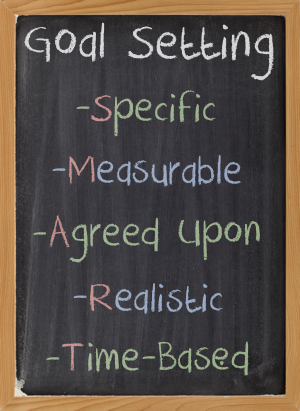
Our leader’s personal vision for our school is impeding the development of a shared vision.  Since principals in our district are reassigned every five years, they seem to want to make a statement about their leadership in each school they govern.  What the staff feel are necessary changes to make or what will most effectively meet the needs of the students can often take a suburban-sized back seat to the dictates of the principal.  When people are not consulted, invited in, considered, or at times even ridiculed for their personal approaches, there is politeness but little buy-in to the leader’s initiatives.  Work is challenging, and relationships are crumbling.  If we could focus on pertinent data, we could devise more immediate plans to achieve our long-term goals (Hughes, Beatty, & Dinwoodie, 2014, p. 207).

Related image

SMART goal setting includes everyone in the process (Haughney, 2014)

Inconsistent visioning is a bottle-neck to our school growth.  We have such a range of staff with various years of experience all willing to work together, but we must fit into one model which isn’t working.  We need to mentor one another and learn from one another to tie together all the wisdom for effective functioning. As Atha reiterates, “The smallest changes can produce large results; to the positive or negative” (2018, p. 5).  “If your employees don’t have a sense of ownership, nothing truly great can occur” (Lepsinger, 2010, p. 14).

Team Learning

If we are to develop stronger team dynamics, our school will need to focus on authentic team learning (Zeeman, 2017, para. 7).  This will provide the platform for the discipline of personal mastery to move toward our shared vision.  Team members need to set aside some of their individualism to become a more fully integrated team member.  My current organization has a large gap between the vision for our school and the current reality.  We need to change how we are doing our work (Lepsinger, 2010, p. 37) so that we can create a balance between our short-term and long-term goals and develop a better team climate (Hughes et al., 2014, p. 215).

Image result for balanced team image

A balanced school team (Hastings, 2014)


A Better Vision

Some years ago my current school district brought in the Dufours to educate us on Professional Learning Communities (PLC).  They inspired and made school teams seems possible and necessary for student success and for teachers to strengthen each other through team planning.  “As educators develop their capacity to function as a PLC, they create a culture that stretches the hopes, aspirations, and performance of students and adults alike” (DuFour et al., 2004, p. 179).  Schools of every level are under intense scrutiny and enormous accountability to educate future citizens and decision-makers.  “Schools do not operate in a vacuum—they must serve the public” (DuFour & Eaker, 1998, p. 158).  DuFour and Eaker promoted the development of mission, vision, and value so that each school can function as a team (DuFour & Eaker, 1998, p. 25).  Creating a professional learning community within each school began to take shape, and then the logistics of releasing teachers to work together became too complicated, and there was no money to put towards team development.  Just another great opportunity to make changes in a tired and work out system set aside for something more comfortable.

How can changes become necessary enough to maintain and nurture through the painful growing process?  Growth necessitates change and is a sign of life.  Atha encourages us not to lose hope when the system needs changing but is unable to handle the pressure of change (2018, p. 7).  Finding the right options can happen through perseverance while keeping our focus on the long-term goals.  Run the race that is before us. (Hebrews 12:1-3)

References

Atha, D. (2018).  A systems-thinking primer: Seeing organizations in action. [Course learning activity 3.1]. Retrieved from https://create.twu.ca/ldrs501/unit-3-learning-activities/

DuFour, R., and Eaker, R. (1998). Professional learning communities: Best practices for enhancing student achievement. Bloomington, IN: Solution Tree.

DuFour, R., DuFour, R., Eaker, R., and Karhanek, G. (2004). Whatever it takes: How professional learning communities respond when kids don’t learn.  Bloomington, IN: solution Tree.

Hastings, W. (2014).  Image retrieved from http://waynehastings.blogs.com/.a/6a00d83451b74169e201156f930ac6970b-pi

Haughey, D. (2014). Smart goals.  Retrieved from [October 17, 2018] https://www.projectsmart.co.uk/smart-goals.php

Hughes, R., Beatty, K., and Dinwoodie, D. (2014). Becoming a strategic leader: Your role in your organization’s enduring success. San Francisco, CA: Jossey-Bass.

Lepsinger, R. (2010). Closing the execution gap: How great leaders and their companies get results. San Francisco, CA: John Wiley & Sons.

Ungerer, M., Ungerer, G., and Herholdt, J. (2016). Navigating strategic possibilities: Strategy formulation and execution practices to flourish. Randburg: KR Publishing.  Retrieved from

No Other Way

health and education, ldrs501, Post 2.1
\

No Other Way

The very nature of an educational setting requires the inherent practice of Transformational Servant Leadership (TSL) tenets delineated in Imbenzi, Page, and Willaume’s (2013) leadership monograph (paras. 20-32).  Since education requires a people-centered focus and TSL focuses on being “committed to helping each person grow personally and professionally” (Northouse, 2013, p. 222), it seems there is no alternative to educational leadership than the TSL way.  The top four features of TSL leader critical to empowering everyone in an educational organization (Northouse, pp. 221-223):

1) Listening

2) Empathy

3) Commitment to the growth of the people

4) Building community.

TSL Meets the Education Demands

Students

In a TSL led school, both the leader and the follower will be transformed through the practice of decision making that adheres to serving others.  Practicing TSL in the classroom changes the traditional structure of authority to one where the teacher focuses on instilling life-long skills, attitudes, and understandings that transcend the classroom (Imbenzi et al., 2013, para. 43).  TSL is a timely and necessary element in our BC classrooms since the provincial mandate includes the requirement to prepare students to be successful in a future that is “different from the one we envisioned even 10 or 15 years ago” (BC Curriculum, 2018).  This need transcends the system of education in any country and can only be truly filled through the TSL path which prepares people to face challenges, develop consistent flexibility, and continually build strong relationships through mutual trust, respect, and reliability.

Staff

An educational setting must also meet the needs of the staff who work there to equip them to build up the students.  The staff – teachers, EAs, custodians, itinerant support staff, administration – cannot adequately meet the current diverse demands of the student population without feeling supported and cared for themselves.

1) TSL leaders ensure there is adequate self-care measures and reminders to mitigate the constant outpouring of energy: physical, emotional, mental, and spiritual.  Without restoration through a caring work environment, people succumb to the stress and discouragement, disillusionment, and burnout (Northouse, 2013, p. 222).

2) TSL leaders focus on caring for their staff and are aware of individual personal needs. They pay specific attention to how people are valued and empowered (Imbenzi et al., 2013, para. 2).

3)  TSL leaders assist their followers to develop their own skills and abilities for more effective participation in the organization’s purpose of educating students.

4) TSL leaders find ways to access appropriate resources to enhance their followers’ ability to meet the mission, vision, and values (MVV) of any school site (Northouse, 2013, p. 228).

STRATEGIC SERVANT LEADERSHIP

Consistent decision-making which maintains the focus on the learning institution’s MVV allows for the TSL leader to consider individuality for the followers within the commonly understood context of the school’s mandate.  A servant leader is not someone who is weak and unable to lead others in a common direction.  To the contrary, a servant leader must be so strong in character and purposeful in vision that they are able to consistently and reliably lead others through changing circumstances, fostering trust and respect among all the followers.

Personal Leadership Considerations

Ephesians 4 speaks to the task of leaders—more specifically teachers—in preparing people to serve so that everyone is built up.  The leaders cannot be “tossed back and forth by the waves, and blown here and there by every wind of teaching and by the cunning and craftiness of men” (Eph. 4:14, NIV).  TSL leaders act in the full knowledge of their strengths as well as their limitations to develop other people first (Northouse, 2013, p. 219).

Visioning

This strategic competency (Hughes, Beatty, & Dinwoodie, 2014, p. 75) is necessary to lead the school or district to where it needs to go for the successful enhancement of all its participants.  Parents, students, staff, administrators, school boards, and trustees need to know that leadership is heading in the right direction and is doing so on budget.  Servant leaders make all decisions in congruency with the MVV and to empower others to also see their place in the vision (Hughes et al., 2014, p. 77).  “Crafting a realistic vision and gaining employee buy-in” (Lepsinger, 2010, p. 6) is a necessary part to close the gap between what the followers know they should do and what they are able to do.

Reframing

Using the ability to see things differently, servant leaders can reframe decisions to include the diversity of ideas among their staff rather than exclude individual perspectives (Hughes et al., 2014, p. 83).  When there are so many educated people in varying stages of professional development with personal pedagogical mindsets, framing the potential of situations and necessary decisions as positive possibilities has a powerful effect on staff cohesiveness.

CRITICAL THINKING AS A TSL LEADER

If critical thinking involves data collection, analysis, reasoned arguments, and relevant application (Atha, 2018, para. 2) then a TSL leader must use critical analysis in their key decisions.  Critical thinking must be clear and devoid of personal influence to ensure decisions are collectively beneficial.  Is it even possible to be a transformational leader without critical analysis?

Jesus presented a clear example of servant leadership that transformed lives through clear rational, open-minded thought that was also fully in line with His God-assigned mission here on earth (John 6:38).  He did not veer from this mission but maintained a consistent delivery in word and in deed regardless of who he was interacting with as he travelled with and taught his disciples. He knew his purpose and served others with humility, caring, and singular focus.

TSL leaders must bring a similar mindset to their workplace. Singular focus while maintaining both the soft side and the hard side of strategic, critical thinking (Hughes et al., 2014, p. 62).  The traits of critical thinking which include humility, perseverance, and responsibility provide the TSL school leader with the stability required to lead well.  There are so many changes that occur each day when serving others in a school.  Knowing that leadership has clarity of vision and consistently applies the rigour of critical thinking to important decisions creates an environment of trust and reduces anxiety.

The transformational servant leadership model is necessary in our schools and in all levels of educational administration.  We are in the business of building people up to reach their own personal potential and we need consistent focus on well-reasoned and data-supported goals that have enduring qualities.  There is no other way to fully meet our educational mandate for producing students who can face the increasing demands of the 21st century world that is changing faster than we can react.  Serving others through leadership builds capacity in everyone.

References

Atha, D. (2018). Learning activity 0.2: Critical thinking.  Course Learning Notes. Retrieved from https://create.twu.ca/ldrs501/activity-0-2/

BC Curriculum. (2018).  Path to Graduation. Retrieved from https://curriculum.gov.bc.ca/graduation

Hughes, R. L., Beatty, K., & Dinwoodie, D. L. (2014). Becoming a strategic leader: Your role in your organization’s enduring success.  San Francisco, CA: Jossey-Bass.

Imbenzi, G., Page, D., & Williaume, D. (2013). Transformational servant leadership. Unpublished manuscript, Master of Arts in Leadership. Trinity Western University: Langley, Canada.

Lepsinger, R. (2010). Closing the execution gap: How great leaders and their companies get results. San Francisco, CA: Jossey-Bass.

Northhouse, P. G. (2013). Leadership: Theory and practice. (6th ed). Thousand Oaks, CA: SAGE Publications.

Introductory Post

health and education, Hi, Introductory Post, ldrs501
\

Working as an elementary teacher in the public school system for the past 27 years has taught me about flexibility, accommodation, adaptation, and leadership with diversity.  I do not aspire for a formal leadership position but am constantly involved in leading small groups and helping other teachers adjust their practice to the needs of today’s students and the constantly changing curriculum.  People do not want to follow me; they want me to assist them in solving problems.  Teaching is not a complacent career.

Straight rows. The illusion of organization.

My daughter and I moved down to the Fraser valley thirteen years ago after marrying into a new family.  While my daughter is off at university, I am enjoying the embrace of 9 grandchildren.  Whew!  Quite a change from being a single parent of one.  My step-daughter and son-in-law recently took their family—four of the grandchildren – to Malawi to spend three years in missional living through SIM.  Change is always part of life, professional or personal.

I can do many things and can make myself learn to do things that are required.  My favourite things to do by choice include running, hiking, reading, writing, and exploring.  While the pace of life is ever increasing, the list of personal activities gets shorter due to time constraints.  I have completed most of the coursework for the TWU Masters of Educational Leadership but am only able to do coursework intermittently. Patience is a virtue, right?  As always, my strategy is to continue putting one foot in front of the other to complete what is before me in the present moment.  I am purposeful in my choices, committed to my responsibilities, and strong in my faith.