One of my favourite words to hear David Attenborough say on his nature videos is “disorientating.” Initially I thought it wasn’t a real word but now I take it to mean “disorienting” with an extra twist of lost-ness.
By now you’ve probably guessed why I am thinking about this word. Yes, being “down under” has been disorientating, I might even call it disorientatating.
Why? Well for one thing the water goes down the sink the opposite direction. If you remember your high school geography, that’s called the Coriolis Effect. In the northern hemisphere the water drains clockwise and in the southern hemisphere, counter-clockwise. It really does go counter-clockwise here, trust me! In fact, a lot of things are the opposite here. Like driving on the left side of the road, with the steering wheel on the right side of the car. And here there are round-abouts at almost every turn, and so Deb and I must repeat the mantra: “go left, look right” because we have been conditioned by a life-time of driving on the other side of the road – the right side in fact. Or is left right? After you get disorientated, you start to lose track. Like the time I went the wrong way around a round-about (and Deb’s life flashed before her eyes). Or the time I took three wrong turns on the way home from work here.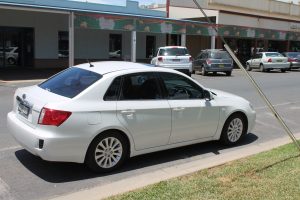
Our trusty Subaru we’ve named “Baroo”
The names are also a mite bit disorientating. On my way to and from work I cross the Gobbagombalin bridge. When we arrived at the airport here in Wagga Wagga, we drove through Gumly Gumly. Later we got to visit Grong Grong after passing through Matong to avoid madness. Recently we visited Cookardinia but there were no restaurants or homes left to stop for dinner at. I could go on…but maybe I’ll do a special feature on place names later.
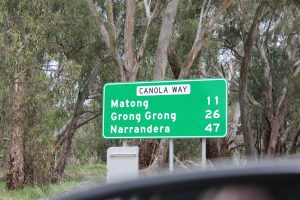
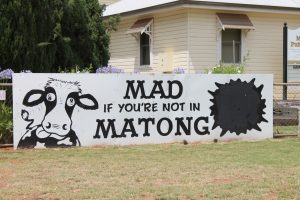
True confessions time. I am the son of Peter who loves maps and has a good sense of direction. I like maps myself, but the map in my head is not always trustworthy, or when I am in a strange place, there is simply no map in my head at all. Mind you, the first time I took the 20 minute drive to work here, I got there and back again with no mistakes at all. That was because I had the navigator with me, and she (my wife Deb) does have a map in her head that works well most of the time. Long before we moved to Wagga Wagga she had studied the geography, and it has served her well. Like anything else you can get too dependent on things – like the navigator. So that first morning I set off on my own on the 20 minute drive to Charles Sturt University, my disorientated hands gripped the steering wheel a bit tightly I confess. Fortunately, this is Wagga, so despite being the largest inland city (town?) in New South Wales, it’s not so very big.
Then there is the Wagga Charles Sturt Campus. It is like a large pastoral area where a campus broke out, with some of the buildings almost out of sight of the next…so quite a few hops of the kangaroo to get from one building to the next. By the way, we’ve only spotted one roo on campus so far, but there are whole herds of them sometimes as a colleague described to me today, including a head-banger he encountered one time when he was living on campus and he awoke to the sound of the kangaroo banging its head on his window. Perhaps the roo was disorientated? Another colleague showed me how to get to the library and Student Central, but two days later when I tried to lead my wife to the same building with the map in my head (or not in my head) it took us over a half hour of going round about the campus pastoral landscape, until at last something looked familiar.
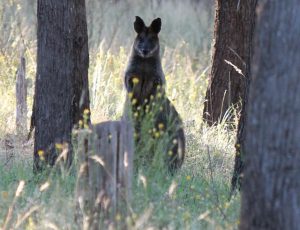
The first kangaroo I encountered “mano a kanga” in a forest near Coolamon. Yes, I think it looks capable of banging its head on a window…
Of course, as long as the navigator has been with me, something has always looked familiar – my dear wife Deb who I brought from Canada. She is ever the wonderful companion she was here in the southern hemisphere as she was in the great white north. Even when I am disorientated her love is patient and kind and provides a homing beacon to help me find my way. The map in her head is a sure one to follow, as is the one who made the geography for us to make maps of – “If our hearts condemn us, we know that God is greater than our hearts, and he knows everything” (1 John 3:20).
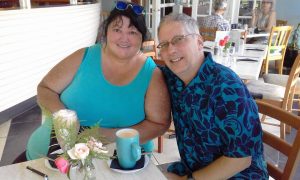 Deb and I at the Hume Lake resort near Albury, New South Wales