Bird of the week – the pūkeko

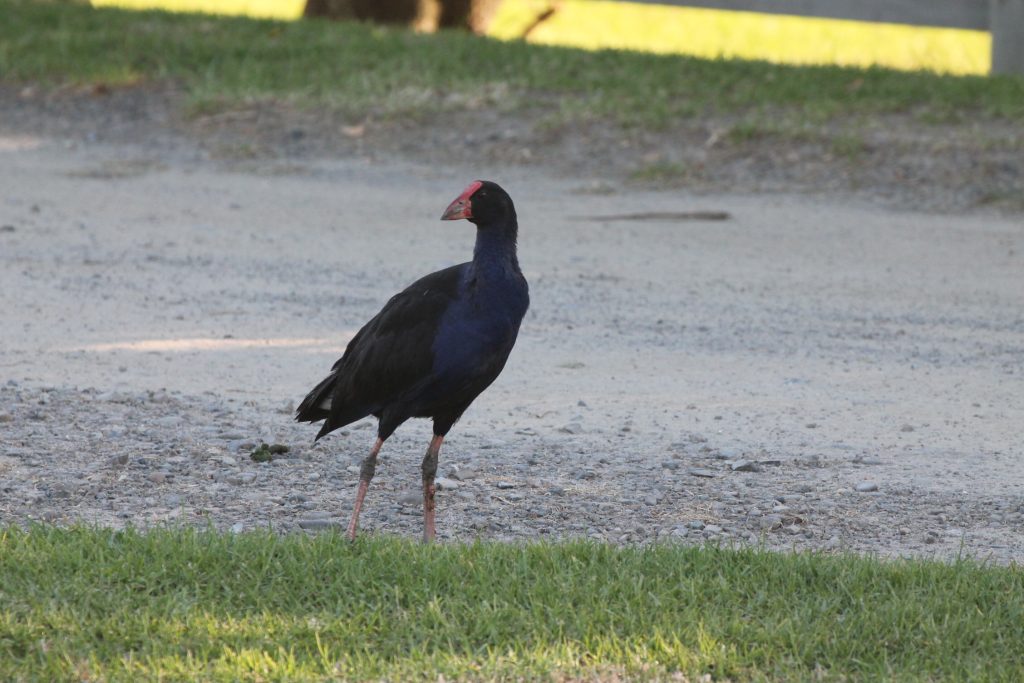
On Saturday my wife and I were on a beautiful beach on the east coast of New Zealand near the small town of Matata. We were enjoying some takeaway seafood there (i.e., that is the Aussi or Kiwi phrase for “take-out food” – we did actually pay for it) from a place called “Aunty’s and Uncle Café and Takeaway” when we noticed an exotic looking bird.

We learned it was the pūkeko. Although we only saw one there in Matata, we were to see many others later. Especially early in the morning the next day as we drove along the windy coastal roads. Apparently pūkeko enjoy foraging beside roads, and we saw at least one pūkeko warning sign in New Zealand. There the warning signs are usually note “wandering” as in “wandering pūkeko” or “wandering kiwi.”
As you might expect, there is quite a road toll and we did see the remains of many unfortunate pūkeko on the road.

I need to quote New Zealand Geographic here to give you further insights on the character and reputation of the pūkeko. This is from an article called “Pūkeko: The Indomitable Swamphen” at

https://www.nzgeo.com/stories/pukeko-the-indomitable-swamphen/

“Popularly regarded as brainless kamikazes lacking all road sense, pukeko are confounding scientists with their complex, flexible social lives. And, while other native birds struggle to survive environmental changes, pukeko seem to take everything in their strutting stride.”

I just noticed the name of the author of the article – Ian Jamieson. I was doing my Ph.D. the same time he was doing a postdoc at Queen’s University in Kingston, Ontario, and then went to New Zealand to continue to work as an Australian ornithologist and write entertaining New Zealand geographic articles like this one. Alas in looking him up, I discovered that he passed away at age 58 in 2015 – see the following for a moving tribute.

http://www.otago.ac.nz/zoology/otago086317.pdf

More details of Ian’s biography are at http://newzealandecology.org/nzje/3307.pdf

The social life that Ian referred to in the article is that they are generally communal nesters. They live in groups whereby it literally does “take a village to raise a child” as they all share care of the communal nests. I read somewhere that they sometimes steal each other’s eggs, but that doesn’t quite make sense because it sounds like the eggs are communal property anyway!
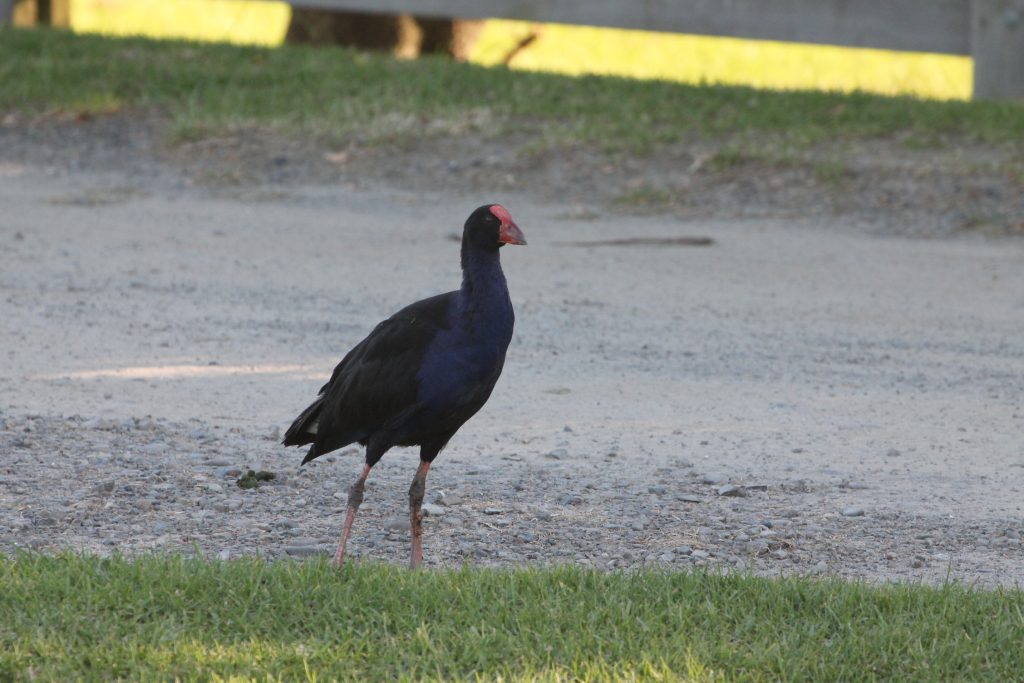
They are very recognizable with their purple-blue body, black wings, red legs, bill and frontal shield. Pūkeko is the Maori name used for the bird in New Zealand. Little did we realize as we beheld this cool bird in New Zealand that we were in for a surprise when we came home to Australia.

Tuesday night when after we had returned to Wagga Wagga that afternoon, I went for a walk by Lake Albert to shake off my jetlag. Jetlag does some bizarre things to people, and as I rubbed my eyes beholding these strutting birds by the lake, I thought, is this really the same bird?
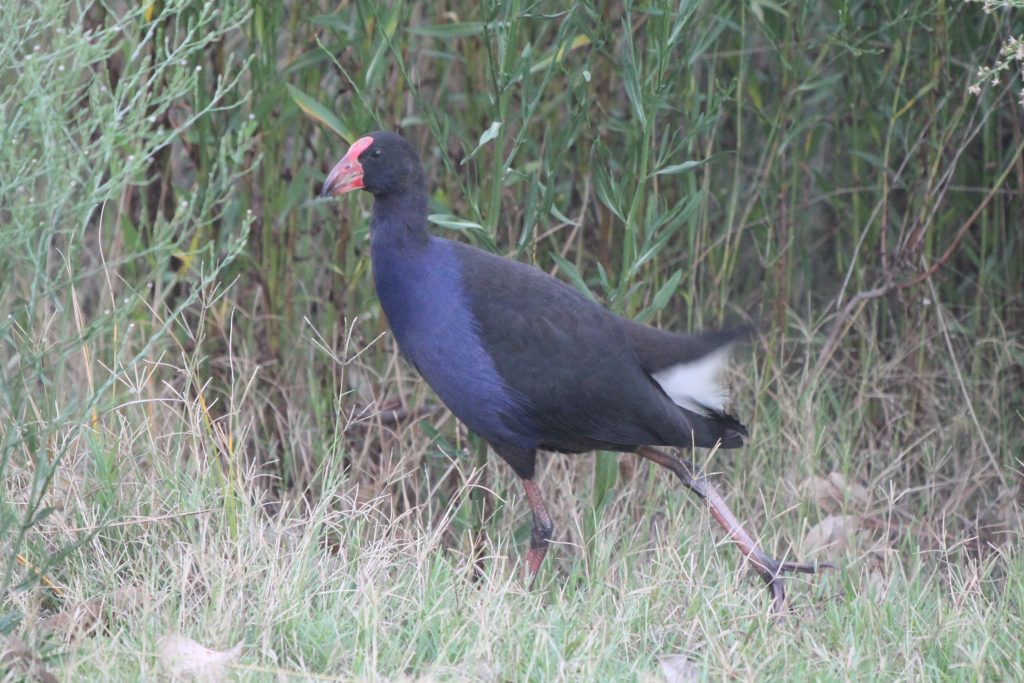
It turns out it is – in fact they are the same subspecies – the Latin name is Porphyrio porphyrio melanotus. In Australia it is known as the purple swamphen. Somehow I prefer the more quirky kiwi name pūkeko.

Now I have gotten over my shock at seeing that this exotic bird is actually found where I live here in Australia, I look forward to many more times of watching these guys strut around like they own the place. In fact, they are thought to have flown over from Australia to New Zealand about 1000 years ago, although their history of how they got where they are is somewhat mysterious. Because of their swimming and quick trotting ability they almost appear flightless (when I first saw the one in Matata I foolishly said to Deb – look at that flightless bird!) but they occur on some remote islands requiring strong flight and an indomitable spirit to reach!

They are just the kind of bird that you will never fully understand, but my old colleague from Queen’s University, Ian Jamieson certainly had a pretty good handle on these quirky birds with a real zest for life. Ian certainly had a zest for life himself (and was a bit quirky), and I remember him fondly as a fun-loving, always good-natured human being from the those good old days we shared back at Queen’s University.

Ian G. Jamieson (1957-2015)

Bird of the week – the brolga

This week’s bird of the week is the brolga.

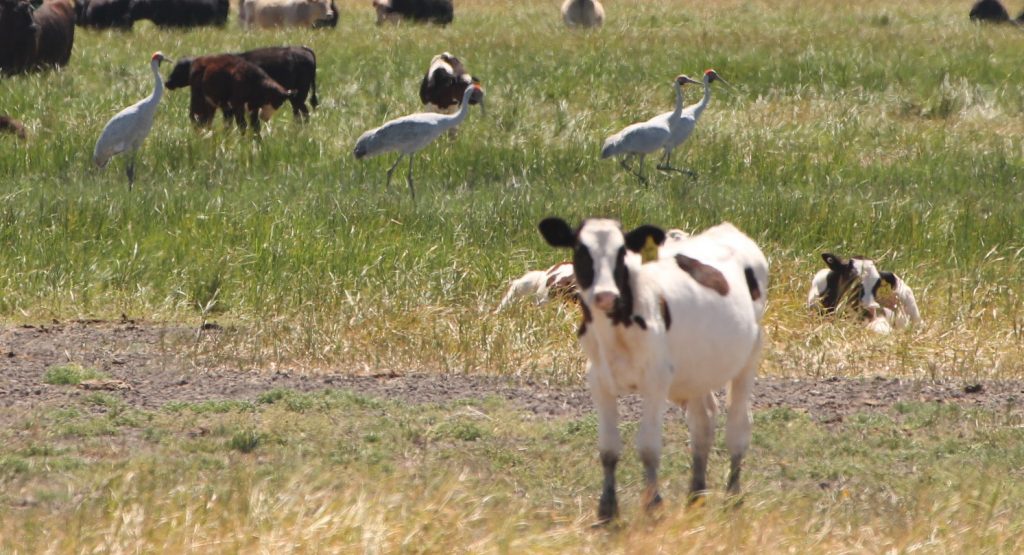
Last Saturday I was exploring a wetland bird sanctuary called “Fivebough Wetlands” which is situated in and among cow pastures near the town of Leeton, New South Wales, Australia.

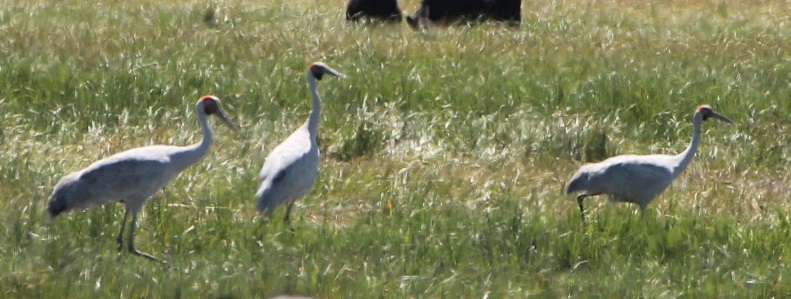
The cows looked interesting too, so I took a picture. To my wonder and surprise, large birds called brolgas – a species I was on the lookout for – were in the picture, walking among the cows.

Brolgas are obviously a relative of the whooping cranes and sandhill cranes we are familiar with in North America. Like those well-known birds, they are quite unusual, and unique to Australia. They are a little more common than North American white cranes though – they can apparently be seen flocking in the hundreds in some places.

So the lesson the brolga left me with was, pay careful attention to your surroundings. The brolga can be a meter and half tall or so as you see in my photos. When you least expect it, one of Australia’s largest birds may walk into your view!

Why did I come here in the first place?

When we had our bon voyage party in Langley in Nov. 26th, as the room was filled with the typical chaos associated with too many people in a room, my buddy Steve Robinson implored us to “tell the story,” i.e., why we were going to Australia? I was very grateful to Steve because in a crowded room like that it is quite daunting to try to explain yourself to everybody one on one. So here (finally almost two months after the first blog post) I will re-tell the story, with a few illustrations thrown in.

Meeting mile-a-minute in China


The above photo tells quite a story. We are standing in front of a calamity that is repeated all over the globe. We are standing in front of a lemon orchard, or to be exact, a former lemon orchard that has been destroyed by the mile-a-minute weed, Mikania micrantha. There is also a people story in the picture. The gentleman on the far left is Professor Fudou Zhang, the one who invited me to Yunnan Province, China, to see this weed in action. When I first saw his message, I had my doubts, but my friend Shiyou Li called him up and certified that it was a legitimate invitation, and said “in my professional opinion, I think you should go.” My friend Shiyou and his wife Ruying actually made it to China that first year I was invited in 2010, to meet up with me and a former colleague of ours, Rongping Kuang, who visited Queen’s University, Kingston, Ontario back in 1990, for a 20 year reunion of the 4 of us in China as shown below.

From left to right, Shiyou Li, David Clements (me), Rongping Kuang, and Ruying Feng


Back to the first photo, when I visited China in 2010, there were three other weed science foreigners visiting with me – Joe DiTomaso from the California, U.S. (second from the left), Hisashi Kato from Japan (just to the left of me), and Leslie Weston from Wagga Wagga, Australia (just to the right of me). We had an amazing week in China visiting many sites where mile-a-minute was a big issue with our Chinese colleagues, as well as of course, enjoying excellent Chinese food from China’s agricultural abundance, albeit threatened by weeds like mile-a-minute.

From left to right: Joe DiTomaso (University of California, U.S.), Leslie Weston (Charles Sturt University, Australia), Hisashi Kato-Noguchi (Kagawa University, Japan), and Fudou Zhang (Yunnan Academy of Agricultural Sciences, China)


It was a great opportunity to get to know each other on that first trip (and there have been six trips to China for me since). Although I had first met Leslie at a conference 5 years earlier, it was there in China she said to me: “You know, Australia is a good place to do a sabbatical” as I mentioned in an earlier post. So here I am here in Australia 8 years later, and I can certainly say she was right about that. I am here joining Leslie’s team at Charles Sturt University, taking advantage of the personnel on her team and the advanced equipment at the Graham Centre for Agricultural Innovation…and studying our beloved weed – Mikania micrantha (mile-a-minute).

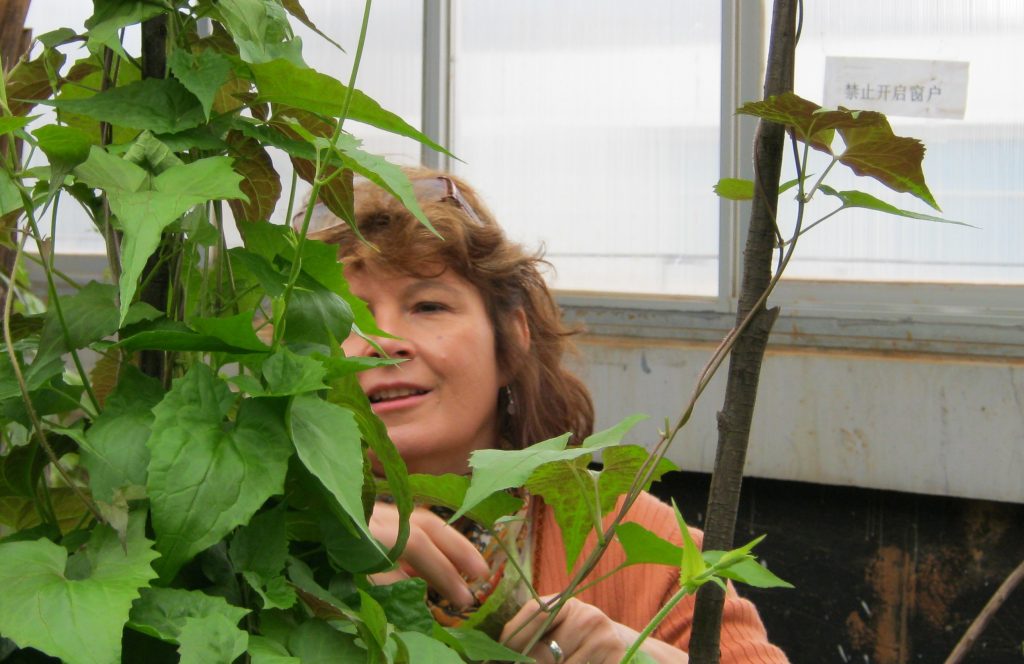
Leslie Weston examining leaves of mile-a-minute at the Yunnan Academy of Agricultural Sciences in Kunming, China. Samples from leaves such as these will be examined to compare genetics of different mile-a-minute populations


You might be wondering, what is a sabbatical? “Sabbatical” comes from the Biblical concept of a day of rest, or a year of rest in every 7. Most universities follow this tradition, allowing faculty members to either stay home and enjoy a change from their normal teaching and administrative opportunities as they pursue research, or go away somewhere to a place to facilitate research opportunities. Trinity Western University certainly supports the sabbatical concept – this is my third sabbatical, but just the second one away, and the first one away was still in Canada, in Guelph, Ontario in 1999-2000. So I am really grateful to Trinity Western University for this opportunity to go far, far away in 2018.

Trinity Western University, Langley, BC, Canada


Still, even with Leslie Weston’s invitation and the welcome from Charles Sturt University, and Trinity Western University granting me the sabbatical opportunity, the prospect of travelling to a relatively expensive country on the far side of the globe was daunting. Just ask my wife about that. So I applied for a prestigious Endeavour Fellowship. Endeavour is a national Australian award named for the British Captain Cook’s Ship that “discovered” this continent down under back in 1770. I was successful in winning an Endeavour Award to support my four months here, and am thus extremely grateful to Endeavour as well.


So that’s the story behind my current exciting endeavour…

Bird of the week – Australian magpie

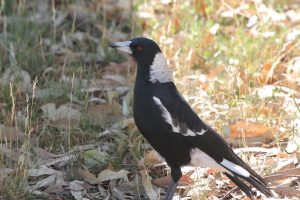
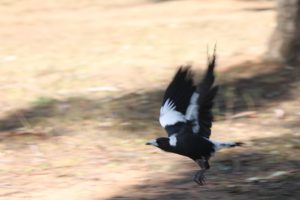
I would be remiss if I didn’t include this bird in the “bird of the week” feature, because I see it every week, everywhere.

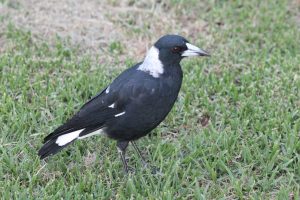
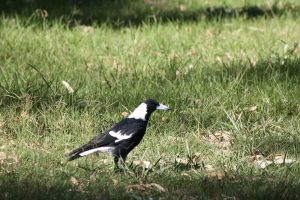
It is closely related to the Northwestern crow we see everywhere in British Columbia and other related crow-birds found throughout most of North America. It is about the same size, but differs in some respects. The obvious thing is that it is not all-black, and actually features quite a lot of white. The black and white patterning is really quite handsome and striking, especially if you are not native to Australia and seeing them for the first time. Perhaps this is why it is referred to as a magpie?

Another major difference is that it does not say “caw” like a crow but has a delightful, almost computerized warbling call, which I managed to capture after some considerable effort in this short video this morning:

https://youtu.be/ZDFEjcXjltQ

Australian magpies, like all of their cousins in the crow family, are quite intelligent. You can tell by the way they look at you, somehow.

Apparently during mating season they can be quite aggressive and actually attack people. However, as my wife and I have heard, they are smart enough to recognize people and remember what people have done for them, e.g., who feeds them. So maybe the best approach with Australian magpies is to be nice to them, with the hope that they will be nice to you.

Bird of the week – rainbow lorikeet and emu (bonus)


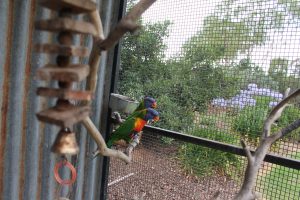
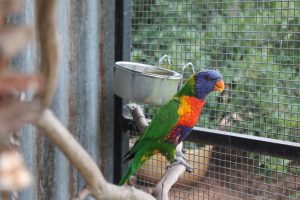
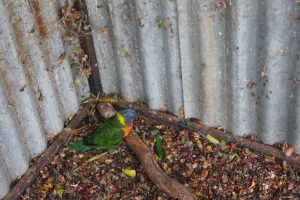
The rainbow lorikeet is a beautiful bird in the parrot family that in Canada you would expect to see only in a cage, of course. My first encounter with them in Australia was in a cage, in fact. When we first came here in late December (2017), we got to look after the menagerie of my hosts here at Charles Sturt University, Leslie and Paul Weston. At that time, they had a pair of rainbow lorikeets with a baby in the nest box.

While Leslie and Paul were away on vacation, and I was feeding and looking after the lorikeets, the baby rainbow lorikeet emerged into the sunlight and gradually found his mobility. It was a joy to see – although occasionally the Weston’s dachshunds got a little too excited about the little guy, and I had to tell them to stay away from the cage.

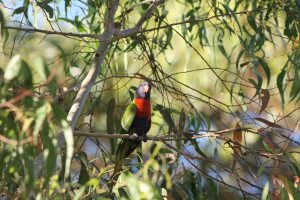
Last week on our trip to Brisbane, we got to see rainbow lorikeets in the wild at the home of my former student, Carla Sbrocci just north of Sydney (see below for the photo of a wild rainbow lorikeet). So obviously in this country, parrots are not limited to cages, and these rainbow lorikeets are distributed all over eastern Australia. In fact, they are invading new areas where they weren’t found before like western Australia near Perth and Tasmania, thanks to human transport.

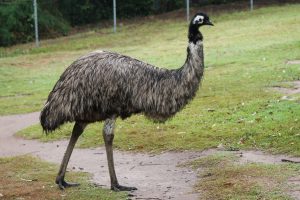
Before we got to Carla’s place, I had actually seen semi-wild rainbow lorikeets at the Koala Sanctuary in Brisbane. They inhabit the “kangaroo feeding” area of the sanctuary where you can go and feed and interact with kangaroos, and also Australia’s “big bird” – the emu.

However, one of the most interesting interactions I witnessed was the emu sticking its head in the rainbow lorikeet’s house to steal their food. As you’ll see in the video, the lorikeets didn’t seem too alarmed – it probably happens all the time! But it was a good picture of just how big these emus are.

So far Deb and I have only seen emus wild once – four of them on the Newell Highway that we took north to Brisbane, in a section of the highway where there was a recent bushfire. We wondered if the fire had something to do with the emus being at the roadside, but alas I didn’t stop to take pictures. Hopefully I’ll be able to feature emus again if we can actually get some photos of wild ones, but in the meantime, enjoy this thieving emu as a bonus to this week’s bird of the week!

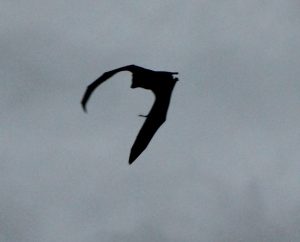
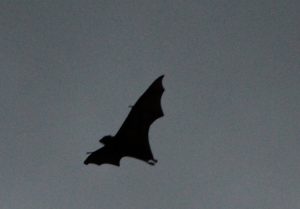
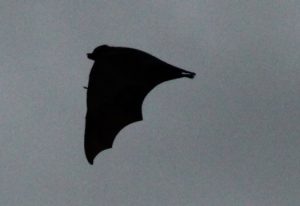
Bird of the Week – Flying Fox

The bird I am featuring this week is not a bird. It is not a plane. It is not a fox. It is a flying fox!

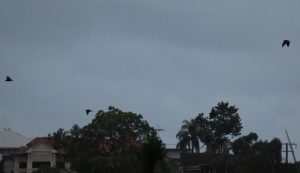
These birds (I mean bats) weight about 1 kilo and have a wingspan of a meter or so, and have been a great spectacle for us to watch here in Brisbane, as they fly up the river near our lodgings in the evening, flying up from wherever they camp. In the daytime they camp in great numbers in trees. Hundreds of them fly up the river and then spread out in search of food…after the bird hour, comes the bat hour!

Come evening they seek out their food — which is primarily pollen but also fruit sometimes. How do they seek these things by echolocation, Deb and I wondered? How might a blind bat find what it needs in the trees, we wondered, as we watch one land in a tree just a few meters away?

The answer is that they find what they need just as you and I would find flowers, using a good sense of smell and a good pair of eyes – yes they can see! Except of course, we can’t fly so we don’t have access to the great number of trees they do.

This ability to fly is of great benefit to the trees they pollinate which have flowers that open at night. In fact, they fly many kilometers every night conducting their pollinator service.

And to watch them fly is quite a thrill. We are used to our “little brown bats” in North America but these bats look a bit more Pterosaur-like flapping along like a bat on a mission with their one meter wing spans. We could watch them all night…see the video for some of the bat action!

https://youtu.be/G_Pl8OE4zSg

 [note all photos and videos in these “bird of the week” features were taken by either me or my wife Deb]