
Servant Leadership

Geenleaf defines servant leadership as a natural feeling that one wants to serve, to serve first. Then conscious choice brings one to aspire to lead (Northouse, p.226).

As Collen Barrett from Southwest Airlines, while being interviewed on the topic of Servant Leadership in a 2008 Youtube video said, that their airline has a passion of serving the people and this is what is their secret of success. She shared an intriguing concept of a priority pyramid in which at the top of the pyramid are colleagues. Serving their colleagues right is of utmost importance to them and this, in turn, leads the employees to serve the passengers better. This is a great example of servant leadership as the airline serves its employee and by doing so they are also leading by example. Another thing that stood out to me from her interview was when she said that when an employee or a passenger is in a problem, they adopt them and make something optimistic come out of it. This is also a trait of a servant leader. The fact that they started this airline because before it only 13% people were flying and most of them were men blew my mind. Southwest Airline is indeed more than just making money, they are connecting people and bringing a positive change, and this is exactly what servant leadership is about.

John Maxwell in his YouTube video “The 5 Levels of Leadership” (2013), stated that leadership is a verb and not a noun, it is an ongoing process. This video was very insightful and taught a lot about what a leader should be and what a leader should never be. The point about level 1- positional level leaders where he states that the employees start cleaning their desks at 4:30 if they do not like the leader struck me well, I could think of scenarios when I did the same too. Level 4- People development level is really aligned with servant leadership as it is about committing yourself to developing other people. This can only be done by serving them right and by guiding them into their right position where they can grow the best and reach their highest potential. As Maxwell said, Successful leaders, discover what others are best at, in this context, they are being mentors and leaders as well as serving others by helping them find their calling.

Servant Leadership differs from Emotional intelligence or self-awareness as Emotional intelligence and self-awareness are personal attributes whereas servant leadership transcends self-interest, it is about serving others and helping them grow. For me, one of the best examples of servant leadership apart from God is, Dalai Lama. Dalai Lama has made it the sole purpose of life to help others find peace and purpose in life. There are so many books written by Dalai Lama that has helped so many people. One of my favorite book written by him is The Art of Happiness. One of my mentors suggested me to read this while I was struggling in life and it helped me find peace and joy. I highly recommend it to everybody since then. I’ve followed his work for quite some time now and I find it very insightful and enlightening.

References:

Barrett, C. (2008). Southwest Airlines’ Colleen Barrett on Servant Leadership. Retrieved from https://www.youtube.com/watch?v=6TgR95vnM0c

Maxwell, J. (2013). The 5 Levels of Leadership. Retrieved from https://www.youtube.com/watch?v=aPwXeg8ThWI

Northouse, P.G. (2016). Leadership: Theory and Practice. Sage Publications.
Transformational Leadership

Transformational leadership is defined as the process whereby a person engages with others and creates a connection that raises the level of motivation and morality in both the leader and the follower (Northouse, p. 162).

When I think of transformational leadership many names pop up in my mind like Mahatma Gandhi, Mother Teresa, Martin Luther King Jr, Steve Jobs, Bill Gates and many more. All these leaders were charismatic. Transformational leadership is about getting followers to transcend their own self-interest for sake of the team and to motivate them to go beyond what they think they are capable of doing (Northouse, p.166). There are various components (4 I’s), traits and practices that make a transformational leader and they are explained and enlisted below (Northouse, p. 167-175)

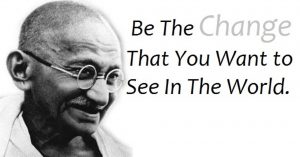
Idealised Influence: It is the emotional component of transformational leadership and involves leaders being strong role models. Transformational leaders usually have high standards of morals and are deeply respected by the followers. It involves having a clear vision about the goals and principles of the group/ organization (Northouse, p.167). It is about modeling the way for followers and guiding them right. A good example of this is Mohandas Gandhi, he was a transformational as well as a servant leader. He was deeply respected by people and people called him ‘baapu’ which translates to father. He had a clear vision of a free and fair nation and practiced non-violence. He guided all his followers by himself being an example of all his principles.

Inspirational Motivation: This is descriptive of a leader who communicates high expectations to followers, inspiring them through motivation to become committed to the organization. It is about enhancing team spirit (Northouse,p.169). Leaders inspire a shared vision by visualizing positive outcomes of the future (Northouse,p.174). For example, in mental health awareness group, it is of utmost importance that we visualize positive outcomes or otherwise the group will lose its sense of purpose. It is important to keep reminding everyone about the change they are trying to make and how important it is and how it serves the mankind better.

Intellectual Stimulation: Leaders stimulate the followers to be creative and innovative and to challenge their own beliefs as well as the leaders. Transformational leaders are considered pioneers, they welcome positive change and new ideas (Northouse, p.169). It involves the creative development of self and others. When I started talking about mental health awareness I knew it will be hard because it makes people uncomfortable or its already been said and they find it repetitive. So I talked to all my group members and we came up with a new idea. We made a chain of videos going up to people and telling them they are beautiful and amazing and captured their reactions. Their faces would light up and they would smile shyly and it was just priceless. So this way we encouraged people to be nice and say good things to each other because it is that simple to make someone’s day.

Individualised Consideration: Leaders have to act like coaches and guides. It is important to listen to the needs of followers and to be supportive (Northouse,p.169). This makes the team trust the leader and creates space for growth. Example, Martin Luther King Jr, he listened to all the problems of his fellow men and addressed them in his speech ‘I Have a Dream” (https://www.youtube.com/watch?v=3vDWWy4CMhE).

Like any other thing, there are many pros and cons to transformational leadership. Its pros are that it considers leadership a process and available to all. It also gives a broader view of leadership and emphasizes values and morals. There are cons to it too. For example, Hitler used his leadership in a negative and a selfish way. It can be abused easily. I would conclude by saying that in my opinion, transformational leadership combined with servant leadership is true leadership.

References:

Northouse, P. G. (2016). Leadership: Theory and practice, Seventh Edition. Thousand Oaks, CA: Sage Publications. ISBN 971452203409

Light Fom Many Lamps: The Most Precious Of Possessions

You wake up in the morning, and lo! your purse is magically filled with twenty-four hours – the most precious of possessions. (Arnold Bennett)

Where did you find the time? (Watson, 1951). This was a question frequently asked from Arnold and a question frequently asked by most of the people to any and every successful person or a leader. This story explained the importance of time and the art of utilizing it to its utmost potential. Bennett was a poverty-stricken clerk wanting to become a writer. He had nothing but time and he realized that time was his most precious commodity, time the most useful tissue of his life and that he must therefore not waste any part of it. (Watson, 1951). With hard work and spectacular time management, he became a great writer.

He was constantly asked the question about how he finds time to write and pursue all his hobbies? He answered that he did not ‘find’ time, he has the same amount of time as everybody else; exactly the same twenty-four hours. Its the way he spent it made the difference (Watson, 1951). This also led him to write his one of the most famous book called, ‘How to Live on Twenty Four Hours a Day’. This book helped so many people and answered their questions about time management and making the most out of it. This story is very relatable to me as being someone whose biggest fear is to waste time, I’ve spent a fair amount of my life trying to figure out ways to make the most of every day, every hour of my life. This is also because punctuality has been a priority not just for me but for my family, my mother always enchanted these words to me that, ‘those who do not respect time, time does not respect them’. Planning for the next day before going to bed, writing down your intentions clearly, making a to-do list for the day became a ritual in my life at a very young age. When I moved from India to Canada just a month and a half ago, I called my parents and told them that I feel like time moves faster here or it just seems like I have lesser time but every day I think I’m getting better at accomplishing my everyday goals and ticking off the things from my checklist and I know no one can master time but I’m constantly trying to get as close to it as possible. Also, Bennett said, “Time is the inexplicable raw material of everything. With it, all is possible; without it, nothing” (Watson, 1951).

When asked what is the biggest mistake you have made in your life, Buddha replied, “The biggest mistake is that we think we have time”. Jay Shetty’s video on the importance of time shared an analogy that if $86,400 were added to your bank account every day and by the end of 24 hours the remaining sum will disappear but another $86,400 will be added next day. Will you waste all the money? Then why do we waste time so easily? We tend to forget that time is more expensive than money. (Retrieved from- https://www.youtube.com/watch?v=vPaS85IA6oY). As Arnold Bennett said, “You have to live on this twenty-four hours of daily time. Out of it, you have to spin health, pleasure, money, content, respect and the evolution of your immortal soul. Its right use, its most effective use, is a matter of highest urgency and most thrilling actuality” (Watson, 1951). I cannot agree more with this.

You wake up every morning, and lo! your purse is magically filled with twenty four hours of the unmanufactured tissue of the universe of your life! It is yours. It is most precious of possessions. No one can take it away from you. It is unstealable. And no one recieves either more or less than you recieve. (Watson,1951)

Watson, L.E. (1988). Light from Many Lamps, (1st Fireside Edition). New York, NY: Simon and Schuster, Inc

Shetty, J.(2018) Before You Waste Time. [Retrieved from: https://www.youtube.com/watch?v=vPaS85IA6oY]