
Transformational Leadership

Transformational leadership is defined as the process whereby a person engages with others and creates a connection that raises the level of motivation and morality in both the leader and the follower (Northouse, p. 162).

When I think of transformational leadership many names pop up in my mind like Mahatma Gandhi, Mother Teresa, Martin Luther King Jr, Steve Jobs, Bill Gates and many more. All these leaders were charismatic. Transformational leadership is about getting followers to transcend their own self-interest for sake of the team and to motivate them to go beyond what they think they are capable of doing (Northouse, p.166). There are various components (4 I’s), traits and practices that make a transformational leader and they are explained and enlisted below (Northouse, p. 167-175)

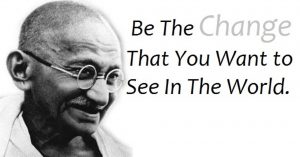
Idealised Influence: It is the emotional component of transformational leadership and involves leaders being strong role models. Transformational leaders usually have high standards of morals and are deeply respected by the followers. It involves having a clear vision about the goals and principles of the group/ organization (Northouse, p.167). It is about modeling the way for followers and guiding them right. A good example of this is Mohandas Gandhi, he was a transformational as well as a servant leader. He was deeply respected by people and people called him ‘baapu’ which translates to father. He had a clear vision of a free and fair nation and practiced non-violence. He guided all his followers by himself being an example of all his principles.
Inspirational Motivation: This is descriptive of a leader who communicates high expectations to followers, inspiring them through motivation to become committed to the organization. It is about enhancing team spirit (Northouse,p.169). Leaders inspire a shared vision by visualizing positive outcomes of the future (Northouse,p.174). For example, in mental health awareness group, it is of utmost importance that we visualize positive outcomes or otherwise the group will lose its sense of purpose. It is important to keep reminding everyone about the change they are trying to make and how important it is and how it serves the mankind better.

Intellectual Stimulation: Leaders stimulate the followers to be creative and innovative and to challenge their own beliefs as well as the leaders. Transformational leaders are considered pioneers, they welcome positive change and new ideas (Northouse, p.169). It involves the creative development of self and others. When I started talking about mental health awareness I knew it will be hard because it makes people uncomfortable or its already been said and they find it repetitive. So I talked to all my group members and we came up with a new idea. We made a chain of videos going up to people and telling them they are beautiful and amazing and captured their reactions. Their faces would light up and they would smile shyly and it was just priceless. So this way we encouraged people to be nice and say good things to each other because it is that simple to make someone’s day.

Individualised Consideration: Leaders have to act like coaches and guides. It is important to listen to the needs of followers and to be supportive (Northouse,p.169). This makes the team trust the leader and creates space for growth. Example, Martin Luther King Jr, he listened to all the problems of his fellow men and addressed them in his speech ‘I Have a Dream” (https://www.youtube.com/watch?v=3vDWWy4CMhE).

Like any other thing, there are many pros and cons to transformational leadership. Its pros are that it considers leadership a process and available to all. It also gives a broader view of leadership and emphasizes values and morals. There are cons to it too. For example, Hitler used his leadership in a negative and a selfish way. It can be abused easily. I would conclude by saying that in my opinion, transformational leadership combined with servant leadership is true leadership.

References:

Northouse, P. G. (2016). Leadership: Theory and practice, Seventh Edition. Thousand Oaks, CA: Sage Publications. ISBN 971452203409

Light Fom Many Lamps: The Most Precious Of Possessions

You wake up in the morning, and lo! your purse is magically filled with twenty-four hours – the most precious of possessions. (Arnold Bennett)

Where did you find the time? (Watson, 1951). This was a question frequently asked from Arnold and a question frequently asked by most of the people to any and every successful person or a leader. This story explained the importance of time and the art of utilizing it to its utmost potential. Bennett was a poverty-stricken clerk wanting to become a writer. He had nothing but time and he realized that time was his most precious commodity, time the most useful tissue of his life and that he must therefore not waste any part of it. (Watson, 1951). With hard work and spectacular time management, he became a great writer.

He was constantly asked the question about how he finds time to write and pursue all his hobbies? He answered that he did not ‘find’ time, he has the same amount of time as everybody else; exactly the same twenty-four hours. Its the way he spent it made the difference (Watson, 1951). This also led him to write his one of the most famous book called, ‘How to Live on Twenty Four Hours a Day’. This book helped so many people and answered their questions about time management and making the most out of it. This story is very relatable to me as being someone whose biggest fear is to waste time, I’ve spent a fair amount of my life trying to figure out ways to make the most of every day, every hour of my life. This is also because punctuality has been a priority not just for me but for my family, my mother always enchanted these words to me that, ‘those who do not respect time, time does not respect them’. Planning for the next day before going to bed, writing down your intentions clearly, making a to-do list for the day became a ritual in my life at a very young age. When I moved from India to Canada just a month and a half ago, I called my parents and told them that I feel like time moves faster here or it just seems like I have lesser time but every day I think I’m getting better at accomplishing my everyday goals and ticking off the things from my checklist and I know no one can master time but I’m constantly trying to get as close to it as possible. Also, Bennett said, “Time is the inexplicable raw material of everything. With it, all is possible; without it, nothing” (Watson, 1951).

When asked what is the biggest mistake you have made in your life, Buddha replied, “The biggest mistake is that we think we have time”. Jay Shetty’s video on the importance of time shared an analogy that if $86,400 were added to your bank account every day and by the end of 24 hours the remaining sum will disappear but another $86,400 will be added next day. Will you waste all the money? Then why do we waste time so easily? We tend to forget that time is more expensive than money. (Retrieved from- https://www.youtube.com/watch?v=vPaS85IA6oY). As Arnold Bennett said, “You have to live on this twenty-four hours of daily time. Out of it, you have to spin health, pleasure, money, content, respect and the evolution of your immortal soul. Its right use, its most effective use, is a matter of highest urgency and most thrilling actuality” (Watson, 1951). I cannot agree more with this.

You wake up every morning, and lo! your purse is magically filled with twenty four hours of the unmanufactured tissue of the universe of your life! It is yours. It is most precious of possessions. No one can take it away from you. It is unstealable. And no one recieves either more or less than you recieve. (Watson,1951)

Watson, L.E. (1988). Light from Many Lamps, (1st Fireside Edition). New York, NY: Simon and Schuster, Inc

Shetty, J.(2018) Before You Waste Time. [Retrieved from: https://www.youtube.com/watch?v=vPaS85IA6oY]

Unit 3 Blog: Rank, Talk, Write

While going through unit 3 notes there were so many moments where I was intrigued and my interest was piqued. After carefully analyzing and critically thinking I have ranked my top hit sentences as follows :

1) Many of today’s leaders are keenly idealistic. It isn’t enough for them to make a living — they want to make a difference. . (Source: https://www.virtuesproject.com/leadership.html ) 

 This sentence from the virtue project blew my mind and is indeed very true. These days leaders are not just about making a living, instead, their main goal is to make a difference. In order to make a difference they serve and there is a significant increase in servant leadership these days. Organizations that offer social responsibility, transparency and a joyful,unified work environment are the ones that can attract and keep such leaders. (Sorce: thevirtueproject)

2) Excellence, then, is not an act but a habit. (Unit 3 notes, Will Durant (1926, p. 87))

Excellence is an art won by training and habituation: we do not act rightly because we have virtue or excellence, but rather have these because we have acted rightly; “these virtues are formed in man by doing his actions” (Aristotle). This quote holds great importance to me, a leader is a giver and not the taker in an organization or group. There are many problems leaders have to face and each time their leadership values are tested. Only by continually sticking to and practicing their values can they be called true leaders.

3) As Warren Buffet, multibillionaire and CEO of Berkshire Hathaway states, “In looking for people to hire, you look for three qualities: integrity, intelligence, and energy. And if they don’t have the first, the other two will kill you (Hoerr, 2017, p. 73) “

Integrity is certainly the highest quality a leader can possess and practice. Without integrity, other qualities don’t mean much. Especially for a servant leader integrity is a prime quality. Integrity stems from honesty but is a higher, more public form of action. When we act with integrity we are consciously making our personal values known to others. The interpersonal nature of integrity makes it a key component of leadership (ibid, p. 77).  There are many ways to develop integrity such as owning up to one’s mistakes, taking the responsibility for consequences to acting with integrity, talking about the importance of acting with integrity and by being a good example to your team. (Unit 3 notes)

4) In Proverbs 16:9 we read, ““A human mind plans the way but the Lord directs the steps”(NRS).”

Believing in God is not incompatible with critical thinking. In other words, faith and reason can co-exist. We learn more about ourselves and the world through the lenses of faith and reason (Unit 3 notes). This also gives leadership an ethical tone. Moreover, having faith makes the leader more patient as he/she believes in God and his timing. Faith also enhance integrity in a leader. Having faith also inculcates a sense of humility in a leader and keeps them connected to their roots.

5) Brazilian philosopher, Rubem Alves (1979) commented that everything is interpretation

This is such a small sentence yet holds immense importance. Undeniably,  interpretation is key to everything as you act according to what you interpret. Every leader interprets a solution in a different way based on what values are prime to him or what is the goal of that particular situation. Rubmen Alves also mentioned about interpretations being controlled by the community, and I could not agree more to this. Rubem Alves also shared language functions as a mediation tool between humans and their world. As humans, we don’t contemplate reality face to face. Since birth, things in our world don’t come to us in their naked form, but always dressed up in the names our community has given them. This community has already defined how and what the world is like and, therefore, already knows it (the world). This knowledge of the world is crystallized in our language. Language, therefore, is not a copy of objects and facts. Language is always interpretation (cited in Goodson 2013, p.47).


6) How long should you remain silent? When you think you have been silent long enough, be silent a little more. (Unit 3 notes)

There is this quote by Dalai Lama that states when you talk, you are only repeating what you already know. But if you listen, you may learn something new. Being a good listener is one of the best qualities a leader can have and it is very rare nowadays as everyone has so much to say. I’m in no way saying that one should not speak freely but to listen mindfully. If someone is sharing something with you, you should listen with your full attention and not just be thinking about what you’ll respond to that. Most of the people listen just to answer but, to listen to understand is actually a quality of a good leader.

7) The value of critical transformational learning is that there is a personal intentionality to the process. ( Source: Unit 3 Notes: MA Lead Student Christel Davidson’s Jan. 9th blog post entitled ‘Designing Our Boxes’)

This blog was a delight to read and was very thought evoking. This box theory resonates with me so well. According to this, a person stays in a box until it is challenged to get out of that boxes. Then the person goes on to make another box because having boundaries is essential for humans. Then one leaves that box as well to make another box and all this will be repeated over and over again (Unit 3 notes). As one of my favorite mentor Robin Sharma says, “progress beings outside your comfort zone”. Getting out of the box here means getting out to your comfort zone and growing and leaving that place once it becomes too comfortable too and moving on to next challenge.

Each time the learner temporarily exits the box to take a fresh view of life, it is not to throw the person into a state of chaos or abandonment of absolutes, but to give a moment where thoughts can be free to explore other possible points of view or to reflect on habits and unconscious actions that are rooted in their beliefs. Once challenged or left open for review, a critical analysis can be made, conclusions drawn and a shifted belief or value stabilized, by restating or redesigning their box. There are endless ways that this can be accomplished, so long as the process evokes the emotions, stimulates the soul and matures the mind ( Source: Unit 3 Notes: MA Lead Student Christel Davidson’s Jan. 9th blog post entitled ‘Designing Our Boxes’)


8) How can I compare and contrast varying theoretical perspectives on the topic? (Unit 3 notes, Chong, 2015)

The thing about journals is that author controls the content and may decide to add or leave out anything they want. There are many authors and many of them can have contradicting views as well. To compare and contrast these varying theoretical perspectives one has to analyze which information intersects with policies and procedures of their field and what aligns with their values. (unit 3 notes)


Assignment: Light from many lamps

ABRAHAM LINCOLN: Without Divine assistance I cannot succeed; with it I cannot fail.

This story is about Lincoln’s farewell address at Springfield, Illinois, on February 11, 1861. The speech was very brief -less than two hundred words (Watson, 1951, p.70).  It was supposed to be a very happy day for him, a day of triumph but close ones could see that he was not happy (Watson, 1951, p.69). It was a bittersweet day for him as he had been elected as the President but he was also leaving the place he was born and lived in, the people who contributed so much to his life and success. His speech was very personal and he talked about how grateful he is for all the people who have supported him throughout and how heavy and sad he feels about leaving this place and these people as he was not sure when or if he will return to Springfield (Watson, 1951, p.70). He was also aware of the challenges that awaited him as the President because the nation was in a bad state at the time and he wanted to make sure he restores the peace and harmony. The thing that stood out from his speech was how he connected with the people and the way he explained that in prayers of god they will always stay together as God is with each one of them. It was this expression of faith and trust, this firm belief that with God’s help he could not fail, which sets Lincoln’s words at Springfield apart and gave them the unmistakable quality of inspiration, radiant and enduring. (Watson, 1951, p70).

Abraham Lincoln was one of the great leaders and he was indeed a servant leader. He believed in serving the world and was against dominance. What made me pick this story out of the book is the quote on the very first page by Abraham Lincoln that says, “Most folks are as happy as they make up their minds to be” (Watson, 1951, p.1). The is so much to learn from Lincoln and he exhibits so many amazing leadership traits. He was very perceptive and determined. He was also empathetic and sensitive as his farewell speech reflects that’s clear. In this particular story, I learned that being a leader you should be selfless and work for the greater good and not shy away from making sacrifices for it. Another important leadership lesson that can be learned here is the importance of being sensitive towards other people and being forever grateful for their contributions and connecting with them on a deeper level. Above all, this story is a great example of leadership, sacrifices, empathy, and determination and it teaches about never forgetting where you came from.

This story has impacted my life to a great extent. It was a gentle reminder that to lead is to serve. His thoughts about connecting through prayer and god hold a great relevance in my life. “Without divine assistance I cannot succeed; with it I cannot fail” (Watson, 1951, p.70), these words have a great impact on my life and I have always practiced this. I’m from a Sikh family and I’m a strong believer and there are words in the Sikh holy book that resonate with this message strongly. Furthermore, I loved his statement about happiness and I find it to be very true. This story has been an enlightening and insightful experience and I would certainly read more about Abraham Lincoln and his ideas and theories


Blog post: Interpreting the survey

A leadership questionnaire does seem like an intriguing task and it has proved to be an enlightening one too. As I’ve read about the various approaches in Northouse, it was rather interesting to apply this to interpret my own self.

So, starting with leadership trait questionnaire, I scored mostly 5’s and the surveys completed by my colleagues and family members agreed to it as well. In skills inventory, I scored a good 28 in both human skills and conceptual skills but I could see my technical skills lagging behind. This made me realize that technical skills are where I need to work harder. Further, in style questionnaire, I scored a range of 45-50 in both task and relationship scores but my task score was a number less than relationship one. I have always been aware of this shortcoming and I’m going to keep working on fixing it.

All in all, this survey was as fun as it was revealing. Also, it almost aligns with my self-conceptions. It gave me a better perspective on my strengths and weaknesses. Indeed, its a good tool for self-assessment as well as the assessment of others.

Follow the leader

Jay Shetty : Leader, host, storyteller, videomaker, former monk, Forbes 30 under 30

Jay Shetty is the leader I identified not so long ago but he has made the biggest impact on my mind and life. I have been following him on almost all social platforms but I found his first video on instagram. Jay has achieved so much at such young age and his story is utterly inspiring. Jay was a troubled teenager from England and he was always trying to find his purpose and one day he attended a seminar by a monk and it moved him to the extent that nothing ever had and he went on to become a monk. He was a monk for three years and the monk energy undeniably radiates from his face and words and is contagious. His biggest idea and mission is to make wisdom go viral. 

During his years as a monk he found the greatest lessons of life and has been trying to spread them and serve the world with it ever since. He is a true example of servant leadership. He has over million views on youtube, 10 million likes on Facebook and a wide range of audience. He has insights about almost all aspects of life; relationships, mindfulness, finding your purpose, you name it. He was also on Forbes 30 under 30 list and it is one of the greatest honor an entrepreneur can ever receive. His social media account link is-  https://www.instagram.com/jayshetty/ 

THE 2 BIG IDEAS:

The first one has to be his biggest mission and that is, making wisdom go viral. Jay works towards mentoring people to achieve personal and professional mastery and by making wisdom go viral what he means is he wants the education and wisdom to be as contagious as distractions so that everyone can become the best version of themselves. I have joined many of his mentoring groups and his words leave you in awe and have a great impact. I have personally adapted various changes suggested by him like waking up early and what’s different in his way of teaching is that he does not just tell you what to do BUT explains to you how and why you should and that is the most impactful thing about him.

The second big idea that he espouses is, finding your purpose. As he suggests that finding your purpose consists of three components; find what you love, find how to make a living from it and then lastly and most importantly, ask yourself how does this serve the world? Most people nowadays struggle to just find their calling and end up in unhappy jobs and that’s one of my biggest fear too. I’ve always wanted to make a positive change in the world and serve it and he is one of the amazing servant leader’s i have ever come across.

The summary of all his big ideas can be found in this compiled video: https://www.youtube.com/watch?v=OmtV0WwNni8

Advice-

Although it seems impossible for me to give a piece of advice to Jay Shetty as he is one of the most self-aware people but after a lot of brainstorming I believe that he can better motivate followers but be breaking a bit of language barrier as all his videos are in English and there are so many populations and countries that don’t even understand the language. So, if the content could be translated in various languages the message could be spread wider than it already is being. I can not possibly think of anything else that i could offer him as an insight

Aligning values, ethics and principles of leadership-

Jay Shetty’s biggest principle that aligns with my principle of leadership is that he is a servant leader. He is trying to make a positive change and serve the followers as much as he can. I remember from one of his interviews, he said that when he heard the monk speaking the words ‘selfless giving’, he was so fixated on it and that’s what he is doing now, serving and selflessly giving. Another value that he lives by is ‘to plant a tree under whose shade you do not mean to sit’ and it completely syncs with my values of leadership. His emphasis on mindfulness is another value that I find similar. He once defined detachment as not not owing anything but not letting anything own you and it has stayed with me ever since. I strongly believe the world needs more servant leaders like him and I’m proud to have picked him as a mentor/leader.

Blog post 3- Servant Leadership

Greanleaf (1997) provided the most frequently referenced definition:

Servant leadership begins with the natural feeling that one wants to
serve, to serve first. Then conscious choice brings one to aspire to
lead. The difference manifests itself in the care taken by the
servant—first to make sure that other people’s highest priority needs
are being served. The best test  is: do those served grow as persons;
do they, while being served, become healthier, wiser, freer, more autonomous,
more likely themselves to become servants? And, what is the
effect on the least privileged in society; will they benefit, or, at least,
will they not be further deprived? (Northouse ,2017,p.226)

There are various principles of servant leadership but the ones that stood out ot me the most are: listening, empathy and healing. All these qualities remind me a great leader from Indian history named Mahatma Gandhi. He was an example of servant leader, listened to all the problems of the followers not just in order to respond but to understand. He was an active listener and a very empathetic person. One time to truly feel and understand how a homeless man feels, he started sleeping on the floor himself so that he can put himself in their shoes and to me that a brilliant example of empathy. Healing means to make whole (Northouse 2017,p.228). To heal the servant leader has to do everything possible to alleviate and support one’s followers. Dandi march by Mahatma Gandhi is again a great example of it. Indeed, there are so many more qualities that make an ideal servant leader but i believe these are the foundational ones.

What are your views about it? Does any servant leader come to your mind while reading this? Share your views.

Blog post 2- Two sides of the same coin: Leaders and Managers

ASSIGNED AND EMERGENT LEADERSHIP

As stated in Northhouse (2017), some people are leaders because of their formal position in an organisation, whereas others are leaders because of the way group members respect them. So the ones based on occupying a position for example team leaders or plant managers are considered undered assigned leadership whereas when others perceive an individual as the most influential member of a group or an organisation, regardless of individual’s title, the person exhibits emergent leadership (Northouse, 2017,p.8).

Emergent leadership is acquired over time through good communication and active participation. Emergent leaders are the most influential people in an organisation irrespective of their job title and people like, respect and follow them for their personality. Personality plays an important role in emergent leadership and the main traits that do so are being more dominant, more intelligent and more confident (Northouse,2017,p.8). All these traits are important for a leader to have an influence or to be recognised. People tend to follow or believe in the vision of a person only if they are confident and trust in their own abilities. Another important factor accounting in being an emergent leader is good communication and it includes being verbally involved and informed, seeking other’s opinion, initiating new idea and being firm but not rigid (Northouse,2017,p.8).

While i was completing my Bachelors in Dental Surgery and i was working as an intern i came across some issues that were not exactly related to my field of study but i felt strongly about them. Being a senior i always tried to hear out the problems of my juniors and help then professionally and then i came across the fact that so many of the students were suffering from anxiety or depression but could not share it with anyone because there is a stigma attached to it especially in a country that i came from i.e. India. This was also affecting the professional part of their life and as i tried to reach out more i realised that this problem was rather extensive and i decided to do something about it. I knew the first step is to break the stigma attached to mental health illnesses so, i started talking about it openly and i started a community, more like a support group, on social media site, instagram. I shared my own story as the first few posts so as to ease the idea of talking about it and slowing it started growing and now it is has 184 people in it that are working towards the same mission of breaking this stigma. This community has made me understand a lot about leadership and how a leader is the giver. We all talk about mental health openly and the goals is to reach out to anyone and everyone who might need help and to direct them the right way and encourage them to seek the required professional help. I’ve always wanted to make a change for good and this seemed like a little step towards it and as leadership is a process i’m excited to see how it shapes me over the coming period of time. Leaving the link in here-

https://www.instagram.com/letterstomy12yearoldself/

This also reminds of the Social identity theory (Hogg,2001) which states that leadership emergence is the degree to which a person fits with the identity of the group as a whole (Northouse,2017,p.9).

Essential activities or leaders and managers:

Leadership is a process that is similar to management in many ways. Leadership involves influence and so does management, leadership entails working with people and so does management, leadership is concerned with affective goal accomplishment and so is management (Northouse,2017,p.13)

Nonetheless, leaders and managers perform a lot of activities completely different from one another as well. The primary activity of managers is to provide order and consistency and to seek stability whereas primary function of leaders is to produce chage and movement and seek adaptive and constructive change (Northouse,2017,p.13). According to Bennis and Nanus (1985), to manage means to accomplish activities and master routine and to lead means to influence others and create a vision for change. They also stated, managers are the people who do things right whereas leaders are the people who do the right thing (Northouse,2017,p.14).

According to Rost (1991), leadership is a multi directional influence relationship whereas management is a unidirectional authority relationship. (Northouse,2017,p.14). It is very important to distinguish between a leader and a manager as they both play out their roles very differently. Leaders make the change and are emotionally involved in the process whereas managers make sure the process is consistent and the resources are well managed. Leaders are the ones initiating new ideas and acting on them whereas managers set strategies and set goals. Leadership is about aligning people and communicating goals and inspiring and motivation the group whereas management is about organising and establishing rules and controlling and solving problems. (Northouse, 2017,p.14).

Approach essential for an organisation to prosper:

No matter how different the approaches are, leadership and management need to work hand in hand in order for an organisation to prosper. Both leaders and managers are required for an organisation to function properly as when managers are involved in influencing a group to meet its goals, they are involved in leadership and when leaders are involved in planning, organizing, staffing, and controlling, they are involved in management. Both processes involve influencing a group of individuals toward goal attainment. (Northouse,2017,p.15). What’s your viewpoint on this? Do you think leaders can work without managers or vice versa? If so, then can the organisation reach its full potential without both leaders and managers working together?

Blog post 1- Defining leadership

Leadership is defined as a process whereby an individual influences a group of individuals to achieve a common goal. (Northouse, 2017, p.5)

Nonetheless,  i don’t believe leadership can be defined in a set of few words as its span is wide and vast. I, myself have always been intrigued by the actual meaning of leadership (one of the reasons for taking this course in the first place). While reading through the chapter i found myself applying a lot of the concepts to myself and to many leaders whom i actively follow. It was indeed very enlightening to know that there are so many different components to leadership. Also, it is very well stated that leadership is a process and its is not a linear one way event, but rather an interactive event (Northouse,2017,p.6)

I cannot agree more with this statement as i don’t believe there is anything such as born leadership. Indeed, there can be a few traits that can enhance it but true leadership develops over time and is available to all. Further moving on the one of the most important component of leadership, influence. Indeed, influence is the sine qua non of leadership and without influence leadership cannot exist ( Northouse, 2017, p.6).  As it is very clear from the definition itself influence is the key component of leadership. Look at all the great leaders, Mahatma Gandhi, Nelson Mandela, Dalai Lama, Obama and the list goes on, one this common among all of them is they are all very influential people.

Groups are the contexts in which leaderships occurs (Northouse, 2017,p.6). A leader is nothing without a group as without follower there can be no leader. Regardless of the size and magnitude of the group and movement, it is necessary for leadership to happen. Group and the leader work hand in hand to attain a mutual goal. Leaders act as mentors to the individuals and help and direct them to reach the mutual goal and utilize their full potential while doing so. Attention to  a common goal gives leadership an ethical overtone (Northouse,2017,p.6). Having a common goals ensures that everyone is working to attain it for the greater good of the group or community and leader is not exploiting then followers for his/her selfish motives.

Power plays an important role in leadership. Being a dentist and working in an healthcare facility has taught me a lot about it. As stated in Northouse, there are different types of powers but the one that stands out to me is personal power. It is not about the position you are assigned but its about your own influence. It reminds me of one of my favorite book by an amazing mentor, Robin Sharma, ‘The leader who had no title’. This book has influenced me in a great way and it is just a testimony to the fact that personal power is indeed greater than positional power and it makes leadership available to to all. Great things happen when both these powers are combined. What do you think, can a leader exist and impact with just personal power or is positional power more of a necessity?